



PQQ and CoQ10 are often paired because they are involved in different parts of mitochondrial biology. CoQ10 directly participates in the process your mitochondria use to produce cellular energy, while PQQ is being studied for signalling pathways involved in mitochondrial biogenesis, the process through which cells form new mitochondria.
That makes the combination biologically interesting. But it does not mean everyone needs to take both, or that PQQ + CoQ10 is a standard medical treatment. A healthcare professional may consider the combination when there is a specific reason to support mitochondrial function, while also looking at your age, medicines, health conditions and the strength of evidence for your particular goal.
Why Would a Doctor Consider PQQ and CoQ10 Together?
The simplest explanation is that PQQ and CoQ10 are not duplicates.
| Compound | Main Role Being Studied | Human Evidence |
|---|---|---|
| CoQ10 | Electron transfer during mitochondrial ATP production and antioxidant defence | Substantial human research across several clinical settings |
| PQQ | Cell signalling associated with mitochondrial biogenesis and redox activity | Promising but considerably smaller human evidence base |
| PQQ + CoQ10 | Combining mitochondrial signalling with support for existing mitochondrial energy production | Some human studies, particularly around cognition, but direct evidence of added benefit remains limited |
Think of your mitochondria as small energy-processing systems inside your cells. CoQ10 is part of the machinery already operating inside them. PQQ is being investigated for signals associated with how the cell regulates mitochondrial growth and renewal.
This complementary biology is the main scientific rationale for stacking them. It is a rationale, however, rather than proof that the combination will produce a meaningful benefit in every person.
What Does CoQ10 Actually Do?
Coenzyme Q10, or CoQ10, is naturally produced by the human body and is concentrated in tissues with high energy requirements, including the heart.
Inside the inner mitochondrial membrane, CoQ10 transports electrons between components of the electron transport chain. This helps create the electrochemical gradient needed to produce adenosine triphosphate, or ATP, which cells use as an immediate source of energy.
CoQ10 also exists in its reduced form, ubiquinol, where it contributes to antioxidant defence.
Unlike many longevity ingredients, CoQ10 has a relatively substantial human evidence base. For example, systematic reviews and randomised trials have investigated CoQ10 in people with heart failure, although the relevance of those findings is specific to that clinical population and should not be extrapolated to healthy adults looking for a general energy supplement.
The same distinction matters throughout supplement research: evidence that a nutrient has a therapeutic role in one population does not automatically prove that everyone will benefit from taking it.
Why CoQ10 comes up during statin use
Statins inhibit HMG-CoA reductase, an enzyme involved in the mevalonate pathway. That pathway is involved not only in cholesterol synthesis but also in endogenous CoQ10 production.
As a result, statin therapy can reduce circulating CoQ10 concentrations. This is one reason doctors sometimes discuss CoQ10 with patients taking statins, particularly when muscle symptoms occur.
However, the evidence for CoQ10 supplementation specifically improving statin-associated muscle symptoms has been inconsistent across trials. A clinician therefore needs to assess muscle symptoms rather than assuming that low CoQ10 is automatically the cause.
What Does PQQ Add?
Pyrroloquinoline quinone, or PQQ, is a redox-active compound found naturally in very small amounts in foods.
Its scientific appeal comes partly from research into mitochondrial biogenesis. Laboratory and animal studies suggest that PQQ can influence signalling involving PGC-1α, a regulator involved in the cellular programme for mitochondrial biogenesis.
This has produced a convenient description of the PQQ + CoQ10 combination: PQQ may help signal mitochondrial formation, while CoQ10 supports energy production within existing mitochondria.
The biology is more convincing than the clinical evidence at present. Researchers have not yet established through large human trials that taking PQQ produces a clinically meaningful increase in mitochondrial number or function in healthy people.
Small human studies are encouraging. One study involving 10 people found changes in markers related to mitochondrial metabolism and inflammation following PQQ intake. Other randomised trials have examined cognitive outcomes using approximately 20 mg of PQQ per day.
For a deeper examination of PQQ itself, read Decode Age's guide to PQQ, mitochondrial function and human research.
Does Taking PQQ and CoQ10 Together Work Better?
This is where the distinction between a promising combination and a proven combination becomes important.
Some human research has evaluated PQQ together with CoQ10. A review of the PQQ literature describes randomised studies in healthy adults using 20 mg of PQQ together with 300 mg of CoQ10. In one 12-week study, the combination produced improvements in measures of word recall compared with placebo.
These findings give researchers a reason to continue studying the pairing. They do not yet establish that PQQ + CoQ10 will consistently outperform appropriately dosed CoQ10 or PQQ alone for energy, exercise performance, healthy ageing or cardiovascular health.
That distinction matters because “synergy” is frequently used in supplement marketing as though two complementary mechanisms automatically produce a greater clinical effect. Biology does not always work that neatly.
Current evidence supports saying that PQQ and CoQ10 have complementary biological roles. Evidence proving that the combination consistently delivers greater health benefits than either ingredient alone is much more limited.
When Might a Healthcare Professional Consider the Combination?
A clinician would generally start with the reason you are considering supplementation rather than with the supplement itself.
1. Ageing and mitochondrial support
Mitochondrial function changes with age, and endogenous CoQ10 concentrations can also decline over the lifespan. This provides a biological reason for interest in mitochondrial nutrients among older adults.
That does not mean age alone creates a requirement for PQQ or CoQ10. Sleep, physical activity, nutrition, metabolic health and underlying medical conditions may have a much larger effect on fatigue and energy.
2. Persistent fatigue that has already been evaluated
Fatigue has many possible causes, including anaemia, thyroid disorders, sleep problems, infection, medication effects, nutritional deficiencies, cardiovascular disease and metabolic conditions.
A supplement should not be used to bypass that investigation.
If a healthcare professional has already assessed the reason for persistent fatigue, mitochondrial support may form one part of a broader nutritional strategy in selected cases. CoQ10 has considerably stronger human evidence in fatigue-related research than PQQ.
3. Statin therapy
Because statins can reduce circulating CoQ10, a doctor may discuss CoQ10 supplementation with certain patients, particularly in the context of muscle symptoms.
The reason for adding PQQ is less established. PQQ should not automatically be added simply because someone takes a statin.
4. Cognitive support in ageing adults
This is one of the more interesting areas for the combination.
Small trials of PQQ alone have reported improvements in selected cognitive measures among healthy middle-aged and older adults. Earlier studies examining PQQ alongside CoQ10 have also reported improvements in some measures of memory and attention.
These studies remain small, and supplementation should not be presented as preventing dementia or treating cognitive decline.
5. Someone already considering mitochondrial supplements
A clinician may also help determine whether combining ingredients makes sense rather than simply adding supplements one after another.
For example, someone already taking CoQ10 may not automatically need PQQ. Likewise, someone interested in PQQ should check whether their existing supplement already contains CoQ10.
That review can reduce unnecessary duplication while making dosage and safety easier to understand.
What Dosages Have Been Studied?
Human PQQ trials commonly use approximately 20 mg per day. Some studies investigating the combination have paired 20 mg PQQ with 300 mg CoQ10.
That does not make 300 mg the universally recommended CoQ10 dose. CoQ10 dosage varies substantially depending on the formulation, clinical purpose and individual.
Ubiquinol and ubiquinone are also different forms of CoQ10. Ubiquinol is the reduced form and has been investigated as a formulation with good bioavailability.
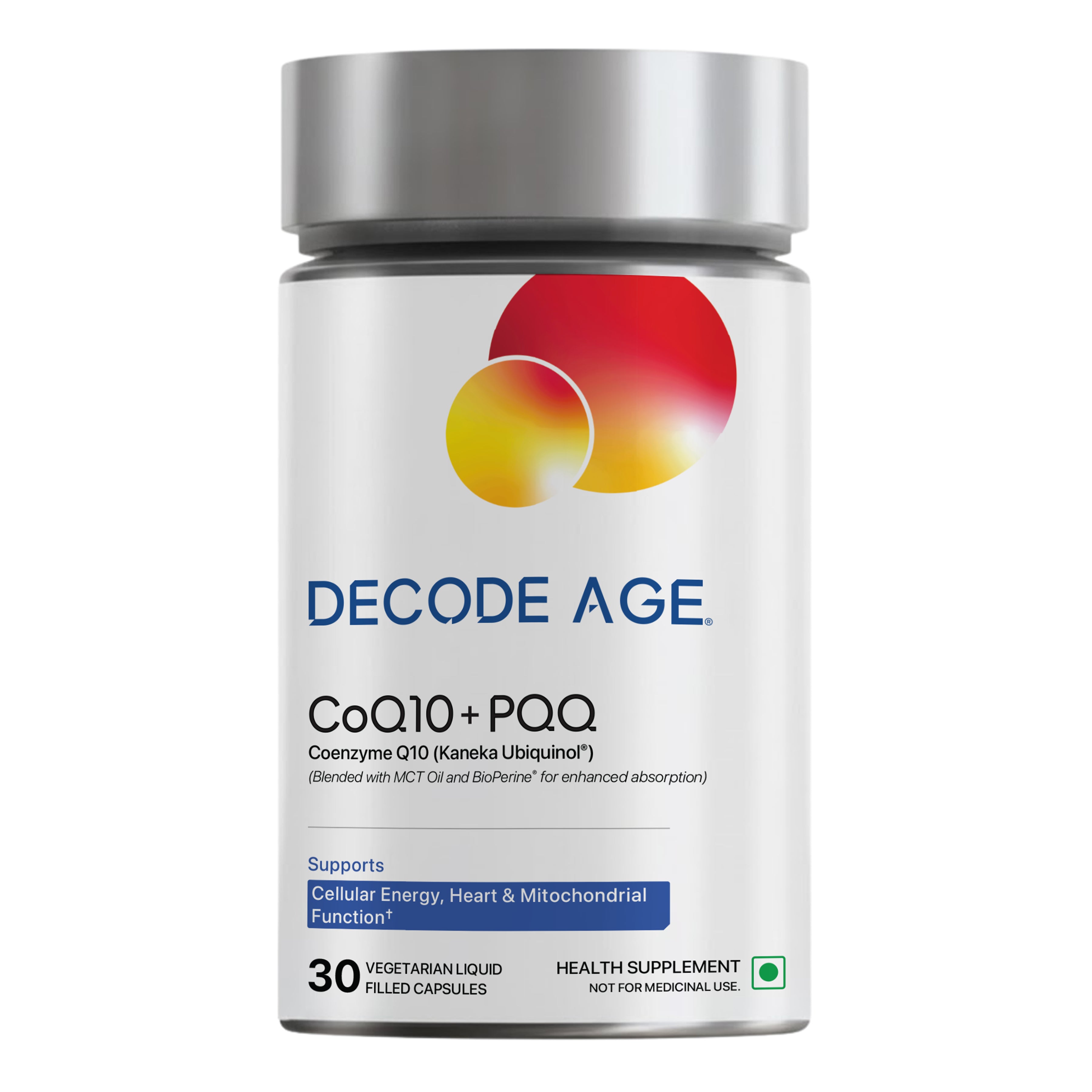
Decode Age CoQ10 + PQQ provides per capsule:
- 100 mg CoQ10 as Kaneka Ubiquinol®
- 20 mg Pyrroloquinoline Quinone Disodium Salt
- 10 mg Natural D-Alpha Tocopherol Vitamin E
- 5 mg Black Pepper Extract standardised to 95% piperine
The formula is intended to support cellular energy and mitochondrial function. It should not be interpreted as a treatment for fatigue, cardiovascular disease, cognitive impairment or another medical condition.
Should You Take PQQ and CoQ10 at the Same Time?
There is no established requirement to separate them. CoQ10 is fat-soluble, so taking a CoQ10-containing supplement with or after a meal is generally practical.
Decode Age recommends taking its CoQ10 + PQQ formulation once daily after breakfast, unless your healthcare practitioner advises otherwise.
Timing is less important than choosing a transparent formulation, using it consistently and ensuring that supplementation fits safely alongside your medicines and health conditions.
Who Should Speak to a Doctor Before Taking PQQ + CoQ10?
Speak with a healthcare professional before using the combination if you:
- take prescription medicines;
- take warfarin or another anticoagulant;
- take medicines for blood pressure;
- are receiving cancer treatment;
- have cardiovascular, kidney or another chronic medical condition;
- are pregnant or breastfeeding; or
- are planning to use the supplement to address persistent or unexplained fatigue.
CoQ10 may interact with warfarin, while there is comparatively little clinical interaction data available for PQQ. Pregnancy and breastfeeding safety data for PQQ are also insufficient.
Decode Age's current product guidance therefore advises people taking medication or living with underlying medical conditions to consult a healthcare practitioner before use.
What Should You Look for in a PQQ + CoQ10 Supplement?
If you and your healthcare professional decide that the combination fits your goals, the label matters more than the size of the benefit list on the front of the pack.
| Check | Why It Matters |
|---|---|
| Exact amount of PQQ | Human studies commonly investigate doses around 20 mg per day. |
| Exact CoQ10 dose | Avoid formulas that mention CoQ10 without clearly stating how much they provide. |
| Form of CoQ10 | Look for transparent identification of ubiquinol or ubiquinone. |
| Ingredient sourcing | Named, traceable ingredients improve formulation transparency. |
| Complete supplement facts | Additional antioxidants and absorption ingredients should also be clearly disclosed. |
| Quality testing | Purity, potency and contaminant testing matter for any supplement used regularly. |
For readers wanting the broader mitochondrial explanation first, Decode Age also has a guide to how PQQ and CoQ10 support mitochondrial energy in different ways.
So, Why Might Your Doctor Recommend Stacking Them?
A healthcare professional might consider PQQ and CoQ10 together because the two compounds address different aspects of mitochondrial biology. CoQ10 has a direct, established role in mitochondrial energy production. PQQ is being studied for signalling related to mitochondrial biogenesis.
The reason to combine them is therefore scientifically plausible.
The evidence is not equally strong. CoQ10 has decades of human research behind it, while PQQ and especially PQQ + CoQ10 combination research remains comparatively small. The combination should therefore be viewed as a targeted nutritional option rather than something every adult needs for energy or healthy ageing.
The most useful question is not simply, “Should I stack PQQ and CoQ10?” It is: What problem are you trying to solve, and is this combination supported well enough for that particular goal?
Frequently Asked Questions
Why are PQQ and CoQ10 taken together?
PQQ and CoQ10 are paired because they have different roles in mitochondrial biology. CoQ10 participates directly in ATP production, while PQQ is being investigated for cell-signalling pathways associated with mitochondrial biogenesis. Their roles are therefore complementary, although clinical evidence proving superior outcomes from the combination remains limited.
Is PQQ better than CoQ10?
They are not directly interchangeable. CoQ10 is part of the mitochondrial electron transport chain and has a considerably larger human evidence base. PQQ is being researched primarily for mitochondrial signalling, cognition and related functions, but clinical evidence is still developing.
Does PQQ create new mitochondria in humans?
PQQ influences pathways associated with mitochondrial biogenesis in laboratory and animal research. Human studies have found changes in mitochondrial-related markers, but large clinical trials have not established that taking PQQ reliably increases functional mitochondrial numbers in humans.
Can you take PQQ and CoQ10 every day?
Both have been used daily in human research, but whether daily supplementation is appropriate depends on the individual, formulation, medicines and health conditions. Follow product directions and speak with a healthcare professional if you take medication or have an underlying condition.
Can I take PQQ and CoQ10 if I take statins?
CoQ10 is sometimes discussed in people taking statins because statins can lower circulating CoQ10. Evidence for improving statin-associated muscle symptoms is mixed, and adding PQQ has not been established as standard care. Discuss persistent muscle symptoms with your doctor rather than treating them independently with supplements.
Is PQQ + CoQ10 a stimulant?
No. Neither works like caffeine. Their proposed effects relate to cellular and mitochondrial biology rather than stimulating the central nervous system to produce an immediate increase in alertness.


Leave a comment
All comments are moderated before being published.
This site is protected by hCaptcha and the hCaptcha Privacy Policy and Terms of Service apply.