



What Makes Marine Collagen Different?
Marine Sources and Type I Collagen
Marine collagen comes from marine raw materials, most often fish skin, scales, and other seafood by-products. In most cases, it is rich in type I collagen, which is the main collagen linked with skin structure. That point matters because both the type of collagen and the way it is processed can affect how the body deals with it.
Marine Collagen Peptides and Hydrolysed Marine Collagen
Native collagen is a large protein, so it is harder for the body to digest and absorb. Hydrolysed marine collagen is split into smaller, more soluble peptides, which can help with absorption and make it easier to use in different formulations [6]. The main point, then, is simple: does this smaller peptide size lead to better bioavailability?
Why Molecular Weight Matters
Smaller peptides are, in general, easier to digest and absorb. That is why hydrolysis and molecular weight matter when judging collagen bioavailability. From here, the next piece is understanding what bioavailability means once these peptides enter the body.
sbb-itb-55c436e
What Does Bioavailability Mean for Collagen?
Bioavailability is the portion of a nutrient your body can absorb and use after you consume it. In simple terms, it asks a practical question: how much of what you take in actually gets into circulation and becomes available to the body? That’s one reason marine collagen is often sold on the idea of better absorption.
From Digestion to Absorption
Once you consume collagen, your digestive system breaks it down into amino acids and short peptides. Studies have found hydroxyproline-containing peptides in the bloodstream after ingestion, which shows that these compounds are absorbed rather than merely broken apart in the gut [1].
Why Absorption Does Not Equal Results
Here’s the catch: absorption is only one part of the story. A higher level in the blood does not automatically lead to better outcomes in skin, joints, or bone. For most well-hydrolysed collagen products, the gap in absorption tends to be small, so the difference in day-to-day results is also likely to be small [1].
That’s why it makes sense to look next at collagen source and peptide size.
How Marine and Bovine Collagen Differ in Practice
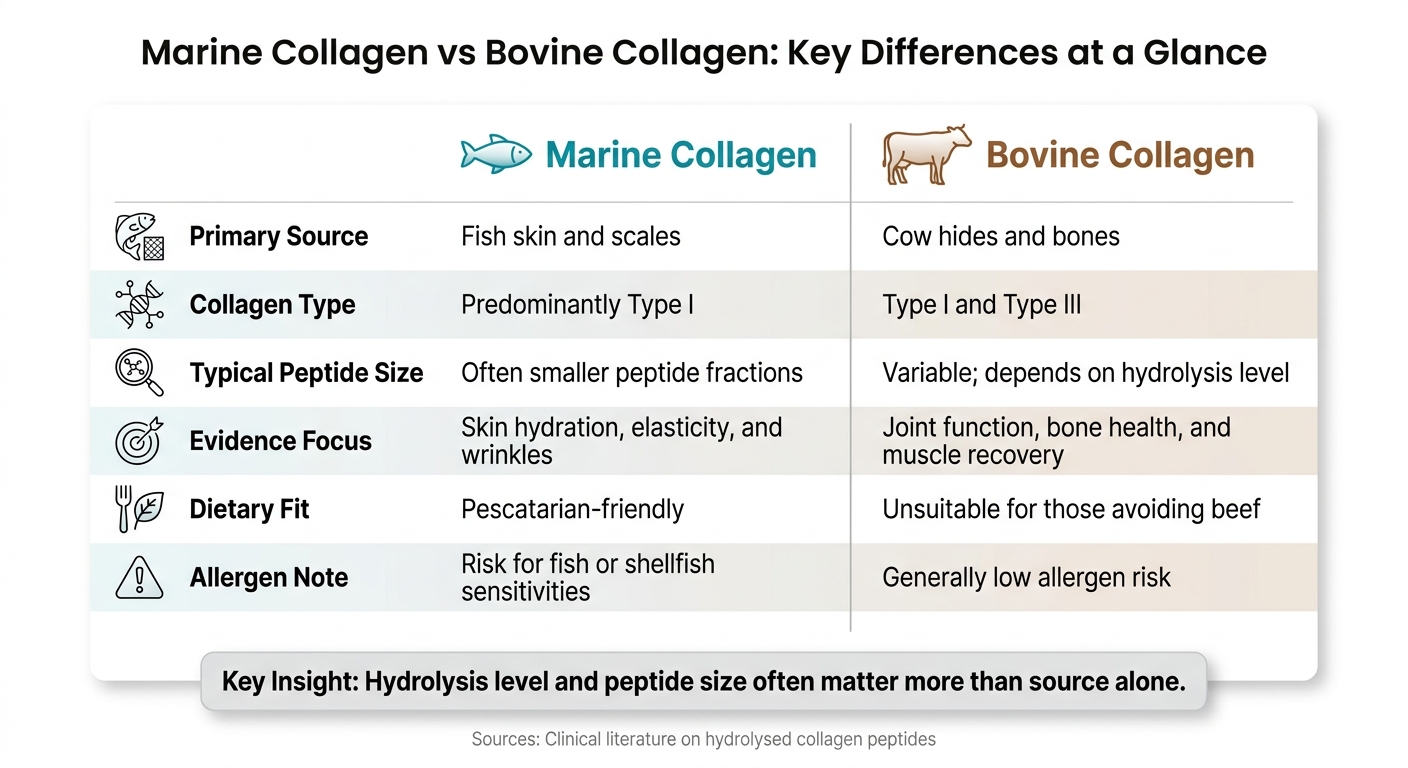
Marine Collagen vs Bovine Collagen: Key Differences at a Glance
Absorption is only one piece of the puzzle. The source, collagen type, and peptide size all affect how a collagen supplement works in day-to-day use. That’s where the practical gap between marine and bovine collagen starts to show.
Table: Marine and Bovine Collagen at a Glance
| Feature | Marine Collagen | Bovine Collagen |
|---|---|---|
| Primary Source | Fish skin and scales [4] | Cow hides and bones [2] |
| Collagen Type | Predominantly Type I [4] | Type I and Type III [2] |
| Typical Molecular Weight | Often smaller peptide fractions, depending on hydrolysis [2] | Variable; depends on hydrolysis level [2] |
| Evidence Focus | Skin hydration, elasticity, and wrinkles [4] | Joint function, bone health, and muscle recovery [2] |
| Dietary Fit | Pescatarian-friendly | Often avoided by those with beef restrictions |
| Allergen Note | Risk for fish or shellfish sensitivities [4] | Generally low risk; unsuitable for those with beef restrictions |
For many Indian readers, dietary fit is a big part of the decision. Bovine collagen may not work for people who avoid beef for religious or personal reasons. Marine collagen, on the other hand, fits better for those looking for a fish-based option.
What the Absorption Data Actually Suggest
Marine collagen is often described as more bioavailable because its peptides are usually smaller [2][4]. Put simply, smaller peptides are often easier for the body to absorb, and that’s the main reason behind the claim.
That said, the gap can shrink quite a bit when bovine collagen is well hydrolysed. If a bovine collagen product has gone through strong hydrolysis and reaches a similar peptide size, the difference in absorption may be modest rather than dramatic [2]. In plain terms, hydrolysis level and peptide size often matter more than source by itself.
So the smarter question isn’t just marine or bovine? It’s also: how well was the collagen processed, and what kind of outcome are you looking for? That’s what human studies on skin, joints, and bone try to answer next.
What Human Studies Say About Marine Collagen Benefits
Human studies carry more weight than marketing copy because they show where marine collagen peptides may help in actual people, not just in theory.
Marine Collagen for Skin
When it comes to skin, researchers usually look at hydration, elasticity, and wrinkle depth. Hydrolysed marine collagen peptides, which are rich in Type I collagen, have been examined in clinical trials for their role in improving skin moisture levels and reducing visible signs of ageing [4]. That’s why marine collagen peptides are often discussed in the context of skin support.
At the moment, the clearest human evidence is for skin. Findings for joints and bone exist, but they are less extensive.
Marine Collagen for Joints and Bone
For joints, studies tend to focus on pain, mobility, and recovery markers. Marine collagen peptides have been studied for their potential to support joint function and reduce discomfort linked with cartilage breakdown [4]. Bone-related outcomes are still being studied, and there are fewer large human trials here than there are for skin.
The next question is whether smaller peptides, especially around 2,000 Da, improve absorption in a way that makes a meaningful difference.
Does Peptide Size Really Matter?
Peptide size does affect absorption, but it doesn’t work in isolation. Hydrolysis, dose, and product quality matter too. So yes, size is worth looking at, but it’s only one part of the picture.
What Studies Show About 2,000 Da Peptides
The main question is simple: do smaller peptides improve absorption enough to make a difference? A peptide range around 2,000 Da points to smaller fragments, and those may be easier for the body to absorb. But bioavailability depends on the peptide profile, not just whether the collagen comes from a marine source.
Put another way, “marine” on the label doesn’t tell you the full story. Even if 2 kDa is used as a marker, hydrolysis quality, dose, and manufacturing consistency still shape whether a supplement delivers what it says it will.
What Matters More Than Source Alone
If peptide size is one piece of the puzzle, product quality is the other big one. A marine label, by itself, doesn’t tell you peptide size, purity, or consistency. That’s why transparency and batch testing are better signals of quality than source alone [3]. Batch-level testing and recognised manufacturing standards also point to tighter quality control [6].
Those details give you a much clearer way to judge whether a marine collagen supplement is worth your attention.
How to Choose a Good Marine Collagen Supplement
When you're comparing marine collagen supplements, the label tells you a lot. In most cases, it's the fastest way to judge whether a product is processed well and dosed properly.
What to Check on the Label
Start with the form. The label should clearly say "hydrolysed marine collagen" or "marine collagen peptides" - not just "collagen" or "marine collagen." That wording matters because hydrolysed marine collagen or marine collagen peptides means the collagen has already been broken into smaller fragments. That makes the product easier to assess. If the label also mentions molecular weight, such as ~2 kDa, that's an extra sign of peptide-size transparency.
Then look at the grams per serving. Human studies often use 5 g–10 g per day [2][5]. If the serving size is hidden in fine print, or the amount per serving isn't stated clearly, that's a red flag. After that, check the rest of the ingredient list. If a clean-label product matters to you, it's worth steering clear of unnecessary additives like artificial colours, flavours, and preservatives [2].
Once the form, dose, and peptide size look in order, the next step is simple: can the brand back up what it says?
Why Testing and Transparency Matter
Marine collagen comes from fish, so contaminant testing isn't just a nice extra. It matters. Some brands now include a batch QR code that links to third-party lab results [3]. That's useful because it gives you something concrete to verify instead of asking you to take marketing claims at face value. For heavy metals, ICP-MS offers more precise testing than basic screening [6].
In India, FSSAI compliance is the baseline legal requirement. Beyond that, signs like cGMP, ISO 22000, FSSC 22000, and HACCP can point to better manufacturing and food safety systems [4][1][6].
Use the table below as a quick scan when you're shopping.
Table: Marine Collagen Buying Checklist
| What to Check | What to Look For | Why It Matters |
|---|---|---|
| Form | Hydrolysed marine collagen / marine collagen peptides | Confirms the collagen has been pre-broken into smaller fragments [2] |
| Serving size | 5 g–10 g collagen peptides per serving | Matches the daily dose range used in human studies [2][5] |
| Peptide molecular weight | Declared on label, such as ~2 kDa | Shows peptide-size transparency |
| Testing | Third-party testing, ideally with a batch-specific QR code or CoA | Helps verify contaminants and label claims [3] |
| Heavy metals | Heavy-metal testing reported by batch; ICP-MS preferred | Important for marine-sourced ingredients [6] |
| Certifications | FSSAI, cGMP, ISO 22000, FSSC 22000, HACCP | Indicates regulatory and manufacturing quality [4][1][6] |
| Ingredient purity | No artificial colours, flavours, or preservatives | Supports a clean-label formulation [2] |
Decode Age Perspective: Where OptiAge Fits
If the science points towards hydrolysed marine collagen, the next step is simple: does the product state clearly what it is, and can you check what’s in it?
OptiAge Marine Collagen Peptides is a hydrolysed marine collagen product made for skin-focused use, with a clear label and batch-by-batch verification. That matters in day-to-day use. OptiAge is made under cGMP, ISO 22000, and FSSC 22000 certified conditions, with third-party batch testing and QR-code access to results on each pack [6][1][3].
Who This Format May Suit
OptiAge may suit people who want a hydrolysed marine collagen peptide product that clearly names its form and can be checked batch by batch. The powder format mixes easily in water or other liquids, so it’s easy to work into a daily routine [4].
Conclusion: Is Marine Collagen Better Absorbed?
The evidence points to a clear takeaway: when it comes to collagen absorption, the form matters more than the source. Hydrolysed collagen peptides and smaller peptide size appear to drive absorption far more than whether the collagen comes from fish or another source [6][1].
Marine collagen is most often Type I collagen. That said, better absorption is linked mainly to hydrolysis, peptide size, and overall product quality, not to marine origin by itself [6][1].
If you're choosing a supplement, look for hydrolysed collagen, a declared peptide size, and third-party batch testing [3].
So, marine collagen is not automatically better absorbed. In most cases, peptide form and product quality matter more than source alone.
FAQs
How long should I take marine collagen?
Marine collagen usually comes from fish and is made up mostly of Type I collagen. This is the main collagen type found in skin, bones and tendons. In most supplements, it is hydrolysed into smaller peptides, which makes it easier for the body to absorb.
Because these peptides are smaller, marine collagen is known for high bioavailability. In simple terms, that means the body can absorb and move the collagen peptides more easily. Research suggests hydrolysed marine collagen may help support skin hydration, skin elasticity and joint health. If you’re choosing a supplement, check for hydrolysed collagen, a clearly stated peptide size and third-party transparency.
Can I take marine collagen with vitamin C?
Yes. Marine collagen usually comes from fish and mostly contains Type I collagen, the main collagen type linked with skin, bones, tendons, and other structural tissues in the body.
It’s often sold as hydrolysed peptides. That simply means the collagen has been broken down into smaller protein fragments, which are easier for the body to digest and absorb. In plain terms, this helps with bioavailability and supports more efficient amino acid uptake.
Is marine collagen safe for daily use?
Marine collagen is usually taken every day and comes mainly from fish. It’s rich in Type I collagen and is often sold in the form of hydrolysed peptides.
Because these peptides are broken into smaller parts, they have a low molecular weight, which helps the body absorb them more easily. Research suggests that hydrolysed marine collagen is a solid option for supporting skin hydration, elasticity, and joint health.

Leave a comment
All comments are moderated before being published.
This site is protected by hCaptcha and the hCaptcha Privacy Policy and Terms of Service apply.