



Collagen powder can help, but mostly for skin hydration and elasticity. For joints, bones, and workout recovery, the effects look smaller and take more time. If I use it, I should think of it as a support supplement, not a fix-all.
What matters most is simple: the right dose, daily use, and a realistic goal. Most studies use 2.5–5 g per day for skin and 5–10 g per day for joints or recovery, with results often showing up after 8–12 weeks or more. It is usually safe for healthy adults, though some people get bloating or stomach upset, often from added sweeteners or fillers.
In this article, I’d focus on what collagen powder can do, what it probably won’t do, how to use it, and what to check before spending ₹ on a product.
What Collagen Powder Is And How It Works In The Body
Collagen is one of the body’s main structural proteins. It helps give form and support to skin, bones, cartilage, tendons, and ligaments. In supplements, collagen is usually broken down into smaller protein pieces called peptides, which the body can process more easily.
Collagen powder usually contains hydrolysed collagen peptides, which means the collagen has been split into smaller fragments to help with digestion and absorption [2].
The Main Types Of Collagen That Matter
For most people, Types I and III matter most. These are the main types used in supplements aimed at skin elasticity, bone health, and connective tissue support [3][1]. They’re the forms most often found in collagen powders. But that leads to the next part that matters more: what the body does with them once you take them.
What Happens After You Drink It
After digestion, these peptides are absorbed and may signal the body to make more collagen [1]. That’s why the next question isn’t just what collagen is, but what it may change in the body.
What Collagen Powder Actually Does: Benefits Backed By Evidence
So what does the research show? In plain terms, collagen powder seems to help most with skin, while support for joints, bones, and recovery looks more modest. It’s not magic. It’s more like a slow-burn supplement that may help over time when used with some consistency.
Skin Elasticity, Hydration And Visible Ageing
The clearest data is on skin. Studies suggest collagen supplementation may support skin elasticity, hydration, and the look of ageing skin. These changes don’t happen overnight. Visible shifts usually take around 12 weeks, and even then, the effects tend to be gradual rather than dramatic. One study reported a 38% wrinkle reduction[1].
That sounds impressive, but context matters. Results can vary based on age, skin condition, dose, and the type of collagen used. Think of it less like a quick fix and more like giving your skin a bit of extra raw material over time.
Joint Comfort, Bone Support And Muscle Recovery
Skin still has the strongest support, but joint and bone effects may matter too, especially for older adults or people who train often.
For connective tissue support, collagen peptides may help when taken regularly, particularly alongside resistance training[2]. That pairing matters. On its own, collagen isn’t a top-tier muscle protein in the way whey is, since it doesn’t have the amino acid profile needed to drive muscle protein synthesis as well. In adults over 50, though, it can still add to total daily protein intake and play a supporting role[2].
Here’s the practical way to look at it:
- For skin: collagen has the clearest use case
- For joints and connective tissue: there may be some help with regular use
- For muscle recovery: it can support an overall protein plan, but it should not be your main muscle-building protein[2]
Claims That Need More Caution
This is where marketing often gets ahead of the science. Some claims around collagen powder go too far. There isn’t strong human evidence showing that collagen causes dramatic fat loss, repairs skin instantly, or reverses ageing.
A better way to frame it is this: collagen may help with specific goals, especially skin-related ones, and maybe offer some support for connective tissue and daily protein intake. But it will not reverse ageing.
Once the expected benefits are clear, the next question is how to use collagen in a way that fits daily routine.
How To Use Collagen Powder Effectively
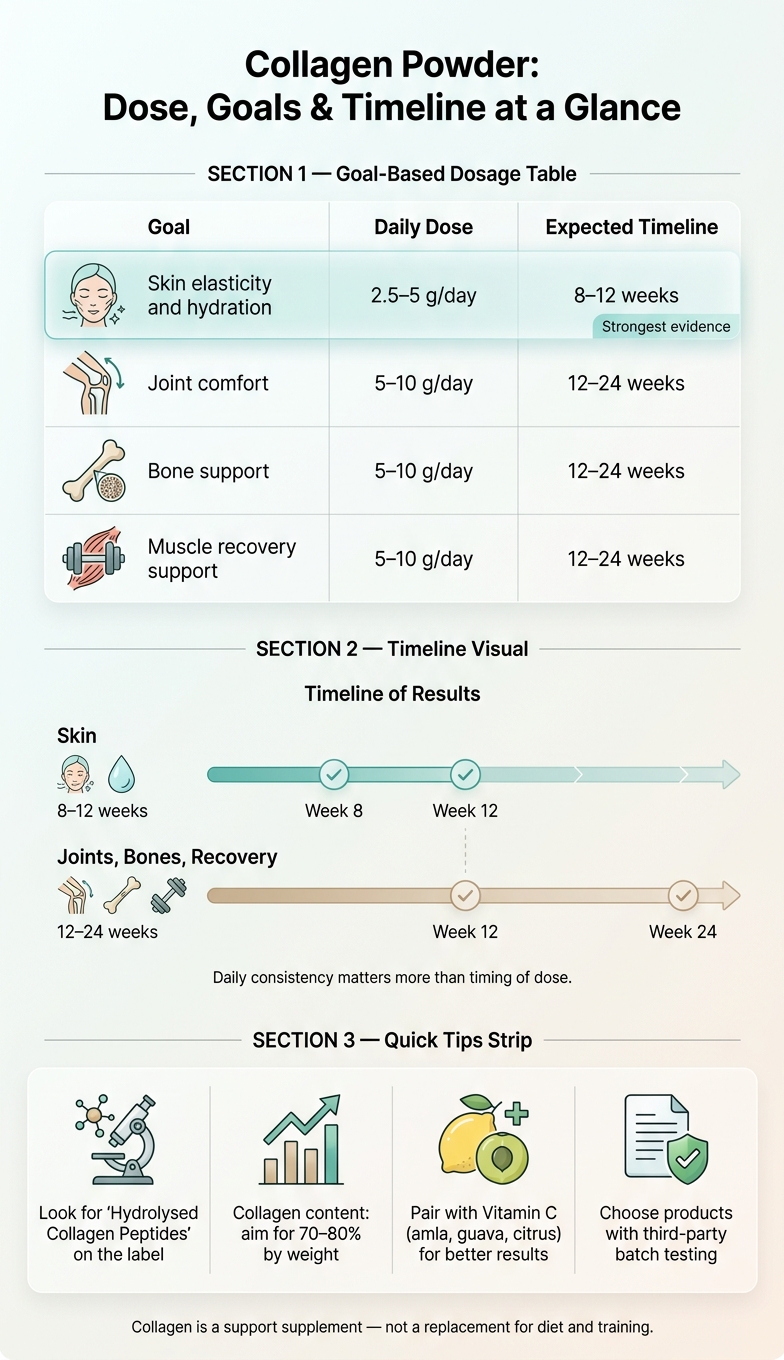
Collagen Powder Dosage, Timeline & Goals: Quick Reference Guide
How Much To Take And When To Take It
The right dose depends on what you're trying to support. For skin, 2.5–5 g a day is common. For joints, bone support, or post-workout recovery, studies more often use 5–10 g a day [5][6].
When you take it matters less than taking it every day. Morning or evening, with breakfast or after dinner - it’s the routine that counts. Once you fix the dose, the easiest move is to tie it to a meal or drink you already have daily.
Simple Ways To Add It To Meals And Drinks
Collagen powder is easy to work into everyday food. You can mix it into coffee, chai, smoothies, oats, daliya, curd, yoghurt, soups, or dal.
A small tip that helps: stir it into hot drinks after they’ve cooled a little. That usually helps cut down clumping.
How Long Before You See Results
Results don’t show up overnight. Skin changes, like better elasticity and hydration, often take about 8 to 12 weeks of steady daily use. For joint comfort, bone support, and muscle recovery, it usually takes longer - often 12 to 24 weeks before you notice a clear shift.
| Goal | Daily Dose | Expected Timeline |
|---|---|---|
| Skin elasticity and hydration | 2.5–5 g | 8–12 weeks |
| Joint comfort | 5–10 g | 12–24 weeks |
| Bone support | 5–10 g | 12–24 weeks |
| Muscle recovery support | 5–10 g | 12–24 weeks |
Once the dose and routine are set, the next step is choosing a powder that fits your goal.
How To Choose A Collagen Powder That Fits Your Goals
Choose a product that lines up with your goal, diet, and budget. A good label should tell you three things at a glance: the collagen type, the collagen dose, and whether the product has been tested.
What To Look For On The Label
Start by checking whether the product contains hydrolysed collagen peptides. This means the collagen has been broken into smaller peptides, which are easier to digest [2]. Then look at the exact grams of collagen peptides per serving. Don’t rely only on the scoop size, because a large scoop doesn’t always mean more collagen [2].
Collagen content by weight can also tell you a lot. A range of about 70–80% is a useful marker. If it drops below 65%, there’s a fair chance the powder includes a fair amount of filler [2].
If you have a sensitive gut, scan the sweetener list too. Some powders use stevia or monk fruit, while others contain sucralose or acesulfame potassium. That small detail can make a big difference in how the product feels day to day. It’s also smart to look for third-party testing, which helps confirm label accuracy and checks for contaminants [2][1].
Matching The Product To Your Goal
Your goal should shape your pick. For skin support, Type I and III collagen are the main ones to look for [3]. If your focus is joint comfort, a formula that also includes anti-inflammatory ingredients such as curcumin may make more sense [4].
| Goal | What To Look For |
|---|---|
| Skin, hair, and nail support | Type I and III collagen peptides [3] |
| Joint comfort | Collagen with anti-inflammatory ingredients like curcumin [4] |
| Bone support | Type I collagen peptides, 5–10 g per serving [2] |
| Muscle recovery support | Collagen peptides paired with a complete protein source [2] |
Key Considerations For Indian Buyers
Most collagen powders are bovine (cattle-derived) or marine (fish-derived), so they are not suitable for vegetarians or vegans. That matters more than many labels make obvious. Plant-based “collagen” products do not contain actual collagen. Instead, they use ingredients that help support the body’s own collagen production [1].
It also helps to think beyond the tub price. Compare products by cost per gram of collagen, not just by container price [2]. A ₹2,000 jar may look cheaper at first glance, but if the collagen dose is low, the math may not work in your favour.
For better day-to-day use, pair collagen with a vitamin C-rich food. Indian options such as amla, guava, and citrus fruits fit well here [1].
Once a product suits your diet and budget, the next step is to check how well you tolerate it and what side effects to watch for.
sbb-itb-55c436e
Safety, Side Effects And Who Should Be Careful
Once you’ve picked a formula, the next step is simple: make sure it sits well with your body. Most healthy adults can take collagen powder without much trouble, but it’s still smart to look at your health history and how your digestion usually reacts before starting.
Common Side Effects And Tolerance
The side effects people report most often are mild, such as bloating, gas, or stomach pain. In many cases, the issue isn’t the collagen peptides themselves. It often comes from added thickeners, flavouring agents, or sweeteners in the product.
A small first dose is a good way to test tolerance before moving to a full serving. Product purity matters too, so check for independent batch testing for contaminants and potency.
When To Speak To A Doctor
Some health conditions call for a doctor’s advice before adding collagen to your routine. Speak to a doctor first if you have kidney disease, liver disease, or need to limit protein intake. It’s also wise to check with your clinician if you take regular medicines, since supplements can sometimes affect a treatment plan.
Pregnant or breastfeeding women should speak to their doctor before starting any new supplement routine. If you have allergies, read the source and ingredient list with care. Collagen comes from animal sources, including bovine and marine ingredients, so it may not suit everyone.
Where Collagen Fits In A Longevity-Focused Routine
Once you’ve sorted the dose and picked the right product, the next step is simpler: where does collagen fit in your day? The short answer is this: collagen is a support supplement, not the base of a longevity plan. Your first job is to meet your total daily protein target.
What Makes Collagen More Useful Day To Day
Collagen tends to work best when it sits inside a routine that already includes resistance training. In plain terms, it makes more sense when you’re already doing the big things right.
Here’s why that matters. Collagen is low in leucine, so it doesn’t function like a complete muscle-building protein. That means it’s better seen as an add-on for skin, joints, and recovery, not the centre of your protein plan. For adults aged 50+, 1.6–2.2 g/kg/day supports muscle retention [2]. Collagen can count toward that daily total, but it shouldn’t be the main source.
Joint comfort can also improve when the rest of the diet supports lower inflammation. Omega-3s and curcumin are often used for that purpose [4].
A Practical Decode Age Perspective

At Decode Age, collagen fits into a personalised healthy-ageing routine. Biomarkers and gut health can help you judge whether collagen deserves a place in that routine, but they don’t replace the evidence on what collagen can and can’t do. Used this way, collagen sits as a helpful add-on within a broader plan built around nutrition, resistance training, and targeted supplementation.
The next step is weighing whether those small, steady gains are worth making it part of your daily routine.
Conclusion: Is Collagen Powder Worth Using?
Yes - but mostly when you’re using it for a clear, specific purpose and taking it steadily, not expecting overnight results. Collagen isn’t a magic fix. It’s more like a small, steady nudge that may help in the right context.
The clearest upside is skin support. That’s where the best results tend to show, and even then, they usually build gradually over about 12 weeks rather than in a few days. Outside of skin, the effects tend to be less dramatic.
For joints, bones, and workout recovery, collagen makes more sense as a support tool alongside a good diet and resistance training. On its own, it’s unlikely to do much heavy lifting.
That’s why product quality and dose matter so much. If you decide to use collagen, pick one with third-party testing and a batch-specific Certificate of Analysis. Those details aren’t just nice to have - they help you know what you’re paying for.
Use collagen for a defined goal, choose the product with care, and treat it as one part of a longer-term routine.
FAQs
Can collagen powder improve hair and nails too?
There isn’t enough direct evidence to say collagen powder on its own improves hair and nails.
One source does mention hair and skin support, but that product also includes biotin as part of the formula. So, it doesn’t show that collagen powder alone is behind those effects for hair or nails.
Should I take collagen with vitamin C?
Yes. Taking collagen with vitamin C can help, because vitamin C is needed for your body’s own collagen production.
When used together, they may better support the goals most people have in mind, like skin and joint support. That’s also why many formulas include both as part of a broader nutrition plan.
How do I know if a collagen powder is high quality?
Choose collagen powder with third-party testing. It’s one of the simplest ways to check purity, potency, and label accuracy. Marks like NSF Certified for Sport or Informed Sport also show the product has been screened for contaminants and banned substances.
It also helps to check for a batch-specific Certificate of Analysis (COA) and GMP-compliant manufacturing. And when you scan the label, simpler is often better: a short ingredient list with no extra fillers or additives is usually a good sign.

Leave a comment
All comments are moderated before being published.
This site is protected by hCaptcha and the hCaptcha Privacy Policy and Terms of Service apply.