



If you buy a B-complex in India today, the big question is not just how much B vitamin it has. It is what forms it uses.
I see many labels still using folic acid and cyanocobalamin, while newer formulas use L-5-MTHF, methylcobalamin, and P-5-P. That matters because active forms need fewer conversion steps in the body. For some people, that can matter more, especially with B12 and folate shortfalls being common in India and with many people carrying MTHFR gene variants.
The short version: a B-complex helps with energy release from food, nerve health, red blood cell production, and methylation. But the label decides how direct that support is.
In this guide, I’ll walk through what a B-complex is, why methylated forms get so much attention, what the research says, who may want to look closer, and how I would read an Indian supplement label in 2026.
B-Complex Supplements and the Eight Essential B Vitamins
What a B-Complex Supplement Is
A B-complex supplement brings together all eight essential B vitamins in one formula. Most of these vitamins are water-soluble, which means the body needs a steady intake through food or supplements. B12 is the main outlier here because the body can store it for years [4]. Each B vitamin helps enzymes carry out key metabolic reactions [4][2]. So when you look at a supplement, the form of each vitamin matters just as much as the dose. It’s not only about how much is listed on the label, but also about how well the body can use it.
Why B Vitamins Work Together
B vitamins don’t work in isolation. They function more like a team, and if one runs low, the others may not do their job as well because many of them share the same pathways [2]. The methylation cycle is a good example. It depends on B2, B6, B9, and B12 working together to help process homocysteine. If even one of those is low, the whole pathway can slow down.
The same pattern shows up in energy production. B1, B2, B3, and B5 work together inside the mitochondria to help convert glucose, fats, and proteins into ATP, the body’s usable energy [4][11]. B9 and B12 are both needed for red blood cell formation, while B6 helps the body make haemoglobin [4]. That’s why taking them as a group makes sense. It matches how they operate inside the body rather than treating each one as a separate piece.
The Eight B Vitamins at a Glance
The table below gives a quick look at what each B vitamin does and the bioactive form now showing up more often in newer formulations.
| Vitamin | Primary Function | Active (Bioactive) Form |
|---|---|---|
| B1 (Thiamine) | Glucose oxidation; energy metabolism | Thiamine pyrophosphate / Benfotiamine |
| B2 (Riboflavin) | Mitochondrial respiratory chain; MTHFR cofactor | Riboflavin-5'-phosphate |
| B3 (Niacin) | NAD+/NADP+ backbone; redox reactions | NAD+/NADP+ precursors: niacin, nicotinamide |
| B5 (Pantothenic Acid) | Coenzyme A component; fatty acid synthesis | Pantethine |
| B6 (Pyridoxine) | Neurotransmitter synthesis (serotonin, dopamine) | Pyridoxal-5'-phosphate (P5P) |
| B7 (Biotin) | Carboxylase cofactor; fatty acid and amino acid metabolism | Biotin |
| B9 (Folate) | DNA synthesis; methylation cycle | L-methylfolate (5-MTHF) |
| B12 (Cobalamin) | Myelin maintenance; homocysteine recycling | Methylcobalamin / Adenosylcobalamin |
You may still spot older names such as B4, B8, B10, or B11 on the internet or on dated labels. They are not part of the essential B-vitamin group. The essential set includes only these eight.
With that groundwork in place, the next step is to look at which forms the body can use more directly.
What a Methylated B-Complex Is and Why Active Forms Matter

Conventional vs Bioactive B Vitamins: Which Forms Does Your Supplement Use?
Methylated and Bioactive Forms Explained Simply
When you pick a B-complex supplement, the label isn’t just small print. The form of each vitamin matters just as much as the dose.
Methylation is a basic chemical process in the body. It uses methyl groups to help manage homocysteine, neurotransmitters, and gene expression [5][7]. A methylated B-complex contains active B vitamin forms, especially in the nutrients where direct use matters most. In simple terms, these forms skip part of the conversion work instead of depending fully on the liver and certain enzymes to switch them into usable forms [1][2].
That’s the key point: the form listed on the label affects how directly your body can put that vitamin to work.
Conventional Forms vs Bioactive Forms
Some people, especially those with lower folate-conversion capacity, may depend more on active folate forms [1][2]. The most common label differences are below.
| Vitamin | Conventional Form | Bioactive Form | Biological Role |
|---|---|---|---|
| B2 (Riboflavin) | Riboflavin | Riboflavin-5'-Phosphate | MTHFR cofactor [2][3] |
| B6 (Pyridoxine) | Pyridoxine HCl | Pyridoxal-5'-Phosphate (P5P) | Neurotransmitter support [1][2] |
| B9 (Folate) | Folic Acid | L-5-Methyltetrahydrofolate (5-MTHF) | Active folate [1][6] |
| B12 (Cobalamin) | Cyanocobalamin | Methylcobalamin / Adenosylcobalamin | Myelin support [1][3] |
One point often missed: Riboflavin-5'-Phosphate doesn’t get much attention, but it is a required cofactor for the MTHFR enzyme itself [2][3].
How Modern Formulations Use Active B Vitamins
Many newer formulas now use active forms because they involve fewer conversion steps [1][2]. That can matter more in older adults or in people whose nutrient-conversion efficiency is lower [1][2][3][4].
Still, active forms are not a must for everyone. Some people are more sensitive to higher methyl donor doses, so the amount in the formula still matters [6][10].
The next step is to look at whether these active forms lead to measurable effects in human studies.
What the Research Says About Bioactive B Vitamins
Evidence on Energy, Nerves, Cognition, and Methylation
Human research is strongest in four areas: homocysteine balance, exercise metabolism, cognition, and deficiency-linked nerve and blood outcomes. The main issue isn’t whether B vitamins matter. It’s whether the active forms lead to measurable changes in people.
On homocysteine, the data are fairly clear. Clinical trials using L-5-MTHF, methylcobalamin, and Pyridoxal-5'-Phosphate (P5P) showed homocysteine reductions of 25% to 35% within 4 to 12 weeks [2]. In people with MTHFR, MTR, or MTRR gene variants, methylated forms lowered homocysteine by about 30% and LDL cholesterol by around 7.5% [6].
For energy metabolism, adenosylcobalamin is linked to mitochondrial pathways, while benfotiamine, the lipid-soluble form of B1, has been studied for carbohydrate handling and mitochondrial support [9][2]. One 28-day RCT in healthy adults found that a B-complex helped participants last 26% longer before exhaustion, along with lower lactate and ammonia levels [8]. That doesn’t mean every person will feel a dramatic shift, but it does suggest a measurable effect under exercise stress.
The cognition data look promising, though they’re less clean-cut. A meta-analysis by Berg J et al. covering 5,275 adults aged 60 and above found a small but statistically meaningful gain in global cognition, with Hedges' g = 0.110, after B-vitamin supplementation [8]. Another meta-analysis by Zhang L et al. reported cognitive benefit only in regions without mandatory folic acid fortification [8]. In plain terms, the baseline diet seems to matter. For mood, a randomised controlled trial by Papakostas et al. found that 15 mg of L-methylfolate improved outcomes in adults with SSRI-resistant depression compared with placebo [4].
What Is Established vs What Is Still Emerging
Some parts are well established. These vitamins play direct roles in blood formation, nerve function, and methylation. B6 in its P5P form is a required cofactor for making serotonin, dopamine, GABA, and norepinephrine [4][2]. When levels run low, the effects can show up in familiar clinical outcomes such as megaloblastic anaemia and peripheral neuropathy.
Other areas are still taking shape. That includes the use of methylated forms for cognitive ageing, mitochondrial optimisation, and epigenetic health. An 8-week clinical trial in adults with elevated homocysteine found that methylated B-vitamin supplementation lowered a GrimAge epigenetic-age marker [7]. That’s an interesting signal, though it’s still early and needs more follow-up.
There’s also an important reality check here: lowering homocysteine is consistent, but that has not translated neatly into fewer cardiovascular events or lower mortality across trials [8][4]. So yes, the biomarker moves. The harder question is whether that shift changes long-term clinical outcomes in a clear way.
Clinical Evidence Snapshot
| Clinical Study | Participants | Main Findings | Study Design |
|---|---|---|---|
| Papakostas et al. [4] | Adults with SSRI-resistant depression | 15 mg L-methylfolate improved depressive symptom scores | RCT |
| Smith AD et al. [7] | Elderly with mild cognitive impairment | Homocysteine-lowering B vitamins slowed the accelerated brain atrophy | RCT |
| Lee MC et al. [8] | 32 healthy adults | 28-day B-complex increased time to exhaustion by 1.26x; lower lactate and ammonia | RCT |
| Berg J et al. [8] | 5,275 adults aged 60+ | Small, significant benefit in global cognition (Hedges' g = 0.110) | Meta-analysis |
| 8-week clinical trial [7] | Adults with elevated homocysteine | Methylated B vitamins lowered a GrimAge epigenetic-age marker | Clinical Trial |
| Carriers of MTHFR/MTR variants [6] | At-risk adults | Methylated B vitamins reduced homocysteine by ~30% and LDL by ~7.5% | Clinical Data |
The next section turns these findings into practical guidance on who may benefit most.
sbb-itb-55c436e
Who May Benefit from a Methylated B-Complex
Lifestyle and Diet Groups That Often Consider Active B Vitamins
Not everyone needs methylated forms. But for some people, the form of a B vitamin can matter just as much as the dose. These are usually the readers who look past the front label and check the fine print.
Vegetarians and vegans often keep a close eye on B12, since dependable food sources are mostly animal-based. If you follow a plant-based diet, the type of B12 in a supplement can matter just as much as how much of it you get.
People with high-stress routines may also pay more attention to B6 and methylation support. Stress can increase nutrient demand, including B6 [2]. Studies on supplementation in healthy adults have reported gains in perceived stress, anxiety, and concentration [8].
Fitness enthusiasts often look at active B vitamins for a similar reason. Training can increase demand for B vitamins, and a 28-day randomised controlled trial found that B-complex supplementation increased time to exhaustion by a factor of 1.26 and lowered blood lactate levels in healthy adults [8].
Individuals with MTHFR gene variants also tend to look more closely at folate form. The MTHFR C677T variant can reduce the enzyme’s ability to convert synthetic folic acid into active folate by 30% to 70% [2][8]. In those cases, L-5-MTHF skips that conversion step.
Adults Over 40 and Healthy Ageing
As people get older, B12 absorption can decline [4]. At the same time, B6 deficiency affects roughly 37.5% of adults aged 60 and older [8]. That matters because both B12 and B6 help with homocysteine metabolism and nerve function.
Some medicines can add to the problem. Long-term use of Metformin or proton pump inhibitors (PPIs) is clinically linked to B12 depletion, and using both together is tied to an 18% increase in B12 deficiency risk compared with Metformin alone [8][4]. For adults dealing with age-linked absorption changes or long-term medicine use, label checking becomes much more than a habit.
These are usually the groups most likely to look closely at form, dose, and overall label quality. The next step is simple: read the label with care and check the exact vitamin forms and dose strengths.
How to Choose a High-Quality B-Complex Supplement in India
What to Look for on the Ingredient Label
Once you understand why active forms matter, the label becomes your best filter. Start with the ingredient list, not the bold claims on the front of the pack.
A good formula tells you the exact form of each vitamin. For example, look for Methylcobalamin for B12, L-5-MTHF for B9, and Pyridoxal-5-Phosphate (P-5-P) for B6. If the label only says Vitamin B6 or Folate, it doesn’t tell you enough. The form matters, and a clear label should spell it out.
It’s also worth checking whether all eight B vitamins are included. If a product leaves out B5 or B7, for instance, it isn’t a full-spectrum B-complex.
A quick note on B6: EFSA lowered the adult upper limit to 12 mg/day in 2023, so check the per-serving amount with care. Many daily-use products stay in the 5–25 mg range and use P-5-P.
Quality Markers That Matter
Three things deserve a close look: label transparency, manufacturing quality, and third-party testing.
If you’re buying in India, check for a valid FSSAI licence number on the packaging. That shows the product meets Food Safety and Standards Authority of India rules. It also helps to see whether the brand mentions GMP (Good Manufacturing Practice), since that points to standardised production [5][9].
Third-party testing gives you one more layer of trust. Verification from groups such as NSF or USP shows that the product contains what the label says and is free from contaminants [2].
Biotin needs a separate warning. If a formula contains high-dose biotin (B7), stop it 3–7 days before blood tests. Biotin can interfere with thyroid (TSH), cardiac (troponin), and hormone lab panels, which may skew results [4].
The main thing is to use these checks together. One label claim on its own doesn’t tell the full story.
Quick Checklist for Indian Buyers
The table below makes label reading a bit easier when you’re comparing products.
| Ingredient to Look For | Why It Matters |
|---|---|
| L-5-MTHF / Methylfolate | Bypasses MTHFR genetic bottlenecks; avoids unmetabolised folic acid build-up [3][6] |
| Methylcobalamin | Active form of B12; better tissue retention and nervous system support [3][2] |
| Pyridoxal-5-Phosphate (P-5-P) | Active B6; ready for immediate enzymatic use without liver conversion [3][2] |
| Riboflavin-5-Phosphate | Active B2; cofactor for the MTHFR enzyme itself [3][2] |
| Benfotiamine | Fat-soluble B1; used in some formulas for nerve and metabolic support [9] |
| FSSAI licence number | Shows compliance for sale in India [9] |
| GMP / third-party tested | Helps check purity, potency, and manufacturing safety [2][5] |
| Specific vitamin forms named | Makes it easier to verify both form and dose of each nutrient [3] |
Also compare the %RDA with ICMR-NIN 2020 guidelines before you buy. These label checks lead directly into the product example in the next section.
A Science-Based Example of a Methylated B-Complex
How MethylAge-B™ Applies an Active-Form Approach
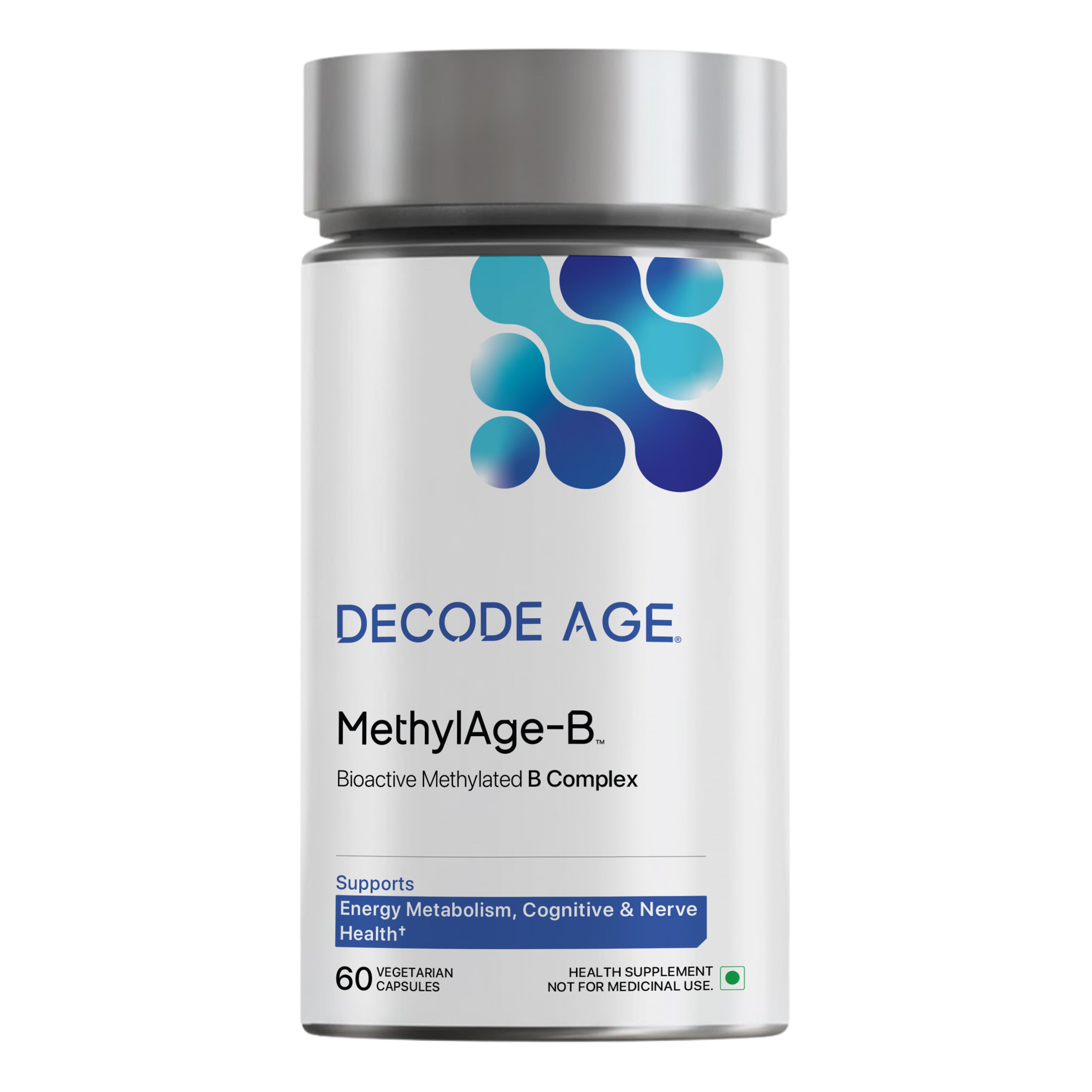
MethylAge-B™ is a clear example of how these label-check points work in practice. It includes all eight essential B vitamins, and the forms used are the active ones the body can use more directly.
Folate is provided as L-5-MTHF at 400 mcg, which meets 100% of the Indian RDA as per ICMR-NIN 2020 guidelines [9]. Vitamin B12 is included as a mix of Methylcobalamin and Adenosylcobalamin, with a combined 600 mcg per serving. That matters because these forms are linked with methylation, nervous system support, and mitochondrial energy pathways [9]. The formula also contains Riboflavin-5-Phosphate, which is the active form of B2, at 30 mg; Pyridoxal-5-Phosphate or P-5-P, the active form of B6, at 10 mg; and Benfotiamine at 150 mg, a lipid-soluble B1 derivative with different absorption traits [9][4].
It goes a step further than a standard B-complex. Alongside the main B vitamins, MethylAge-B™ includes TMG (Betaine Anhydrous) at 600 mg to help with homocysteine metabolism, CDP-Choline at 100 mg for cognitive pathway support, and Pantethine [9]. The capsule shell is also HPMC vegetable-based [9].
The point is not the brand name; it is the use of active forms that match the biology discussed above.
That’s what makes this a useful example. It turns the selection criteria from theory into something you can spot on a label.
For related reading, explore Decode Age articles on methylation, mitochondrial energy, healthy ageing, and vegetarian nutrition.
Making an Informed Choice
A B-complex brings together eight water-soluble vitamins that help with energy production, nerve function, red blood cell support, and DNA-related processes.
Methylated forms matter most when the body may struggle with conversion, but they are not a must for every person. Active forms such as L-5-MTHF, methylcobalamin, and pyridoxal-5-phosphate skip key conversion steps, which can matter when absorption is low, genetic differences are involved, or nutrient demand is higher [7][8].
Still, the science means little if the label doesn’t spell it out clearly. The form on the label is what counts: L-5-MTHF instead of folic acid, methylcobalamin instead of cyanocobalamin, and P-5-P instead of pyridoxine HCl. Clear labelling, suitable doses, GMP-compliant manufacturing, and third-party testing are the main signs of a good product. That same active-form approach is used in MethylAge-B™.
Pick the form, dose, and product quality that fit your body and your goals - not the one making the most noise.
FAQs
Do I need a methylated B-complex?
Most healthy adults who eat a varied diet usually don’t need a separate B-complex supplement. Food is often enough.
That said, a methylated B-complex can make sense in some cases. It may help people with MTHFR variants, high homocysteine, a poor response to standard B vitamins, or absorption issues.
This may include:
- vegans
- adults over 60
- people taking metformin
- people using PPIs
It’s best to speak with your healthcare provider before starting one, especially if you have unexplained neurological symptoms or take methotrexate.
Can I take B-complex every day?
It depends on your diet and your own health needs. Most healthy adults who eat a mixed diet with eggs, fish, meat, dairy, and leafy greens usually get enough B vitamins from food, so a daily supplement may not be needed.
That said, daily use can make sense for some people. This often includes vegans, older adults, people with MTHFR variants, and those on restricted diets. The key is not to overdo it. High doses aren’t always a good idea, so it’s best to check with a healthcare provider before taking a B-complex every day.
How do I read a B-complex label?
Look past the broad “B-complex” label and read the fine print. A good methylated B-complex should list the active forms clearly, such as:
- L-methylfolate/5-MTHF instead of folic acid
- Methylcobalamin instead of cyanocobalamin
- Pyridoxal-5-phosphate (P-5-P) instead of pyridoxine HCl
- Riboflavin-5-phosphate for B2
It’s also worth checking how clear the label is. You want transparent ingredient naming, dosages that make sense, and a formula without extra fillers, artificial colours, or sweeteners that don’t add any purpose.


Leave a comment
All comments are moderated before being published.
This site is protected by hCaptcha and the hCaptcha Privacy Policy and Terms of Service apply.