



Picture your skin barrier as a brick wall. The outer skin cells are the bricks, and lipids - mainly ceramides, cholesterol, and fatty acids - act as the mortar [1][7]. This wall sits in the stratum corneum, which is the skin’s outermost layer.
When that mortar stays in good shape, it helps keep water inside the skin and blocks irritants from getting in. When it starts to wear down, transepidermal water loss (TEWL) goes up, which means moisture escapes more easily [5][7]. That’s when skin often starts to feel dry, tight, and easily irritated.
Once this lipid layer weakens, even normal day-to-day habits can make things worse. Common triggers include:
- Harsh, high-pH cleansers that strip away barrier lipids [2]
- UV exposure and pollution, which create free radicals that harm skin cells and structural proteins such as collagen and elastin [1]
- Using acids, retinoids, and exfoliants together in one routine, which can leave skin more reactive [3][4]
Signs That Your Skin Barrier Is Damaged
A weakened barrier usually doesn’t stay quiet for long. Common signs include tightness that won’t go away, flaking, rough texture, redness, stinging when you apply skincare, and skin that looks dull or tired [3][6]. If products that normally work fine suddenly make your skin feel hot or irritated, that often points to a barrier under stress.
Why Barrier Support Becomes More Important After 30
After 30, the skin starts making less lipid and collagen [6]. In simple terms, the mortar between the bricks gets thinner, so the barrier becomes less able to hold on to moisture. Skin may also turn more reactive than before. That’s why ceramides become a bigger part of the conversation here: they help replenish the skin’s lipid layer.
sbb-itb-55c436e
Ceramides: The Lipids That Seal Moisture and Protect the Skin Surface
Ceramides are the main lipids in the skin barrier. They sit between cells in the stratum corneum and act like mortar between bricks, sealing tiny gaps, slowing water loss, and helping shield skin from outside stressors [1]. When this lipid layer gets worn down, skin loses moisture faster and often starts to feel touchy.
Ceramide levels drop with age, UV exposure, pollution, and harsh actives such as strong acids or retinoids. That can increase TEWL and lead to dryness, redness, flaking, itching, or stinging [1][5][6][7]. Topical ceramides help refill those gaps, which can improve hydration and calm reactive skin [1].
How Ceramides Help Dry and Sensitive Skin
If your skin is dry or sensitive, ceramides can help soften rough patches, cut down moisture loss, and support a smoother, stronger-looking skin surface [1]. They’re also a good match for people using retinoids, AHAs, or high-strength vitamin C, since those ingredients can push the barrier a bit too hard. Ceramides help keep that barrier in better shape while you use them [1][4][6].
How to Use Ceramide-Rich Moisturisers Effectively
Use a ceramide-rich moisturiser on slightly damp skin right after cleansing. That simple step helps hold onto water already sitting on the skin [1][6]. It also helps to pair ceramides with humectants like glycerin or hyaluronic acid. Think of it this way: humectants pull water in, and ceramides help keep it from slipping out again [1][8].
A harsh, high-pH soap can chip away at the skin barrier, so a pH-balanced or amino acid-based cleanser is often the gentler pick. That works on the surface barrier, while collagen supports the deeper skin structure.
Table: Common Ceramide Types in Skincare and Their Barrier Benefits
| Ceramide Type | Primary Function | Ideal Use Case |
|---|---|---|
| Ceramide NP | Improves barrier function and moisture retention | General hydration and dry skin |
| Ceramide AP | Helps smooth rough skin | Rough texture and sensitivity |
| Ceramide EOP | Strengthens the skin's protective layer | Severely dry or compromised skin |
| Ceramide NG | Enhances skin hydration and lipid balance | Early signs of ageing and dullness |
| Ceramide AS | Soothes irritation and supports barrier repair | Reactive or inflamed skin |
Multi-ceramide formulas are made to match the skin’s natural lipid mix more closely [1].
Collagen: The Protein That Supports Skin Firmness and Resilience
Collagen does its main work in the dermis, the deeper layer of the skin, where it helps maintain firmness and springiness [1][2]. Think of it as part of the skin’s inner framework. When that framework starts thinning out, skin doesn’t snap back the way it used to.
With age, the body makes less collagen. On top of that, UV exposure speeds up collagen breakdown [1][6]. Over time, this can show up as reduced firmness, fine lines, and that gradual loss of bounce many people notice first around the face [1][6]. This inner support becomes even more important when the skin barrier is also letting more water escape from the surface.
What Research Says About Collagen Peptides for Skin
Oral collagen peptides have been studied for skin support, but the results aren’t one-size-fits-all [8]. A lot depends on the dose, the formula, and whether a person takes them regularly enough for any effect to show up [8].
Who May Benefit Most From Collagen Support
Collagen support may matter more for people who are starting to see reduced firmness, early fine lines, or signs of heavy sun exposure over the years [1][6]. It also makes sense to pair that support with habits that protect collagen in the first place.
- Topical vitamin C helps support collagen formation [1][4]
- Daily SPF helps slow further collagen breakdown from UV exposure [1][4]
Collagen helps support the deeper skin structure, while ceramides help guard the outer layer. In simple terms, one helps with the scaffold underneath, and the other helps seal and protect the surface. That’s why both layers need attention at the same time.
Ceramides + Collagen: How This Duo Supports a Stronger Skin Barrier
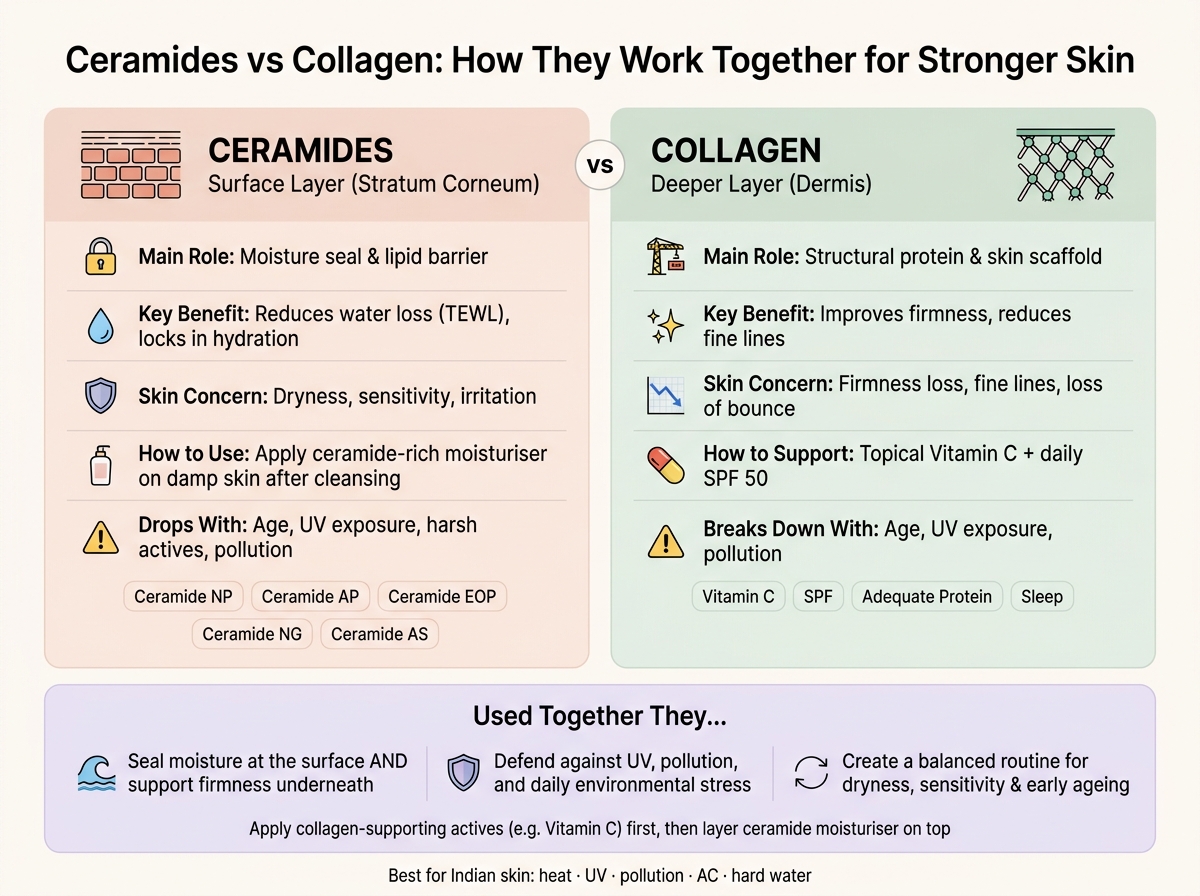
Ceramides vs Collagen: How They Work Together for Stronger Skin
Ceramides and collagen do different jobs, and that’s exactly why they work well together. Ceramides look after the skin’s outer barrier, while collagen helps support the deeper structure underneath. Used side by side, they can help skin keep in moisture, feel steadier, and show fewer early signs of ageing over time [1][4]. This kind of pairing makes sense for people dealing with dryness, sensitivity, mild loss of firmness, or day-to-day stress from sun, pollution, and strong actives.
In day-to-day skincare, this is less about doing more and more about using the right order. Ceramide-rich moisturisers help soothe the surface and cut down transepidermal water loss. At the same time, collagen-supporting actives like topical vitamin C help support collagen production and improve firmness [1][2]. A simple way to layer them is to apply the collagen-supporting product first, then use a ceramide-rich moisturiser on top to help lock things in and shield the skin surface [1][4]. Like most skincare, results come with steady use, not one good night.
The table below makes the difference easy to see.
Table: Ceramides vs Collagen by Layer, Function, and Skin Concern
| Feature | Ceramides | Collagen |
|---|---|---|
| Layer | Stratum Corneum (Surface) | Dermis (Deeper layers) |
| Main Role | Moisture seal and lipid barrier | Structural protein and scaffold |
| Main Benefit | Reduces irritation, locks in hydration | Improves firmness, reduces fine lines |
| Skin Concern | Dryness and sensitivity | Firmness loss and fine lines |
A Practical Skin Barrier Routine for Indian Conditions
India’s climate doesn’t give skin much of a break. In one city, you’re dealing with heat and sweat. In another, it’s dry AC air all day. Add harsh UV, dust, and pollution, and the skin barrier can start feeling worn out. That’s why a routine should do two things well: support the barrier day to day and help the skin stay steady over time. You don’t need 10 steps. You need a routine you can stick to.
Morning and Night Barrier Routine
In the morning, the aim is clear: protect and hydrate.
- Start with a gentle, soap-free, pH-balanced cleanser so you don’t strip away the skin’s natural lipids [2][9].
- Follow with a hydrating toner or a humectant such as glycerin or hyaluronic acid.
- Apply a ceramide-rich moisturiser. In hot and humid weather, milky or gel-based formulas often feel better on the skin [1][3].
- If you use vitamin C, apply it before moisturiser. It helps with antioxidant defence and works well alongside SPF [1].
- Finish with a broad-spectrum SPF 50 sunscreen [1][2][3].
At night, the focus shifts from protection to repair.
- If you wore sunscreen or spent time outside, double cleanse to remove buildup, sunscreen, and pollution residue [1][2].
- Then use a ceramide-rich cream. If your skin feels dry or tight, go for a richer texture.
- Niacinamide or low-dose retinol can work in a barrier-aware routine, but don’t use retinol on the same night as physical exfoliation [3][4].
Lifestyle Habits That Support Barrier and Collagen Health
Skincare works better when your daily habits aren’t working against it. What you eat, how well you sleep, and how much sun you get all play a part in barrier repair and collagen health.
Adequate protein and vitamin C intake help support collagen synthesis. Daily sunscreen helps protect both barrier function and collagen [1][4][3]. It sounds basic, but this step does a lot of heavy lifting.
Over-exfoliation is one of the fastest ways to upset the skin barrier. Harsh scrubs and frequent exfoliation can leave skin more reactive, especially in hot weather, polluted air, or strong sun [2][4]. If your skin starts feeling hot, itchy, or tight, that’s a sign to pull back. Drop the actives for a bit and stick to a plain ceramide moisturiser with a calming ingredient like centella asiatica until your skin settles [3].
Water temperature matters too. Wash with lukewarm water, not hot water, since hot water can strip barrier lipids [2][9].
Table: Routine Options for Dry, Sensitive, and Early-Ageing Skin
The table below makes the routine easier to match with what your skin needs right now.
| Skin Concern | Morning Focus | Night Focus | Key Ingredients |
|---|---|---|---|
| Dry / air-conditioned spaces | Hydrating toner + lightweight ceramide moisturiser + sunscreen | Richer ceramide cream | Glycerin, Hyaluronic Acid, Ceramides |
| Sensitive / Reactive | Gentle cleanser + ceramide moisturiser + sunscreen | Centella or niacinamide serum + plain ceramide cream | Centella Asiatica, Niacinamide, Squalane |
| Early-Ageing | Vitamin C serum + ceramide moisturiser + sunscreen | Low-dose retinol + ceramide cream | Vitamin C, Retinol, Ceramides |
| Pollution / dullness | Antioxidant serum + sunscreen | Double cleanse + antioxidant serum + ceramide moisturiser | Vitamin C, Vitamin E, Ceramides |
Decode Age's View: Skin Barrier Health as Part of Healthy Ageing
From a longevity point of view, skin health is a practical sign of how well the body is holding up over time. At Decode Age, skin health is treated as part of healthy ageing. It can reflect hydration, recovery, and the build-up of daily stress. So barrier support matters not just for comfort, but for healthy ageing as well.
Daily barrier care also ties into a long-range goal: helping the skin stay resilient during The Decade of Healthy Ageing. In that frame, ceramides help guard the surface barrier, while collagen helps support deeper resilience. When the barrier is weak, the issue goes beyond dryness. It may also point to inflammation, slower recovery, and lower resilience. Barrier care helps support skin function, not only moisture.
Why Skin Health Fits Into a Longevity Mindset
This points to a more personal way of looking at skin ageing. Nutrition, sleep, UV exposure, and stress all shape ceramide and collagen health. Supporting the skin barrier with ceramides and collagen is one part of a bigger picture, alongside steady daily habits and a view of skin as part of the body’s broader biology. Together, these fit into a broader routine aimed at preserving skin function with age.
Conclusion: How to Build a Stronger Skin Barrier With Ceramides and Collagen
In simple terms, ceramides help lock in moisture and shield the skin on the surface, while collagen helps maintain firmness and bounce underneath. They work in different layers, so they’re not doing the same job. That’s exactly why they pair well.
If you’re dealing with stubborn dryness, easily irritated skin, or the first signs of ageing, this duo offers a science-backed way to care for skin. A ceramide-rich moisturiser layered over collagen-supporting actives can help defend the barrier without putting too much pressure on it [1][4].
What helps most is not doing more, but doing it steadily. A gentle daily routine usually does more for the skin barrier than cycling through too many strong actives. That steady approach gives skin the support it needs for repair and for better resilience over time.
Skin barrier health goes beyond appearance. It affects how well your skin holds moisture, recovers after stress, and copes with daily triggers like sun exposure, heat, pollution, and hard water, all of which are common across India. Used together, ceramides and collagen can help support a stronger, more resilient skin barrier over time.
FAQs
Can I use ceramides and collagen together every day?
Yes, ceramides and collagen support skin health in different but complementary ways. Ceramides help strengthen the skin barrier and lock in moisture, while collagen-focused ingredients help support skin structure, firmness, and resilience.
Used together, they can fit well into a daily skincare routine to support hydration and the skin’s overall look and feel. That said, skin can be a bit picky. It’s best to pay attention to how your skin reacts and scale back use if you notice sensitivity or irritation.
Do collagen peptides actually help the skin barrier?
Yes, but indirectly. Collagen peptides help support skin health by signalling the body to make more collagen. That can improve firmness, elasticity, and the look of fine lines and wrinkles.
Their main job is to support skin structure and bounce, not to repair the skin barrier directly. Think of it this way: collagen peptides help with the skin’s inner framework, while ceramides help lock in moisture and protect the surface. They work well side by side, but they do different jobs.
How long does it take to see results from ceramides?
Ceramides need daily, steady use because skin barrier repair takes time. It’s a slow process, not something that changes overnight. That said, you may notice relief from dryness or tightness soon after you apply them.
More visible changes in barrier function, moisture retention, and skin resilience usually show up after 4 to 8 weeks of regular use. In plain terms, the key is consistency over time.



Leave a comment
All comments are moderated before being published.
This site is protected by hCaptcha and the hCaptcha Privacy Policy and Terms of Service apply.