



Why Human Clinical Trials Matter For Urolithin A
Lab And Animal Studies Versus Human Trials
Lab and animal studies can show how Urolithin A may work. But the harder question is whether those same effects show up in people during placebo-controlled trials. That’s where trial design starts to matter far more than theory alone.
The main point isn’t just mechanism. It’s whether supplementation leads to measurable changes across the messy, varied reality of human biology.
What Makes A Strong Longevity Trial
For Urolithin A, confidence rests on a few core features: randomisation, double-blinding, placebo control, enough participants, and endpoints that mean something in daily life.
Sample size is one of the biggest weak spots in current Urolithin A research. A 2025 systematic review found only three high-quality RCTs involving a total of 174 participants [2]. That’s a small pool. And small studies often come with wide confidence intervals, which means the results may shift when tested in a larger, more mixed group.
Study duration matters too. Trials lasting six to eight weeks can pick up changes in endurance or mitochondrial biomarkers, but they are usually too short to show clear shifts in muscle mass [2].
Then there’s the issue of what gets measured. Biomarkers such as mitophagy induction or C-reactive protein can show that something is changing at the cellular level. Still, that does not always mean a person will walk faster, feel stronger, or perform better physically. A stronger trial looks at both sides: biological markers and functional outcomes. That’s how researchers test whether a cellular signal turns into something a person can actually notice.
With that benchmark in mind, the next section follows how Urolithin A research moved from early discovery into human trials.
Table: Human Studies Versus Animal Studies
The contrast becomes clearer when you put both side by side.
| Feature | Animal / Lab Studies | Human Clinical Trials (RCTs) |
|---|---|---|
| Focus and practical relevance | Biological mechanisms and lifespan extension; identifies how it might work | Functional outcomes such as strength, endurance, and mobility; identifies if it works and at what dosage |
| Evidence strength | Strong for mechanistic plausibility; limited for clinical use | Gold standard for confirming real-world efficacy and safety |
| Microbiome factor | Controlled or bypassed in standardised lab animals | Reflects wide variation in human Urolithin A production |
| Typical endpoints | Cellular mitophagy, rodent grip strength, lifespan | 6-minute walk distance, VO2 peak, muscle torque, safety |
sbb-itb-55c436e
Overview Of Urolithin A Research And Clinical Trials
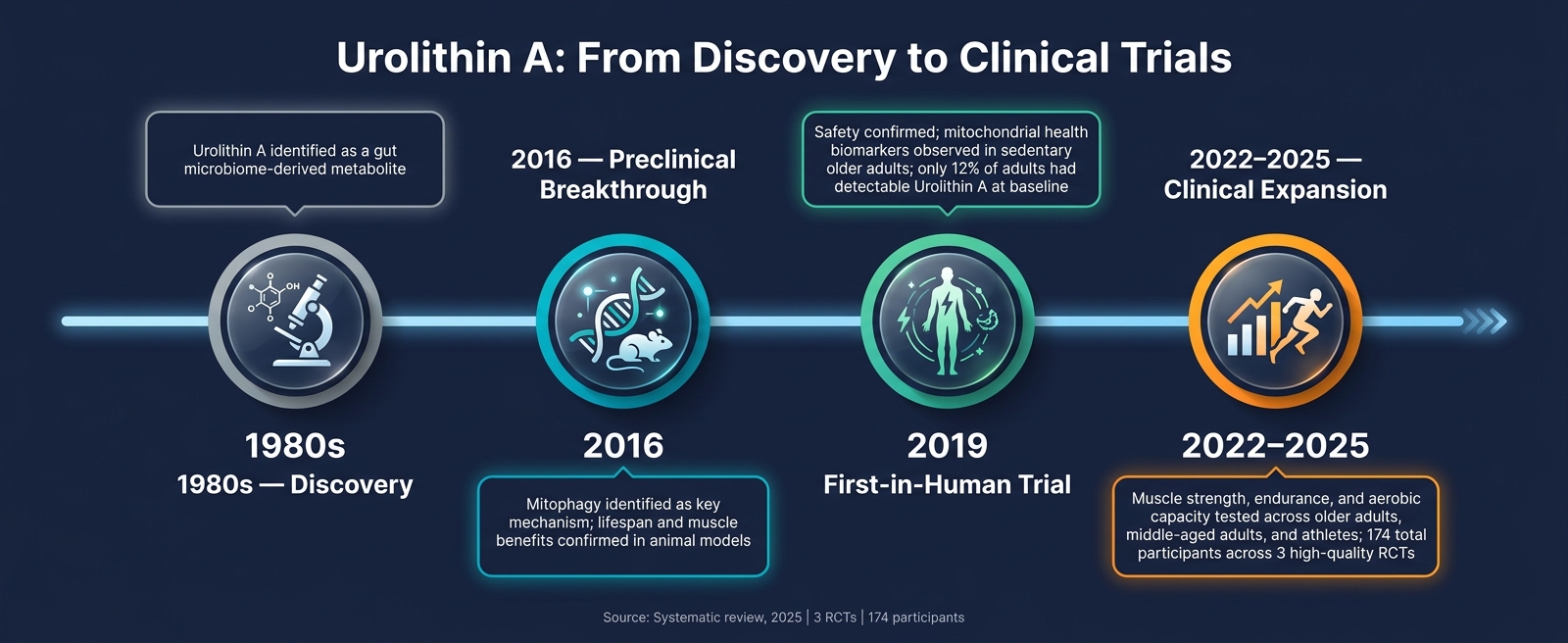
Urolithin A Research Timeline: From Discovery to Clinical Trials
From Discovery To Early Human Studies
Human research on Urolithin A picked up after preclinical studies tied it to mitophagy, mitochondrial health, and better muscle function and endurance in lab models. In 2016, preclinical work showed that Urolithin A could induce mitophagy and extend lifespan in C. elegans, while also improving muscle function in rodents [2][4]. That work laid the groundwork for the first human trials.
The first human randomised, double-blind, placebo-controlled trial showed that Urolithin A was safe, entered the bloodstream, and was associated with biomarkers linked to mitochondrial health in sedentary older adults [2][3]. One detail stood out: only 12% of healthy adults had detectable Urolithin A at baseline [3]. Even after drinking pomegranate juice, only about 40% converted its precursors into Urolithin A [1][3]. Put simply, not everyone makes the compound efficiently on their own. The study also found that a 500 mg dose led to more than six times the plasma exposure seen with 240 mL of pomegranate juice [3].
Expansion Into Muscle And Mitochondrial Research
Once safety and absorption were clear, research moved to a more practical question: does Urolithin A help people perform better?
Human studies then shifted from basic safety checks to outcomes such as muscle endurance, strength, and physical performance. Liu et al. studied adults aged 65–90 years for four months at 1,000 mg/day and reported better 6-minute walk performance along with lower inflammation [2]. Singh et al. tested 500 mg/day and 1,000 mg/day for four months in middle-aged overweight adults and reported higher hamstring strength, VO₂ peak, and lower C-reactive protein [2][4]. In a six-week pilot RCT involving 20 male academy soccer players, researchers tested 1,000 mg/day. The Urolithin A group covered 239 m more in the Yo-Yo Intermittent Recovery Test than the placebo group [4].
Taken together, these studies show a clear shift in the research path - from mechanism and safety to muscle health, endurance, and exercise output.
| Milestone | Research Phase | Key Focus |
|---|---|---|
| 1980s | Discovery | Urolithin A identified as a gut microbiome-derived metabolite [1] |
| 2016 | Preclinical breakthrough | Mitophagy identified as the mechanism; lifespan and muscle benefits seen in animal models [2][4] |
| 2019 | First-in-human | Safety confirmed; mitochondrial health biomarkers observed in sedentary older adults [2][3] |
| 2022–2025 | Clinical expansion | Muscle strength, endurance, and aerobic capacity tested in older adults and athletic populations [2][4] |
The next section examines these results by outcome: muscle health, endurance, and performance.
What Human Trials Show About Muscle Health And Physical Performance
Now that absorption and safety look settled, the next thing that matters is simple: do these biological changes lead to better physical function? Human trials suggest they can, but the pattern is not uniform. The clearest signal shows up in muscle endurance, while effects on strength, sprint output, or lean mass are smaller and less steady. In other words, not every measure improves at the same pace. [2]
Findings In Older Adults
A randomised trial in 66 sedentary adults aged 65–90 tested 1,000 mg daily over 4 months and found better muscle endurance. [2] That matters, because endurance tends to shape day-to-day function more than many people realise, especially in older age.
At the same time, the gains were not universal. A pooled analysis showed only a small, non-significant change in six-minute walk distance. [2] No trial has shown a significant rise in muscle mass measured by DXA either, so the main takeaway here is fairly clear: the signal is in endurance, not muscle size. [2]
The same thread appears in younger and more active groups, where physical performance markers tend to show the clearest movement.
Findings In Middle-Aged And Active Populations
In middle-aged, overweight adults, Singh et al. studied 88 participants aged 40–65 and tested daily doses of 500 mg and 1,000 mg over 4 months. The 1,000 mg dose led to a significant improvement in hamstring torque and VO₂ peak compared with placebo, while the 500 mg dose showed smaller effects. That points to a dose-response pattern. [2]
Small trials in trained groups tell a similar story. In a 2024 pilot study of 20 male athletes doing resistance training, 1,000 mg/day for 8 weeks led to gains in quadriceps strength and bench-press repetitions to failure. [2] [4] Then, in a 2025 pilot randomised controlled trial in 20 male academy soccer players, 1,000 mg/day during a 6-week preseason improved Yo-Yo IRT1 performance and countermovement jump height. Sprint speed and jump power, however, did not change significantly. [4]
So across older adults, middle-aged adults, and trained athletes, the pattern stays pretty steady: endurance and aerobic performance improve more often than muscle mass. That’s an important distinction. If someone expects bigger muscles on a scan, the current data do not support that. If the goal is better fatigue resistance or improved exercise output, the evidence looks more encouraging.
Table: Summary Of Major Clinical Trials
| Trial / Lead Author | Participants | Dose | Duration | Main Findings |
|---|---|---|---|---|
| Liu et al. (2022) | 66 sedentary adults, aged 65–90 | 1,000 mg/day | 4 months | Improved muscle endurance in hand and leg muscles; no significant change in 6-minute walk distance or muscle mass [2] |
| Singh et al. (2022) | 88 middle-aged overweight adults, aged 40–65 | 500 mg or 1,000 mg/day | 4 months | 1,000 mg improved hamstring torque and VO₂ peak; no significant increase in muscle mass by DXA [2] |
| Zhao et al. (2024) | 20 male athletes in resistance training | 1,000 mg/day | 8 weeks | Improved quadriceps strength by about 8% and bench press repetitions to failure by about 11% [2] [4] |
| Monsalve Acevedo et al. (2025) | 20 male academy soccer players | 1,000 mg/day | 6 weeks | Improved Yo-Yo IRT1 performance by 239 m and countermovement jump height by 3.33 cm; no significant change in sprint speed or jump power [4] |
Across these trials, 1,000 mg/day shows the steadiest signal. That brings up the next issue: whether these changes are tied to mitochondrial adaptation in humans.
How Urolithin A Triggers Mitophagy And What Human Biomarkers Show
Mitophagy Explained Simply
Mitophagy is the cell’s quality-control system for clearing out damaged mitochondria and reusing their parts. Think of it as routine maintenance: old or faulty energy units are removed so the healthier ones can keep doing the job. Urolithin A may switch on this process through AMPK and mTOR signalling. In human studies, researchers track this by checking muscle tissue, gene expression, and ATP efficiency.
Human Evidence On Mitochondrial And Mitophagy Biomarkers
Performance results mean more when they’re supported by what’s happening inside the tissue.
The strongest human biomarker data comes from muscle biopsies. In a Phase I safety trial published in Nature Metabolism, Ryu et al. tested 250 mg, 500 mg, and 1,000 mg in healthy older adults. At the 500 mg dose, biopsies taken after 28 days showed a statistically significant upregulation of mitophagy-related gene expression [5].
A 2022 JAMA Network Open trial by Liu et al. added a second line of evidence. In 66 sedentary older adults aged 65–90, 1,000 mg per day for 4 months improved mitochondrial efficiency, measured as more ATP produced for the same amount of oxygen used in muscle tissue [5]. This efficiency is a key part of how compounds like NMN boost energy levels by supporting NAD+ and mitochondrial health. That matters because it points to better muscle mitochondrial function, not just a change in signalling on paper.
Some trials have also reported lower CRP and IL-6 [5]. In a 2025 pilot study of academy soccer players, Urolithin A helped preserve salivary antioxidant capacity during preseason [4].
That said, these are biomarker findings. They show biological activity, but they do not, on their own, prove day-to-day benefit.
Evidence Strength Across Research Areas
| Research Area | Human Evidence | Evidence Strength |
|---|---|---|
| Mitochondrial biomarkers | Upregulation of mitophagy-related and oxidative phosphorylation genes in muscle biopsies; improved ATP efficiency | High |
| Muscle strength | Significant gains in hamstring torque and leg press repetitions in some RCTs | Moderate |
| Aerobic endurance | Improved aerobic performance measures in older adults and significant Yo-Yo test gains in athletes | Moderate |
| Muscle mass | Most human trials up to 4 months show no significant increase in lean mass | Low |
| Immune and inflammatory health | Some evidence of reduced CRP and inflammatory markers | Preliminary |
| Cognitive health | Primarily based on preclinical models; human data is lacking | Very Preliminary |
Taken together, the strongest human evidence sits at the molecular level. Urolithin A has shown fairly steady effects on mitophagy-related and mitochondrial biomarkers. By contrast, outcomes like endurance and strength look promising but are less settled, while muscle mass and cognitive findings are still early in human research.
The next question is whether these signals show up at doses that are practical and well tolerated. Safety and dose shape how useful these findings are outside a trial setting.
Dosage, Safety, And How To Read The Evidence
Dosage Used In Human Studies
Human studies have mostly tested purified Urolithin A at 500 mg or 1,000 mg per day. In most cases, supplementation lasted from 6 weeks to 4 months [2][4].
The dose seems to shape the type of effect seen. A 2025 systematic review covering three trials and 174 adults aged 24 to 72 reported that 1,000 mg/day showed the most steady gains in strength and physical performance. By contrast, 500 mg/day appeared to have more of an effect on mitophagy-linked biomarkers than on clear performance outcomes [2][4].
That distinction matters because biomarker shifts and day-to-day physical gains are not the same thing. You can think of it like seeing movement on a dashboard versus seeing the car move better on the road. The first is useful, but the second tends to matter more to people.
Direct supplementation may also help avoid one major problem with food-based intake: not everyone produces Urolithin A from foods at the same rate. Gut microbiome differences can lead to big person-to-person variation, so taking purified Urolithin A offers a more consistent route [3].
Dose is only one piece of the puzzle, though. The other two are simple: how well people tolerate it, and how long they were actually followed.
Safety And Tolerability In Clinical Trials
So far, published human trials have described Urolithin A as safe and well tolerated, with mostly mild adverse events that were similar to placebo [2][3]. That’s a good sign, but it needs to be read in context.
A few details stand out:
- One crossover study reported zero dropouts [2][3].
- A systematic review found dropout rates below 10% across trials [2][3].
- One safety review recorded 15 mild adverse events with Urolithin A, compared with 26 after pomegranate juice [3].
In plain terms, the short-term safety picture looks reassuring. People generally stayed on the supplement, side effects were mostly mild, and trial retention was decent.
Still, there’s a catch. Most studies have lasted no more than 4 months, and published human data do not yet tell us much about what happens with longer use [2][4]. That short follow-up is one of the main reasons the evidence still needs a careful reading.
What Researchers Still Do Not Know
The current evidence base has clear limits. For one, the studies are still small. Most trials have included fewer than 100 participants, and the groups studied have been fairly narrow: mainly healthy older adults, overweight middle-aged adults, or elite athletes [2][4].
That leaves some big gaps. There is still very little human data in people with conditions where muscle decline is a direct clinical issue, such as sarcopenia, or in people recovering from major surgery [2].
The follow-up period is another weak spot. No published human trial has tracked outcomes beyond 4 months, which means researchers cannot yet make firm calls about long-term effects on muscle mass, falls, or hospital admissions [2].
"Insufficient evidence exists to support the use of urolithin A to improve muscle function in any population at present, but existing data support conducting larger randomised controlled trials." - Miles D. Witham, Professor of Evolutionary Medicine, Newcastle University [2]
There is also the question of the microbiome. Researchers know that gut microbiome differences affect how much Urolithin A people make from food. But trials have not yet shown whether those same microbiome differences change how people respond to supplemental Urolithin A itself [3].
Here’s the bottom line for reading the research: the early signal is promising, the short-term safety profile looks decent, but the evidence is still based on small, short studies. That’s why dose, safety window, and study duration matter so much when judging what these findings can - and cannot - tell us.
Conclusion
Key Takeaways From Current Human Evidence
Taken together, human trials point to a real biological effect, but not a final clinical answer.
Current human studies show a clear biological signal, modest gains in function, and short-term safety at 500 mg to 1,000 mg per day. The main issue now is simple: do these biomarker changes turn into results people can actually notice in day-to-day life?
Muscle function and endurance are where the most interesting findings show up. Human studies suggest gains in endurance and some strength measures in older adults, middle-aged adults, and athletes [2][4]. In a 2025 pilot study of elite academy soccer players, 1,000 mg/day improved Yo-Yo Intermittent Recovery Test performance by 239 metres compared with placebo [4]. At the same time, current human evidence does not show a clear rise in muscle mass. DXA-based studies found no significant difference versus placebo [2]. Put plainly, the signal looks stronger for function than for mass.
The short version: a systematic review covering 174 participants found that 4 of 12 outcomes improved significantly [2]. That matters, but it is still not the same as a final answer.
How Readers Should Approach This Evidence
The best way to read this evidence is by looking at the type of trial, sample size, and whether the outcome matters in real life. For Urolithin A, the studies are human and randomised, which is good, but most are still small and short-term. They show biomarker gains, yet those changes do not always lead to large functional improvements [2][4]. Since many people do not naturally produce meaningful amounts of Urolithin A from food, direct supplementation may give more steady exposure [3].
If you’re thinking about Urolithin A, especially for age-related muscle decline or recovery after surgery, it’s worth speaking with a healthcare professional first. The research is promising, but it is still too limited in size and duration to support strong claims.
FAQs
Does Urolithin A really work in humans?
Human trials suggest Urolithin A is safe, well tolerated, and bioavailable at daily doses of 500 mg to 1,000 mg. That matters because a compound can look good on paper, but if the body doesn’t absorb it well, the story usually falls apart fast.
Research also points to a possible link between Urolithin A and mitochondrial health. In some studies, it was linked with higher mitophagy, the process cells use to clear out worn-out mitochondria, and lower levels of certain inflammatory biomarkers.
That said, the picture gets less clear when muscle performance enters the frame. Some human trials reported gains in endurance and strength, while others did not find a meaningful effect. So, where does that leave us? The current evidence looks promising, but it still isn’t firm enough to treat these findings as settled.
Who may benefit most from Urolithin A?
Human RCTs suggest Urolithin A is safe and bioavailable at 500 mg to 1000 mg daily. That makes it a point of interest for people who want to support mitophagy, mitochondrial health, and muscle function.
In human studies, researchers have seen possible gains in muscle strength and endurance, along with favourable shifts in biomarkers linked to mitochondrial health. That said, the picture is not fully settled. Some physical performance findings have been mixed, and larger, longer trials are still needed to see how these results hold up over time.
Is 1,000 mg the most effective dose?
Current human studies usually use 500 mg to 1,000 mg of Urolithin A. So far, these amounts seem safe and are absorbed well by the body. Some trials have also linked them with better muscle function and lower biomarkers, including C-reactive protein and acylcarnitines.
That said, the evidence base is still small. Because of that, it’s too early to say with confidence that 1,000 mg is the best dose.

Leave a comment
All comments are moderated before being published.
This site is protected by hCaptcha and the hCaptcha Privacy Policy and Terms of Service apply.