



In India, low B12 status is common, vegetarian eating patterns are common, and some people may not convert folic acid well. So the right pick is less about marketing words like active or bioactive and more about your diet, lab markers, age, medicines, and family risk.
Quick comparison
| Type | Best suited for | Main point |
|---|---|---|
| Regular B-complex | Most healthy adults with no known absorption or conversion issues | Usually enough for routine top-up |
| Methylated B-complex | People with high homocysteine, known MTHFR variant, low B12 risk, or poor response to standard forms | Uses forms closer to what the body needs |
I’ll keep this simple: if you eat little or no animal food, take metformin or PPIs for a long time, are over 60, or are planning pregnancy, the form of folate and B12 may matter more. If not, a regular B-complex may do the job at a lower cost.
What Is a B-Complex Supplement?
A B-complex supplement brings all eight water-soluble B vitamins into one formula. These vitamins work as cofactors, helping enzymes carry out key metabolic reactions in the body. When intake is low or when absorption is poor, the effects can show up in day-to-day functions like energy production, nerve health, and blood formation [6].
Most B vitamins are not stored well in the body. B12 is the main exception, since the liver can store it for years. That’s why steady intake or timely replenishment matters for the rest of the group [6].
The 8 B Vitamins and What They Do
Each B vitamin plays a different part, but many of them work side by side or in sequence:
| Vitamin | Common Name | Primary Role |
|---|---|---|
| B1 | Thiamine | Helps the body turn carbohydrates into energy |
| B2 | Riboflavin | Supports energy production and cellular growth |
| B3 | Niacin | Supports DNA repair and energy metabolism |
| B5 | Pantothenic Acid | Required for making fatty acids and hormones |
| B6 | Pyridoxine | Helps build neurotransmitters like serotonin and dopamine, and supports haemoglobin production |
| B7 | Biotin | Supports the metabolism of proteins, fats, and carbohydrates |
| B9 | Folate | Essential for DNA synthesis, cell division, and methylation |
| B12 | Cobalamin | Maintains nerve myelin and supports red blood cell formation |
This shared role is why both intake and activation matter. In simple terms, it’s not just about swallowing a supplement. The body also needs to use those vitamins in the right form. Together, B vitamins support energy metabolism, nerve function, blood formation, and DNA-related processes.
B9 and B12 deserve a closer look here. They are closely tied to methylation, a process involved in gene regulation and homocysteine recycling. If that sounds technical, think of methylation as one of the body’s routine maintenance systems. It helps keep many small but important processes moving in the right direction. Some supplement forms need conversion before the body can use them well, which is why the form of a vitamin can matter as much as the amount [9].
Why B-Vitamin Status Can Fall Short
More than 53% of the Indian population is low in at least one B vitamin [7]. That number tells you something important: the issue isn’t only about eating too little. Absorption and conversion also affect how much support a person gets from food or supplements.
Diet is the most obvious reason. B12 is found almost only in animal foods, so vegetarian and vegan diets often fall short on steady B12 intake [7][6]. Folate is found in leafy greens and lentils, but cooking habits matter too. Boiling vegetables in a lot of water and then throwing that water away can destroy 40% to 80% of their folate content [4].
Age can make things harder. Between 10% and 30% of older adults have lower gastric acid and reduced intrinsic factor production, and both are needed to absorb B12 from food [6]. So even if the diet looks fine on paper, the body may not extract enough.
Medicines add another layer. Long-term use of Metformin, often prescribed for diabetes, roughly doubles the risk of biochemical B12 deficiency. Proton pump inhibitors used for acid reflux can have a similar effect [6]. In practice, this means a person may be eating well and still come up short.
Genetics can also shape the picture. Up to 47% of North Indians carry the MTHFR C677T variant, which may reduce folate conversion efficiency [8]. That makes the form of a vitamin more than a technical detail. It can shape how well the body puts that nutrient to work. This conversion bottleneck is why the next section looks at regular and methylated forms.
What Does "Methylated" Actually Mean?
Methylation Explained Simply
Methylation is a basic chemical process that happens in the body all the time. Put simply, it adds a methyl group - one carbon and three hydrogen atoms - to DNA, proteins, or other molecules, which can change how those molecules behave.
Why does that matter in day-to-day health? Because methylation helps run a long list of core jobs in the body. It helps regulate gene expression, supports DNA repair, plays a part in making neurotransmitters like serotonin, dopamine, and norepinephrine, and helps maintain the myelin sheath that protects nerve cells [2][10].
When folate or B12 levels are low, or when the body does not convert them well, homocysteine levels can go up [7].
Active B Vitamins vs Conventional Forms
For anyone buying a supplement, the main point is simple: how much work does the body need to do before it can use the vitamin?
Many standard B-complex supplements contain forms that need to be converted first. Folic acid, for instance, has to pass through several steps before it becomes L-5-methyltetrahydrofolate (L-5-MTHF), which is the form used in the methylation cycle. Cyanocobalamin also needs conversion before the body can use it in an active way [2][3].
Methylated, or bioactive, forms are already closer to the forms the body uses. So the body has fewer steps to deal with.
| Vitamin | Conventional Form | Active / Bioactive Form |
|---|---|---|
| B9 (Folate) | Folic Acid | L-5-Methyltetrahydrofolate (L-5-MTHF) |
| B12 (Cobalamin) | Cyanocobalamin | Methylcobalamin / Adenosylcobalamin |
| B6 (Pyridoxine) | Pyridoxine HCl | Pyridoxal-5-Phosphate (P-5-P) |
| B2 (Riboflavin) | Riboflavin | Riboflavin-5-Phosphate |
That’s the main biological difference between regular and active forms.
These conversion steps matter more when the body is less efficient at turning vitamins into their usable forms. Since MTHFR variants are fairly common in India, some people may do better with forms that are already active [8]. But that does not mean everyone needs methylated vitamins.
So the next practical step is clear: how do regular and methylated B-complex formulas differ in actual use?
Regular B Complex vs Methylated B-Complex: What Is the Difference?
How Regular Forms Are Processed in the Body
Most standard B-complex supplements use forms that the body has to convert before it can use them. Folic acid and cyanocobalamin are two common examples. They don’t work as-is in the body. First, they need to go through conversion steps, and that processing load is one of the main differences between regular and methylated B-complex supplements.
For many people, this conversion happens without much trouble. But it doesn’t work equally well for everyone. MTHFR variants can reduce folate conversion [9][4]. High-dose folic acid may also leave unmetabolised folic acid circulating in the body [9][2].
How Methylated or Bioactive Forms Differ
Bioactive forms are already very close to the forms your cells use. L-5-MTHF, methylcobalamin, adenosylcobalamin, and riboflavin-5-phosphate fall into this group [6].
That doesn’t mean they are automatically stronger or better for every person. For people with normal enzyme function and a varied diet, a regular B-complex is usually enough to correct low intake [1][5][6]. The main point is simpler than it sounds: active forms take a more direct route. Form starts to matter more when conversion is less efficient, which is why the research becomes more useful in certain groups.
Comparison Table: Regular vs Methylated B-Complex
| Feature | Regular B-Complex | Methylated B-Complex |
|---|---|---|
| Vitamin B9 | Folic Acid | L-5-MTHF |
| Vitamin B12 | Cyanocobalamin | Methylcobalamin / Adenosylcobalamin |
| Vitamin B6 | Pyridoxine HCl | Pyridoxal-5-Phosphate (P-5-P) |
| Vitamin B2 | Riboflavin | Riboflavin-5-Phosphate |
| Activation Required | Yes - multiple enzymatic steps | Minimal - already near-active |
| MTHFR Dependency | Yes, for folate conversion | Bypasses MTHFR for folate conversion |
| Risk of Unmetabolised Folic Acid Building Up | Possible with high-dose folic acid | Not typically associated |
| Typical Use | General population supplementation | People with higher conversion needs or elevated homocysteine |
| Evidence Strength | Well-established for general replenishing levels | Most relevant in specific groups |
For many healthy adults, regular forms are enough for routine supplementation. So the better question isn’t which one wins on paper. It’s which one fits your situation. Genetics, diet, age, and current health status can all shape that answer.
The next section shows when these differences matter in human studies.
What Does the Research Say?
Folate, B12, and Homocysteine: What the Evidence Shows
Once conversion becomes the sticking point, the next question is simple: do active forms lead to better results? In day-to-day deficiency treatment, human trials show very little gap between standard and active forms.
A 2019 Cochrane review found no clinically meaningful difference between oral cyanocobalamin and methylcobalamin for treating B12 deficiency [5]. In the same vein, Henderson et al. reported that L-methylfolate and folic acid led to similar increases in red cell folate in women of childbearing age [5].
The picture shifts in people with MTHFR variants. These variants can reduce how well folic acid is converted. In such cases, methylated B vitamins have been shown to lower homocysteine by about 30% [2]. That becomes far more relevant when homocysteine is already high.
There’s another detail worth noting. High-dose folic acid can leave unmetabolised folic acid (UMFA) circulating in the blood, while L-5-MTHF does not produce UMFA [2][6]. High folic acid can also mask B12 deficiency by correcting anaemia without fixing nerve damage [6]. That’s one reason many newer formulations now use active forms.
So, where do these differences matter most? Usually in cases where diet, age, or genetics make conversion less dependable.
Energy Metabolism, Nervous System Function, and Methylation
B vitamins don’t make energy on their own. They help enzymes turn food into energy the body can use. If someone has a clear deficiency, correcting it can make a big dent in fatigue. But in people who already have enough B vitamins, there’s no clear clinical proof that a higher-dose B-complex gives extra energy [6].
The same idea applies to nervous system function. B12 is needed for myelin maintenance, and deficiency can lead to irreversible nerve damage [6]. Fixing the deficiency helps deal with that risk. But taking more than you need has not shown a clear extra neurological upside in healthy adults. The clearest clinical gains show up when there is either a deficiency or a conversion bottleneck.
Clinical Evidence Table
| Study / Source | Participants | Main Finding | Evidence Strength |
|---|---|---|---|
| Cochrane Review | Patients with B12 deficiency | No clinically meaningful difference between oral cyanocobalamin and methylcobalamin [5] | High |
| Henderson et al. | Women of childbearing age | L-methylfolate and folic acid produced equivalent red cell folate elevation [5] | Moderate |
| Papakostas et al. | Patients with elevated homocysteine and impaired folate conversion | 15 mg L-methylfolate significantly improved outcomes compared to placebo [6] | Moderate |
That’s why the Indian context needs a closer look next.
sbb-itb-55c436e
Why This Matters in India
Vegetarian Diets, B12 Intake, and Folate Patterns
These conversion gaps matter in India for a simple reason: many people are not getting enough, and even when they do, the body may not absorb or use it well. More than 53% of Indians are low in at least one B vitamin [7].
B12 is the bigger issue for many vegetarian and vegan households. It occurs naturally only in animal foods, so a plant-based diet does not give a dependable source of B12. There’s a lot of chatter around fermented foods, spirulina, and algae, but they are not dependable B12 sources for humans. If someone does not eat animal foods, the proven choices are fortified foods or supplements [6].
Folate is a different but linked issue. Many Indian meals include folate-rich foods, yet the way they’re cooked can make a big dent in how much is left on the plate. Boiling vegetables in lots of water and then throwing that water away can destroy 40% to 80% of food folate [4]. A small kitchen habit can help here: keep the cooking liquid instead of draining it off.
The table below shows how much folate some common Indian foods contain:
| Food Item | Folate per 100 g |
|---|---|
| Black-eyed peas (Lobia) | 208 mcg [4] |
| Lentils (Masoor Dal) | 181 mcg [4] |
| Chickpeas (Chana) | 172 mcg [4] |
| Spinach (Palak) | 146 mcg [4] |
| Fenugreek (Methi) | 57 mcg [4] |
These intake gaps are not just a diet story on paper. They show up in public health data too. Average homocysteine levels in Indians are 2 to 3 times higher than global norms, largely due to low B12 and folate intake [7]. India also reports one of the highest rates of neural tube defects in the world: 4 to 8 per 1,000 births, versus 0.5 to 1 per 1,000 in populations with good supplement coverage [4].
Urban Stress, Ageing, and Individual Variation
Food is only one part of the picture. Age and common medicines can also shift B12 status. Long-term use of metformin or proton pump inhibitors is linked with a higher risk of B12 deficiency, and that matters in India because both are widely used [6].
Ageing adds another layer. As people get older, stomach acid and intrinsic factor tend to drop, and that makes B12 absorption harder [6]. In city life, the load can get heavier: poorer diet patterns, stress, and regular medicine use can all add up. Low B12 in older groups is also being linked more often with poorer performance on cognitive tests [7].
There’s also a genetics angle. MTHFR variants are common in North Indians, which means some people do not convert folic acid as well [8].
Put all of that together, and one thing becomes clear: label reading matters in the next section.
How to Choose the Right B-Complex
A Practical Checklist for Indian Consumers
Start with the Supplement Facts panel, not the big claims on the front. That’s where the useful detail sits. The same B vitamin can act differently based on its chemical form, so if conversion is a concern, the label should tell you whether the formula helps ease that load. Check the ingredient name and the dose on the facts panel, not just the vitamin name.
Use the table below as a quick label-reading guide:
| B Vitamin | Conventional | Active |
|---|---|---|
| B1 (Thiamine) | Thiamine HCl, Thiamine Mononitrate | Benfotiamine, Thiamine Pyrophosphate |
| B2 (Riboflavin) | Riboflavin | Riboflavin-5-Phosphate |
| B6 (Pyridoxine) | Pyridoxine HCl | Pyridoxal-5-Phosphate (P5P) |
| B9 (Folate) | Folic Acid | L-5-MTHF, L-Methylfolate |
| B12 (Cobalamin) | Cyanocobalamin | Methylcobalamin, Adenosylcobalamin |
Use the label to confirm both the form and the dose, not just the vitamin name. Dose changes the use case. A formula with 400 mcg is not doing the same job as one with 15 mg. The right dose depends on why you’re taking it.
Also check basic quality markers. Look for supplements made in GMP-compliant facilities and independently tested for purity and potency [12][1]. One more thing people often miss: high-dose biotin can interfere with thyroid and cardiac test results, so stop it before blood work if your doctor or lab tells you to [6].
When a Regular Formula May Be Enough and When Active Forms Are Worth Considering
For many healthy adults eating a mixed, balanced diet, a standard B-complex may be enough. Active forms make more sense when intake, absorption, or conversion is less dependable.
| Situation | Form to Prioritise | Why |
|---|---|---|
| Vegetarian or vegan | Vitamin B12, often as methylcobalamin | B12 is scarce in plant diets [6][4] |
| Adults over 60 | High-dose B12 (1,000 mcg+) | Absorption declines with age [6] |
| Long-term metformin or PPI use | B12 support | These drugs raise deficiency risk [6] |
| Elevated homocysteine | L-5-MTHF and methylcobalamin | Supports homocysteine recycling [2] |
| Known MTHFR variant | L-5-MTHF instead of folic acid | Bypasses one conversion step [11][4] |
| Pregnancy planning | 400–800 mcg folate; consider 5-MTHF if MTHFR status is known | Folate needs rise in pregnancy [4][6] |
These label cues help match the formula to the person using it. Once you know what to look for, the product example that follows becomes much easier to judge.
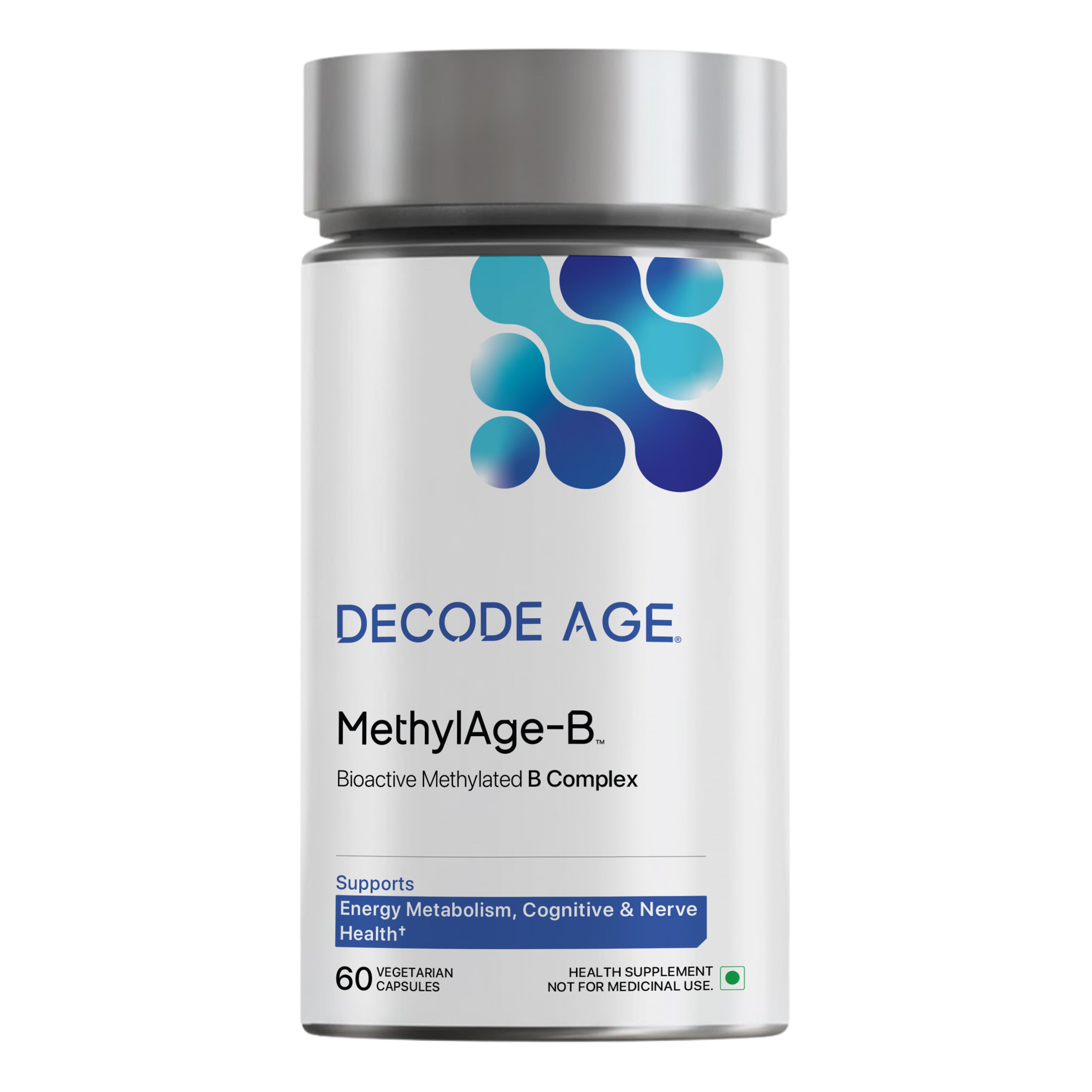
Understanding Decode Age MethylAge-B™
MethylAge-B™ shows what a bioactive B-complex can look like when it uses active vitamin forms along with helper nutrients. The label makes this easy to see in practice.
Why This Formulation Uses Active and Supportive Nutrients
Folate and B12 are the clearest examples. MethylAge-B™ uses L-5-MTHF (Quatrefolic®) instead of folic acid. That means it bypasses the MTHFR conversion step and supports DNA synthesis and homocysteine recycling [2][3][11]. For B12, the formula includes methylcobalamin, which supports the nervous system and myelin maintenance, and adenosylcobalamin, which supports a mitochondrial enzyme involved in energy metabolism [6][10].
The rest of the formula helps other linked metabolic steps. Benfotiamine is a lipid-soluble thiamine derivative that supports thiamine-dependent energy metabolism [6]. Riboflavin-5-phosphate is the active coenzyme form of riboflavin, so the body can use it for energy metabolism without an extra phosphorylation step [1][6]. Pantethine is an active derivative of vitamin B5 and a precursor to coenzyme A, which is required for fatty acid metabolism [6]. TMG (trimethylglycine) works as a direct methyl donor and gives the body another route to recycle homocysteine back into methionine [2][10]. CDP-choline supports neurotransmitter synthesis and membrane phospholipid remodelling [3][10][11].
The table below groups the ingredients by function, not by marketing claim.
| Nutrient | Role | Target System |
|---|---|---|
| L-5-MTHF (Quatrefolic®) | DNA synthesis and homocysteine recycling | Methylation |
| Methylcobalamin | Myelin maintenance and nerve support | Nervous System |
| Adenosylcobalamin | Cofactor for mitochondrial energy metabolism | Metabolism |
| Benfotiamine | Supports thiamine-dependent energy metabolism | Energy / Nervous System |
| Riboflavin-5-Phosphate | Active coenzyme form of B2 | Energy |
| Pantethine | Precursor to coenzyme A | Metabolism |
| TMG / CDP-Choline | Methyl donation and neurotransmitter support | Methylation / Brain Support |
Review the Full Label
For the exact formulation details, see the full label on the Decode Age MethylAge-B™ product page.
Which Type Should Indians Take and Why?
The honest answer is simple: it depends on your biology, diet, and nutrient status, not on which bottle looks more impressive.
So this choice isn’t just about labels. It’s about whether your body needs a form it can use more directly. In India, low B-vitamin status and high homocysteine are common enough that this decision deserves a bit more care. A regular B-complex can still help fill day-to-day gaps at a lower cost, but it may fall short when the main issue is poor conversion or weak absorption.
Methylated forms matter more when conversion is the bottleneck. MTHFR variants are seen in India, especially C677T in North Indians, so some people may convert folate less well [8]. Older adults, along with people taking metformin or PPIs for a long time, may also need to watch their B12 status more closely. Strict vegetarians and vegans should treat B12 as a must-have supplement, since plant foods do not reliably supply biologically active B12 [6].
If you’re not sure what you need, lab markers are a better guide than marketing language. Check serum B12, RBC folate, and homocysteine before deciding whether active forms are worth it.
FAQs
How do I know if I need a methylated B-complex?
Consider a methylated B-complex if you have documented MTHFR variants or homocysteine above 12 mcmol/L. It may also matter in cases of persistent folate or B12 deficiency, treatment-resistant depression, or recurrent pregnancy loss.
In India, B-vitamin shortfalls and gene polymorphisms are fairly common, so active forms can give the body a more direct path to use these nutrients at the cellular level. A healthcare professional can review blood markers such as homocysteine or red cell folate and help you decide if this approach makes sense.
Which blood tests should I check before choosing one?
Before you pick a regular or methylated B-complex, start with homocysteine. If it’s high, that can point to poor methylation or a functional deficiency, even when other test results look normal. Serum folate and vitamin B12 are also common markers, but they don’t always show how much of these nutrients is actually available inside cells.
If there’s a family history of cardiovascular disease or health problems that don’t have a clear cause, MTHFR genetic testing may be worth discussing as well. A healthcare professional can help you read those results in the right context and decide what makes sense for your needs.
Can I take a regular B-complex if I am vegetarian?
Yes. A regular B-complex can help if your diet is limited or you’re not getting enough from food. For vegetarians, the main watch-out is B12. It’s found mostly in animal-based foods, so the risk of deficiency is higher.
A standard B-complex works well for many people. The catch is that the body has to convert some of these vitamins into their active forms before it can use them well. If that conversion doesn’t happen smoothly, the benefit may be lower.
In some cases, a clinician may suggest methylated forms instead. This is more likely if you have trouble with absorption, issues with vitamin conversion, or high homocysteine levels.

Leave a comment
All comments are moderated before being published.
This site is protected by hCaptcha and the hCaptcha Privacy Policy and Terms of Service apply.