



India, despite its sunshine, faces a surprising challenge: vitamin D deficiency. Factors like indoor lifestyles, air pollution, and darker skin tones requiring longer sun exposure hinder natural vitamin D3 production. Adding to this is a lesser-known issue - vitamin K2 deficiency, as diets here often lack fermented foods and specific animal products rich in K2. Together, these deficiencies pose risks to bone health and heart health.
Vitamin D3 helps your body absorb calcium, but without K2 to guide it to bones, calcium may settle in arteries, causing the "calcium paradox" - weaker bones and hardened arteries. This article explains how D3 and K2 work together to ensure calcium strengthens bones while protecting arteries, offering practical insights for better health.
The key vitamin D3 K2 benefits go beyond bone strength. Together, these nutrients support calcium management, cardiovascular health, vitamin D absorption and everyday immune resilience, making them a practical combination for long-term wellness.
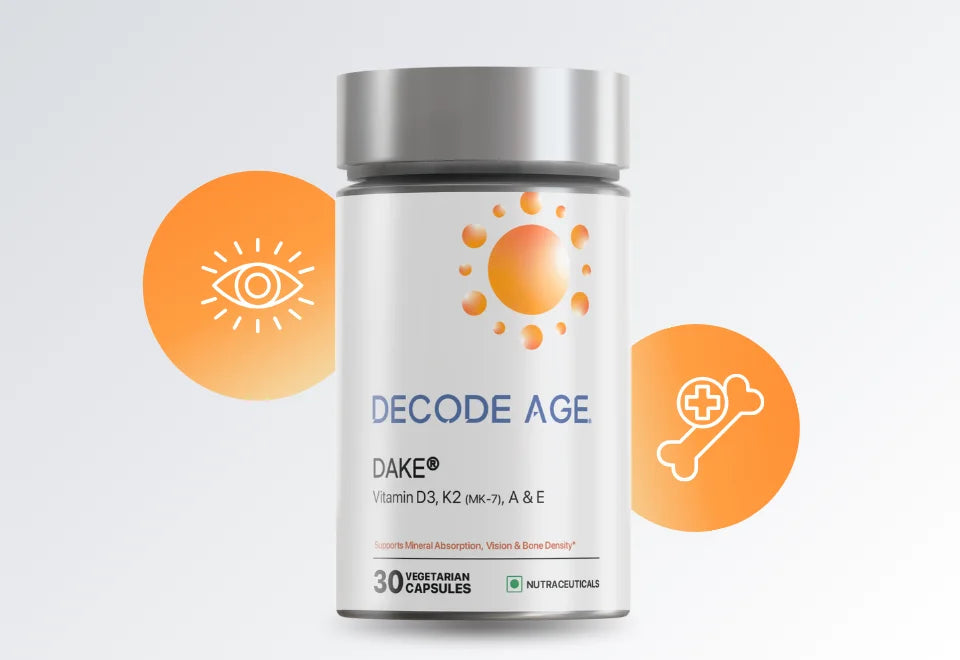
Introducing DAKE 5000 | A D3 and K2 Supplement for Complete Vitamin D Support
For those looking for a D3 and K2 supplement, DAKE 5000 brings together vitamin D3 and K2 to support calcium absorption, bone strength and heart health in one complete formula.
How Vitamin D3K2 Work Together
Vitamin D3 plays a key role in calcium absorption, boosting the production of transport proteins like TRPV6 and Calbindin-D9k in the gut, a process that can be monitored through a gut microbiome test. This increases active calcium uptake by 30–40% [3]. However, Vitamin K2 ensures that this absorbed calcium is properly utilised, activating two vital proteins - Osteocalcin, which helps integrate calcium into the bone matrix, and Matrix Gla Protein (MGP), which prevents calcium from settling in arteries and soft tissues [1][3]. Together, they form a seamless mechanism that supports both bone strength and cardiovascular health.
The process hinges on gamma-carboxylation, which is entirely dependent on K2. Without enough K2, both Osteocalcin and MGP remain inactive, leaving the calcium absorbed by D3 without a proper destination. Studies indicate that supplementing with D3 alone can raise Coronary Artery Calcium (CAC) scores by 10–15% in some individuals when K2 is deficient [3]. This highlights why addressing deficiencies in both nutrients is critical for long-term health.
"K2 acts as a traffic director for calcium. It ensures that the calcium D3 helps you absorb ends up where it should (bones and teeth) and stays away from where it should not be (arteries and soft tissue)." - Dr. Sushmitha A R [1]
In India, where D3 and K2 deficiencies are common due to dietary habits and limited sun exposure, supplementing D3 without K2 misses the opportunity to safeguard both bones and arteries.
The benefits of this synergy are supported by clinical evidence. The Rotterdam Study revealed that higher K2 intake was linked to a 50% reduction in arterial calcification and cardiovascular mortality over 7–10 years [4]. Additionally, postmenopausal women taking both D3 and K2 saw a 20–30% reduction in fracture risk [3]. These findings underscore how the partnership between these vitamins supports healthy bones and a resilient cardiovascular system, making it a vital approach for a population grappling with increasing rates of osteoporosis and heart disease.
1. Vitamin D3 Alone
Bone Health
Vitamin D3 is key to ensuring strong and healthy bones. It reduces the programmed death of osteoblasts (the cells responsible for bone formation) and promotes bone mineralisation by guiding calcium into the bone matrix effectively [8]. In a randomised study, participants taking a daily dose of 0.75 μg of 1α-hydroxyvitamin D3 experienced an increase in lumbar spine bone mineral density (BMD) over two years. In contrast, those on calcium lactate supplementation saw a decrease in BMD [6]. Poor bone health can lead to hip fractures, which are linked to a 15–20% higher mortality rate among older adults [7]. By strengthening bones, vitamin D3 supplementation helps lower the risk of such fractures.
Cardiovascular Health
Vitamin D3 also plays a role in cardiovascular health, though indirectly, by influencing calcium regulation. However, without enough vitamin K2, the calcium absorbed due to vitamin D3 can end up in the arteries, potentially leading to calcium buildup and increasing the risk of cardiovascular issues [2][8].
Calcium Management
One of vitamin D3's primary functions is maintaining calcium balance in the body. Working alongside parathyroid hormone, it enhances calcium absorption in the gut (which can be optimised by maintaining a healthy gut microbiome) and reabsorption in the kidneys, ensuring serum calcium levels remain within the healthy range of 4.4–5.4 mg/dL. When vitamin D3 levels are low, the body compensates by pulling calcium from bones, which weakens their structure over time [8].
Immunity
Vitamin D for immunity is important because it supports immune cell function and helps the body maintain a balanced immune response. Since vitamin D deficiency is common in India, maintaining healthy vitamin D levels may support everyday immune resilience, along with bone and muscle health. A D3 and K2 supplement can be especially useful when the goal is to support vitamin D absorption, calcium utilisation, and long-term wellness together.
Relevance to the Indian Population
Despite India's sunny climate, vitamin D deficiency is surprisingly common due to lifestyle choices and environmental factors. This makes longevity supplements a necessity for many. However, using vitamin D3 alone, without the addition of vitamin K2, can lead to improper calcium distribution, potentially affecting cardiovascular health [7][8]. Understanding the limitations of vitamin D3 on its own highlights the importance of pairing it with vitamin K2 for better overall health benefits.
2. Vitamin K2 Alone
Bone Health
Vitamin K2 plays a crucial role in bone health by activating a protein called Osteocalcin through a process known as gamma-carboxylation. This activation enables Osteocalcin to bind calcium to hydroxyapatite, a mineral that forms the structural framework of bones. Without adequate levels of K2, Osteocalcin remains inactive, resulting in calcium not being effectively integrated into the bone matrix.
Additionally, K2 supports bone health by protecting osteoblasts, the cells responsible for forming bone, from programmed cell death (apoptosis). It also reduces the activity of osteoclasts, the cells that break down bone tissue, by inhibiting the NF‑kB signalling pathway [9]. These combined actions help maintain bone density and contribute to long-term skeletal health.
Interestingly, the benefits of K2 extend beyond bones, as it also plays a protective role in cardiovascular health.
Cardiovascular Health
Vitamin K2 is essential for cardiovascular health due to its activation of Matrix Gla Protein (MGP), a powerful inhibitor of arterial calcification [2][8]. MGP prevents calcium–phosphate crystals from building up in the walls of arteries and stops vascular smooth muscle cells from transforming into osteoblast-like cells, which could otherwise lead to stiffening and reduced elasticity of the arteries.
Studies highlight the impact of K2 on heart health. For instance, a high intake of K2 has been associated with a 52% reduction in severe aortic calcification risk. Daily supplementation of around 25 µg of K2 has been linked to a 36% lower risk of coronary heart disease. Additionally, a large cohort study reported that K2 intake could reduce the risk of death from heart disease by 57% [2].
Calcium Management
Vitamin K2 ensures proper calcium management in the body by activating both Osteocalcin and MGP. This dual action directs calcium to the bones, where it is needed, and prevents its accumulation in the arteries, where it could cause harm. By addressing calcium deficiency in bones and preventing arterial calcification, K2 supports both skeletal and cardiovascular health simultaneously [2].
Relevance to the Indian Population
The importance of K2 becomes even more significant when considering Indian dietary habits. Foods rich in K2, such as natto (a fermented soy product from Japan) and certain animal-based products, are not commonly consumed in India [2]. While the gut microbiota can synthesise some amount of K2, the quantity produced is often insufficient to meet the body's needs. This gap is particularly concerning given the association between bone loss and vascular calcification. For example, aortic calcification has been linked to a 2.3-fold increase in the risk of femur fractures, highlighting the interconnected nature of bone and cardiovascular health.
Addressing the dietary gap in K2 intake is vital for improving public health outcomes in India. By supporting strong bones and a healthy heart, K2 complements the role of vitamin D3, which was discussed earlier in its connection to overall health. Together, these nutrients form a powerful duo in promoting long-term well-being.
sbb-itb-55c436e
3. Vitamin D3 + K2 Together
Bone Health
When combined, Vitamin D3 and K2 work together to significantly improve bone health. D3 enhances calcium absorption in the intestines by as much as 40% [4] - ensuring that more calcium enters the bloodstream. K2 then steps in to activate Osteocalcin, a protein that directs this calcium into the bone matrix where it is most needed.
Studies back this up with compelling data. K2 supplementation has been shown to reduce vertebral fractures by 60%, hip fractures by 77%, and nonvertebral fractures by 81% [5]. For postmenopausal women, a group particularly at risk for bone loss, combining D3 and K2 has resulted in a 1–2% annual improvement in bone mineral density and a 20–30% decrease in fracture risk [3].
Cardiovascular Health
While Vitamin D3 alone helps increase calcium levels, high doses without K2 can lead to calcium being deposited in places it shouldn't be, like the arteries. This can increase coronary artery calcification (CAC) scores by 10–15% in some individuals [3]. K2, however, activates Matrix Gla Protein (MGP), which prevents calcium from settling in arterial walls.
This protective role of K2 is well-documented. The Rotterdam Study, which tracked 4,807 participants over seven years, found that individuals with the highest intake of K2 had a 50% reduction in arterial calcification and cardiovascular mortality [4]. Additionally, daily supplementation with 180 mcg of MK-7 (a form of K2) reduced carotid-femoral pulse wave velocity by 6–8% and slowed coronary artery calcification progression by 12% over two years [3]. These findings highlight how K2 makes high-dose D3 supplementation safer for cardiovascular health.
Calcium Management
The synergy between D3 and K2 ensures calcium is not only absorbed efficiently but also directed to the right places. While D3 boosts calcium absorption, K2 ensures proper distribution by activating proteins like Osteocalcin for bone mineralisation and MGP to protect arteries. Without this balance, calcium supplements or high doses of D3 can lead to ectopic calcification, where calcium deposits form in soft tissues [1][3].
A commonly recommended ratio is 100 mcg of K2 (as MK-7) for every 1,000 to 2,000 IU of D3 [4]. MK-7 is particularly effective due to its longer half-life of about 72 hours, compared to just 6 hours for MK-4, allowing for consistent levels in the body with a single daily dose [3][4]. Since both vitamins are fat-soluble, taking them with meals containing healthy fats - like dal tadka with ghee or snacks with nuts - can improve absorption by 30–50% [4].
Relevance to the Indian Population
For India, where deficiencies in both Vitamin D3 and K2 are widespread, this pairing is especially critical. Supplementing D3 without K2 could exacerbate arterial calcification, a serious concern in a country already grappling with high rates of cardiovascular disease. The combined benefits of D3 and K2 address these nutritional gaps, offering a practical solution to improve overall health. This synergy is a key component in understanding how ageing can be slowed down through targeted nutrition.
Regular testing of Vitamin D levels every 6–12 months is advisable, with an optimal serum 25(OH)D level between 40–60 ng/mL [1]. However, individuals on blood-thinning medications like Warfarin should consult a doctor before adding K2 to their regimen, as it can interfere with the drug’s effects [1][3][4].
Pros and Cons

Vitamin D3 vs K2 vs D3+K2: Benefits Compared
Understanding the strengths and drawbacks of essential nutrients like Vitamin D3 and Vitamin K2 can help you make smarter choices when it comes to supplementation. Below is a clear comparison of their benefits and limitations, along with the advantages of combining the two.
| Feature | Vitamin D3 Alone | Vitamin K2 Alone | D3 + K2 Combined |
|---|---|---|---|
| Bone Health | Boosts calcium absorption by up to 40%, but may not ensure that calcium reaches bone tissue effectively [4]. | Activates Osteocalcin, aiding in anchoring calcium into the bone matrix [1]. | Lowers fracture risk by 20–30% and improves bone mineral density by 1–2% annually [3]. |
| Cardiovascular Health | High doses could increase coronary artery calcification (CAC) scores by 10–15% without K2 [3]. | Activates MGP, helping to prevent arterial calcification and reduce vascular stiffness [3]. | Safeguards arteries by directing calcium away from vessel walls, linked to a 50% reduction in cardiovascular mortality [4]. |
| Calcium Management | Enhances calcium absorption in the intestines but lacks the ability to guide it to bones [1]. | Directs calcium to bones and teeth, preventing deposits in soft tissues [3]. | Balances both absorption and distribution, reducing the risk of ectopic calcification [1][4]. |
| Main Limitation | May lead to calcium deposits in soft tissues at higher doses [3]. | Does not increase calcium absorption from the gut [1]. | Needs careful monitoring if taken with blood thinners like Warfarin [4]. |
This table highlights the complementary roles of Vitamin D3 and K2. While D3 enhances calcium absorption, K2 ensures it is deposited in the right places, making their combination more effective for overall health than taking either nutrient alone.
Important Considerations
While Vitamin D3 toxicity is rare, it can occur at doses exceeding 10,000 IU daily. On the other hand, Vitamin K2 toxicity is extremely uncommon [1][4]. However, combining these vitamins does come with a few precautions:
- Blood Thinner Interactions: If you're on medications like Warfarin, even small doses of K2 (as low as 50 mcg) can influence INR levels. Always consult your doctor before adding K2 to your routine [5].
- Chronic Kidney Disease: Those with impaired kidney function should be cautious, as their bodies may struggle to regulate calcium and Vitamin D metabolism, increasing the risk of hypercalcaemia [1].
- Monitoring D3 Levels: For individuals taking higher doses of Vitamin D3, regular monitoring of serum 25(OH)D levels every 6–12 months is recommended. Aim for an optimal range of 40–60 ng/mL to stay within safe limits [3][4].
Conclusion
Research clearly highlights that Vitamin D3 and K2 complement each other perfectly. While D3 boosts calcium absorption from the gut by 30–40%, it’s K2 that ensures this calcium is properly directed to bones and not deposited in arteries.
For Indian adults, this combination is especially important. Factors like darker skin tones, limited sun exposure due to indoor lifestyles, air pollution, and diets lacking fermented foods contribute to widespread deficiencies of both nutrients. This creates a dual problem: weakened bones due to calcium deficiency and increased cardiovascular risks from calcium buildup in arteries. The D3 + K2 pairing directly addresses these issues.
When choosing a D3 and K2 supplement, opt for Vitamin D3 as cholecalciferol and Vitamin K2 as MK-7 (menaquinone-7), as this pairing supports vitamin D absorption, calcium utilisation and long-term bone and heart health. MK-7 stands out for its longer half-life of approximately 72 hours, making it more effective than MK-4. A typical recommendation is 1,000 IU of Vitamin D3 paired with 100 mcg of Vitamin K2, taken with your largest meal to maximise absorption. Regular monitoring of serum 25(OH)D levels is also advised to ensure levels remain within the optimal range. This personalised approach underscores the importance of evidence-based supplementation for maintaining bone strength and cardiovascular health over the long term.
It’s worth noting that individual factors like BMI, age, existing deficiencies, and metabolic health significantly influence how your body utilises D3 and K2. Services like Decode Age can provide biomarker-based insights and tailored solutions to create a supplementation plan that aligns with your unique biological needs. This personalised strategy is particularly valuable in India, where these deficiencies are both common and often overlooked.
FAQs
Do I really need K2 if I’m already taking vitamin D3?
Yes, pairing Vitamin K2 with Vitamin D3 offers notable benefits for both heart health and strong bones. Vitamin D3 helps your body absorb calcium effectively, while Vitamin K2 ensures that this calcium is directed to your bones where it’s needed, rather than accumulating in your arteries. Without sufficient Vitamin K2, excessive calcium can lead to arterial calcification, which may pose cardiovascular risks. Studies suggest that using these two vitamins together enhances their effectiveness, promoting better long-term health. Decode Age highlights the importance of this combination for maintaining overall wellness and cellular health.
Which K2 form is better with D3 (MK-7 or MK-4)?
When paired with vitamin D3, MK-7 is frequently chosen over MK-4 because of its extended half-life, lasting up to 96 hours compared to MK-4's 8–24 hours. This longer duration ensures stable tissue levels with just a single daily dose. Furthermore, MK-7 is effective at lower doses for activating crucial bone proteins such as osteocalcin, making it a convenient option for promoting both bone and heart health.
Who should avoid vitamin K2 (e.g., people on blood thinners)?
People taking blood-thinning medications, such as warfarin, need to exercise care with vitamin K2. This vitamin can interfere with the effectiveness of these drugs, potentially leading to changes in blood clotting levels. If you're on warfarin, it’s crucial to keep your daily intake of vitamin K - whether from food or supplements - consistent. Before adding any new supplements to your routine, always consult your doctor or pharmacist to confirm they won’t conflict with your prescribed medications.




Leave a comment
All comments are moderated before being published.
This site is protected by hCaptcha and the hCaptcha Privacy Policy and Terms of Service apply.