



Quercetin and vitamin C are often paired in immune and antioxidant supplements. It is an intuitive combination: quercetin is a plant flavonoid with antioxidant activity, while vitamin C contributes to normal immune function and the protection of cells from oxidative stress.
There is also a plausible scientific reason to take them together. Vitamin C may help recycle oxidised quercetin, while quercetin may help protect vitamin C from oxidation. However, a promising mechanism is not the same as a proven result. Human studies have not yet shown that the combination delivers a clear, meaningful benefit beyond either ingredient alone.
For most healthy adults, the two can generally be taken together at standard oral doses, preferably with food if supplements tend to upset the stomach. The important caveat is medication use: people taking prescription medicines, or those who are pregnant or breastfeeding, should check with a healthcare professional first.
This article explains what each ingredient does, what the evidence on their pairing actually shows, and how to use them responsibly without overstating the science.
How Quercetin and Vitamin C Work
Quercetin as a Plant Flavonoid
Quercetin is a plant pigment and a flavonol found in red onions, apples, kale, capers and berries [3]. In plants, it helps deal with stress. In the human body, it acts as an antioxidant by scavenging free radicals [1][3].
There’s a catch, though. Quercetin has low oral bioavailability [1][3]. Put simply, the body doesn’t absorb it well, and after oral intake it is metabolised quite fast [1][3].
Vitamin C and Normal Immune Function
Vitamin C is a water-soluble, electron-donating antioxidant with two well-established roles: it contributes to normal immune function and to the protection of cells from oxidative stress [3]. It helps support the production and activity of white blood cells, and it also helps maintain the linings of the gut and airways [1][2].
At moderate doses, vitamin C is absorbed well. But as intake goes up, absorption drops [5].
Vitamin C does not work in the same way as quercetin. Even so, people often discuss the two together because both are linked to antioxidant activity.
Possible Complementary Mechanisms
The main proposed link between quercetin and vitamin C is antioxidant recycling.
When quercetin neutralises a free radical, it becomes oxidised. Vitamin C may donate electrons and help restore quercetin to its active antioxidant form [1][2]. There is also some suggestion that quercetin may help protect vitamin C from oxidation [2]. That sounds neat on paper, and lab work supports the idea.
So the key issue isn’t whether the mechanism can happen. It’s whether that mechanism leads to clear effects in human studies.
sbb-itb-55c436e
What the Human Evidence Shows
Studies on Quercetin with Vitamin C
Human trials on quercetin and vitamin C used together are still limited. In one small randomised trial in healthy men, the combination led to slightly lower CRP and IL-6 than either ingredient on its own. Even so, the researchers said the effect was small [1].
A 2025 randomised trial also looked at vitamin C with bioflavonoids. It found that 1 g vitamin C plus 50 mg bioflavonoids lowered platelet reactivity, but not by a meaningful margin beyond vitamin C alone [4].
So the main issue is less about hype and more about formulation. On paper, a pairing may sound promising. In people, the outcome can be much more modest.
What We Know About Each Ingredient Alone
Vitamin C has authorised health claims for contributing to normal immune function and helping protect cells from oxidative stress [3]. That part is on firmer ground.
Quercetin is a bit more mixed. In a randomised controlled trial with about 1,000 participants, 1,000 mg per day did not significantly cut upper respiratory tract infection rates in the general population. There was, however, a healthier subgroup aged 40 and older that reported fewer illness days [3].
That split matters. It suggests the effect may depend on who is taking it, rather than showing a clear result across the board.
What the Evidence Does Not Prove
Current research does not support claims that quercetin and vitamin C together can prevent or treat infections. It also does not show, in any clear way, that the pair works better than either ingredient alone [1][3].
Even lab work adds a note of caution. Some studies show that the combined antioxidant activity can end up lower than expected, depending on the concentration and ratio used [6]. In plain terms, putting two well-known compounds together does not always mean you get more from the mix.
That is why the next section explains how QuerceVit combines these ingredients with bromelain.
Why QuerceVit Combines Quercetin, Vitamin C and Bromelain
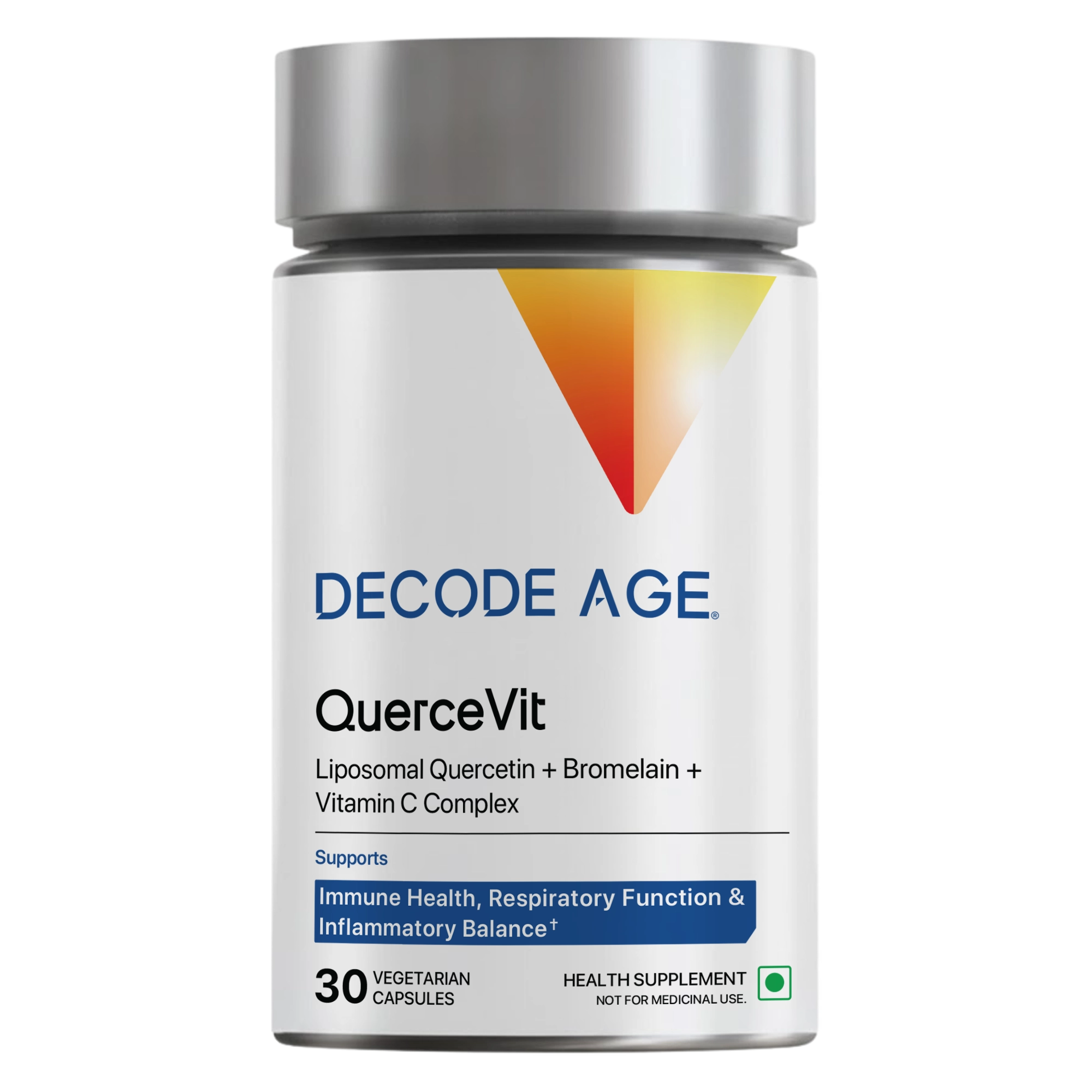
QuerceVit combines quercetin, vitamin C and bromelain to deal with one stubborn issue: quercetin doesn’t absorb well on its own. The formula is built as a practical way to support quercetin uptake while also giving antioxidant and immune support [1][3].
The Role of Quercetin and Vitamin C in the Formula
Direct human data on this exact pairing is still limited, so QuerceVit is best seen as a sensible formulation rather than a proven fix-all. In this mix, vitamin C helps support normal immune function, while quercetin adds antioxidant support [2][3].
That pairing also makes sense from a day-to-day use point of view. One ingredient is widely known for immune support, and the other is often used for its antioxidant role. Put them together, and the formula feels less like a random stack and more like a targeted blend.
Why Bromelain Is Included
Bromelain is included mainly because quercetin is poorly absorbed when taken alone. It’s a pineapple-derived enzyme often added to quercetin formulas with the idea that it may help with absorption, while also serving as an extra functional ingredient in the blend [1][3].
Studied Doses and Timing
Since direct studies on taking quercetin and vitamin C together are still limited, the best starting point is the dose range used in human research. Studies have used 250–500 mg of quercetin once or twice daily and 200–500 mg of vitamin C once or twice daily [3]. In some cases, researchers have used 500–1,000 mg per day of each [2]. These are research-based ranges, not a one-size-fits-all recommendation.
A simple way to take them is with meals. Quercetin is often taken with a meal that contains some fat, which may help with uptake. Vitamin C is commonly taken at the same time, mainly because it’s easy to stick to and tends to feel gentler on the stomach that way. If you’re using higher daily amounts, splitting the dose across two meals can make things easier.
One practical point matters here: vitamin C absorbs well at lower doses, but that absorption drops as intake goes above 1,000 mg [5].
Once dosage and timing are sorted, safety becomes the next thing to look at.
Safety and Medication Interactions
Dose is only one part of the story. Interactions with medicines can matter just as much, and in some cases, more. Here’s a quick look at the main points:
| Category | Specific Concern |
|---|---|
| Blood thinners | Quercetin may enhance the effect of anticoagulants such as warfarin [1][3] |
| Antibiotics | May interact with fluoroquinolone antibiotics such as ciprofloxacin [3][2] |
| Heart and BP medicines | May interact with some statins, calcium-channel blockers and blood-pressure medicines [1][3][2] |
| Kidney health | High vitamin C intake above 1,000 mg may raise oxalate kidney-stone risk in susceptible individuals [1][3] |
| Iron overload | Vitamin C increases the absorption of dietary iron, so caution is advised for people with iron-overload conditions [3] |
| Other medicines | Immunosuppressants, chemotherapy and diabetes medications need medical review [1][2] |
If you are pregnant, breastfeeding, or taking any long-term prescription medicine, speak with a healthcare provider before adding either supplement. And if they upset your stomach, don’t push through it on an empty stomach; take them with a larger meal instead [2].
Conclusion
Quercetin and vitamin C are generally taken together at standard oral doses, and for most people, that’s considered fine. The science does suggest a possible link between the two: vitamin C may help recycle oxidised quercetin back into its active form. Still, the big point is this: human data showing extra, clear-cut benefit from taking them together is still limited [1][3]. The mechanism looks interesting on paper, but whether it leads to results people can actually feel or measure is not fully settled yet [1][2][4].
For day-to-day use, it’s best to take them with food. If your stomach tends to act up with supplements, splitting higher doses across the day may be easier to tolerate [2][3]. That small step can make a difference, especially for people who get acidity, nausea, or general stomach discomfort.
A bit of caution matters here. If you take prescription medicines, especially anticoagulants, statins, immunosuppressants, calcium-channel blockers, chemotherapy, or fluoroquinolone antibiotics, talk to a healthcare professional before adding either supplement [1][3]. The same goes for pregnant or breastfeeding women, and anyone using long-term medication [1][3]. Supplements may look harmless on the shelf, but interactions are where things can get tricky.
It’s also worth being careful with the way this pairing is framed. Quercetin and vitamin C should not be pitched as a treatment for infections or as some guaranteed immune shield [1][3]. That kind of claim runs ahead of the evidence.
If you’d rather not piece the stack together yourself, QuerceVit offers a simple formula that combines quercetin, vitamin C, and bromelain. For a closer look at the formula and the science behind it, see below.
FAQs
Can I take quercetin and vitamin C every day?
Yes. You can usually take quercetin and vitamin C together every day. The combo makes sense from a biology point of view, but strong human proof for added benefits is still limited.
In one 8-week randomised, double-blind trial in male athletes, researchers used 500 mg/day of quercetin plus 200 mg/day of vitamin C. The study found some improvement in LDL markers, and there were no major safety concerns reported.
A simple way to take it is with food, since that may help with tolerance. It’s also smart to be careful if you use medicines, because quercetin can affect how the body handles some drugs.
How long does quercetin take to work?
Yes, quercetin and vitamin C can be taken together. In most cases, this is a compatible, low-risk pairing that people often use for immune and respiratory support.
Vitamin C may help recycle oxidised quercetin, although human research showing clear clinical synergy is still limited. For better absorption, take quercetin with a meal that includes some fat. If you use medicines such as anticoagulants, statins, immunosuppressants or chemotherapy, speak with your doctor first.
Who should avoid quercetin with vitamin C?
Quercetin and vitamin C are usually seen as a compatible, low-risk pair for antioxidant and immune support.
That said, if you take certain medicines, especially anticoagulants, statins or chemotherapy, it’s best to speak with your doctor before using them together. Quercetin is often taken with a meal that contains some fat, since that may help with bioavailability, and vitamin C can be taken at the same time.


Leave a comment
All comments are moderated before being published.
This site is protected by hCaptcha and the hCaptcha Privacy Policy and Terms of Service apply.