



A 2025 trial of 122 women aged 40 and above tested oral and topical trans-resveratrol over eight weeks. A 1.5% topical formula showed promise for pigmentation, while neither route showed clear improvements in hydration or elasticity.[1]
My main takeaway: a cream’s results do not establish what a capsule can do. Studies that combine resveratrol with other ingredients also cannot tell us how much it contributes.
Here, we review five proposed skin effects, separate lab findings from human results, and explain what to consider before choosing a product.
|
Skin Benefit |
Proposed Mechanism |
Human Clinical Evidence |
Limitations |
|---|---|---|---|
|
Antioxidant Defences |
Neutralises some reactive oxygen species and influences Nrf2 antioxidant signalling and NF-κB inflammatory pathways. |
Topical studies suggest antioxidant activity in the skin. |
Visible skin benefits remain unproven. Oral blend studies cannot isolate resveratrol's effects. |
|
Ageing-Related Skin Appearance |
Antioxidant and anti-inflammatory pathways may support skin appearance. |
A 2012 oral blend study reported improvements in hydration, elasticity, roughness and wrinkle depth. A 2014 topical blend study reported improvements in fine lines, firmness, elasticity and radiance. |
Both studies used multiple ingredients. Resveratrol's individual contribution is unclear. No evidence of age reversal or wrinkle removal. |
|
Skin Elasticity |
Preclinical research suggests effects on collagen and elastin breakdown through SIRT1, SIRT6 and matrix metalloproteinases. |
Earlier blend studies reported improvements. However, a 2025 trial found no statistically significant improvement with oral, topical or combined resveratrol. |
Evidence is mixed. Improved elasticity does not necessarily indicate increased collagen production. |
|
Skin Hydration |
May influence skin lipids, keratinocyte maturation and barrier proteins such as filaggrin and loricrin. |
A 2012 study involving 50 participants reported improved skin moisture after 60 days of an oral blend containing 8 mg resveratrol. A 2025 trial found no statistically significant improvement in hydration. |
The earlier study used additional ingredients. Increased sebum does not establish improved hydration or skin barrier repair. |
|
Even Skin Tone |
Cell studies suggest effects on melanin production through tyrosinase, MITF and ERK signalling. |
A 2025 trial found that 1.5% topical trans-resveratrol significantly reduced pigmentation scores after eight weeks. Oral resveratrol showed no statistically significant pigmentation benefit. |
Topical findings are promising but preliminary. Studies remain small and short, and results cannot be generalised to oral supplementation. |
How Resveratrol Works in the Skin
Resveratrol is a phytoalexin: a defence compound that plants produce in response to stress.[1][2]
Skin faces constant oxidative stress. This happens when reactive oxygen species overwhelm its antioxidant defences, potentially damaging lipids, proteins and DNA. Sun exposure and pollution can add to this stress.[1][3]
In laboratory studies, resveratrol can neutralise some reactive oxygen species and influence Nrf2, a pathway that switches on antioxidant defences, including enzymes such as superoxide dismutase and catalase. It also affects NF-κB, a pathway involved in inflammatory signalling, and may reduce signals that promote inflammation. These findings come mainly from cell, tissue and animal studies; they do not prove visible skin benefits in humans.[1][2][3]
Oral resveratrol has low bioavailability because the gut and liver break it down quickly. Topical formulations deliver it directly to the skin, but their effects also depend on the formula. Neither delivery route guarantees that laboratory findings will translate into effects on human skin.[1][2][3]
Researchers study these actions in relation to antioxidant defence, ageing and skin tone. Of these claims, resveratrol’s antioxidant effect is the best studied.
sbb-itb-55c436e
1. Supporting Skin Antioxidant Defences
Antioxidant support is the most studied claim about resveratrol for skin. Topical studies suggest it acts directly as an antioxidant in the skin. One small oral study also reported better moisture, elasticity and wrinkle depth after participants took a capsule containing resveratrol, grape extracts and pomegranate extracts.[1][2] However, these findings cannot show whether resveratrol alone produced those changes.
In skin cells, resveratrol may reduce oxidative stress and support antioxidant defences.[2][3]
Results from topical use depend on how well resveratrol penetrates the skin and how stable it remains. It can also degrade under UV exposure.[3] Antioxidant support is plausible, but visible skin benefits are not proven. Human evidence for the next benefit is even less consistent.
2. Supporting Skin Appearance as We Age
Proposed Mechanism
Resveratrol has been studied for its potential to modestly improve visible signs of skin ageing, including roughness, fine lines and elasticity. The pathways discussed earlier may help explain these possible effects.[1][2]
Human Findings
A small randomised study in 2012 found that a daily capsule containing trans-resveratrol and grape and pomegranate compounds improved skin hydration, elasticity, roughness and wrinkle depth compared with placebo.[1]
A 2014 study tested a topical blend of trans-resveratrol, baicalin and vitamin E. It reported improvements in fine lines, firmness, elasticity, radiance and roughness.[1]
The results offer some promise, but differences in how the blends were delivered and their added ingredients make resveratrol’s effect hard to separate.
Exposure Route, Formulation and Study Limits
Both studies tested blends, rather than resveratrol alone, so its individual contribution remains unclear.[2][3]
Confidence in the Findings
These small, short studies suggest modest cosmetic changes - not age reversal or wrinkle removal.[3]
The next benefit is elasticity, where the evidence is less consistent.
3. Supporting Skin Elasticity
Proposed Mechanism
The extracellular matrix forms the skin’s supporting framework. Collagen gives skin strength, while elastin helps it spring back. Preclinical studies suggest that resveratrol may slow collagen and elastin breakdown by acting on collagenase, elastase, SIRT1, SIRT6 and matrix metalloproteinases.[2][3] These findings do not show that resveratrol increases collagen in human skin.
Human Findings
Some small, older studies of resveratrol-containing blends reported better skin elasticity, but findings vary. A 2025 trial involving 122 healthy women aged 40 and above found no statistically significant improvement in elasticity after eight weeks with oral trans-resveratrol supplement, topical trans-resveratrol or both, compared with placebo.[1]
Exposure Route, Formulation and Study Limits
Blends make it hard to separate resveratrol’s effects from those of other ingredients. Short follow-up periods leave longer-term effects uncertain. Also, elasticity tests measure how skin behaves - not how much collagen it produces.[1][2]
Confidence in the Findings
Human evidence remains mixed. For those considering supplementation, it is important to follow trans-resveratrol dosage guidelines to ensure safety and efficacy. Hydration is the next measure to examine when assessing resveratrol’s effects on skin.
4. Supporting Skin Hydration: Mixed Findings
Proposed Mechanism
The stratum corneum helps skin retain moisture by limiting water loss. Keratinocyte differentiation - the process through which these cells mature - also helps maintain the skin barrier. Resveratrol may support hydration by influencing skin lipid production and keratinocyte maturation. Preclinical studies link it to barrier proteins such as filaggrin and loricrin, but these findings do not prove better hydration in humans.[1][3]
Human Findings
Human studies show mixed results. In a 2012 placebo-controlled study, 50 healthy participants took an oral blend containing 8 mg of resveratrol, along with pomegranate and grape extracts, for 60 days. Skin moisture improved, but the effect cannot be attributed to resveratrol alone.[1]
In contrast, a 2025 double-blind, randomised, placebo-controlled trial involving 122 participants found no statistically significant improvement in skin moisture after eight weeks. The treatments tested were 75 mg of oral trans-resveratrol, 1.5% topical trans-resveratrol, or both combined. Topical treatment increased sebum, but this did not improve measured skin moisture.[1]
Exposure Route, Formulation and Study Limits
Higher hydration readings do not prove barrier repair. These readings measure skin moisture, not whether the barrier has been restored.[1][2]
Confidence in the Findings
The evidence for hydration remains mixed. The next section looks at skin tone, where topical findings are more relevant.
5. Supporting Even Skin Tone: Mainly Topical Findings
Proposed Mechanism
Lab studies suggest resveratrol may reduce melanin production by affecting tyrosinase and MITF through the ERK pathway. These findings come from cells, not human studies.[3]
Human Findings
A 2025 randomised controlled trial involving 122 women found that 1.5% topical trans-resveratrol reduced pigmentation scores after eight weeks compared with placebo. The difference was statistically significant. Oral trans-resveratrol at 75 mg alone did not show a statistically significant effect on pigmentation.[1]
Exposure Route, Formulation and Study Limits
Smaller studies of topical resveratrol derivatives also reported lower pigmentation scores. However, these studies were short, involved few participants and tested compounds that differ from the oral trans-resveratrol used in supplements.[3]
Confidence in the Findings
The topical findings are promising but preliminary. Oral trans-resveratrol has not shown the same effect on pigmentation, making the delivery route the next question to examine.[1][3]
Oral and Topical Resveratrol: Why the Route Matters
Mixed findings on hydration, elasticity and pigmentation put the delivery route in focus. How resveratrol is delivered changes exposure, so oral and topical results need to be assessed separately.[2][3]
| Route | What is studied | Relevant evidence | Main limitation |
|---|---|---|---|
| Oral | Absorption and metabolism | In a 2025 human trial, taking 75 mg twice daily increased blood levels of resveratrol metabolites at 4 and 8 weeks.[1] | Extensive metabolism in the gut and liver leaves little unchanged resveratrol in circulation. Higher metabolite levels do not prove skin benefits.[2][3] |
| Topical | Local concentration, stability and skin penetration | A 1.5% trans-resveratrol cream applied twice daily significantly increased cheek-area sebum levels after 8 weeks.[1] | UV exposure can change trans-resveratrol into the cis isomer.[3] |
| Oral plus topical | Combined effects on skin appearance | In the eight-week trial, the combined group had the largest drop in wrinkle scores.[1] | This does not show that capsules alone produce the same effect. |
Human skin studies remain small and short, and often test blends containing other ingredients. That makes it difficult to pin down resveratrol’s role in the results.[1][2]
Seek medical advice before taking supplements if you are pregnant, breastfeeding, scheduled for surgery, or taking blood-thinning medicines or medicines that affect drug metabolism.[2]
The next issue is why supplement formulas usually use trans-resveratrol.
Why Supplements Use Trans-Resveratrol
Resveratrol has two isomeric forms, cis and trans: both contain the same atoms, but those atoms are arranged differently. Trans-resveratrol is the form most often used in research and supplements.[1][3]
UV light can convert trans-resveratrol into the cis form. Supplement formulations therefore often aim to protect the trans form from this change.[3]
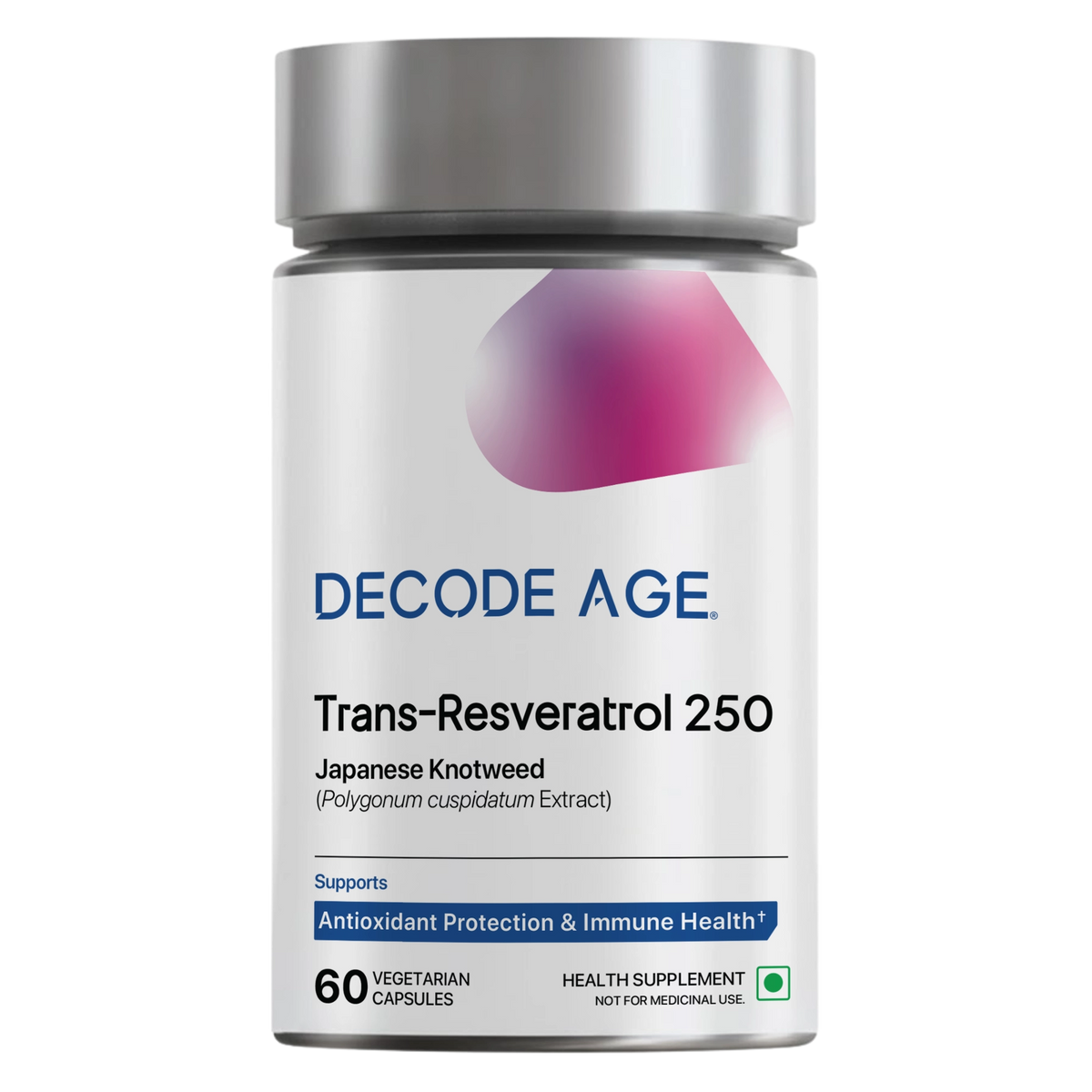
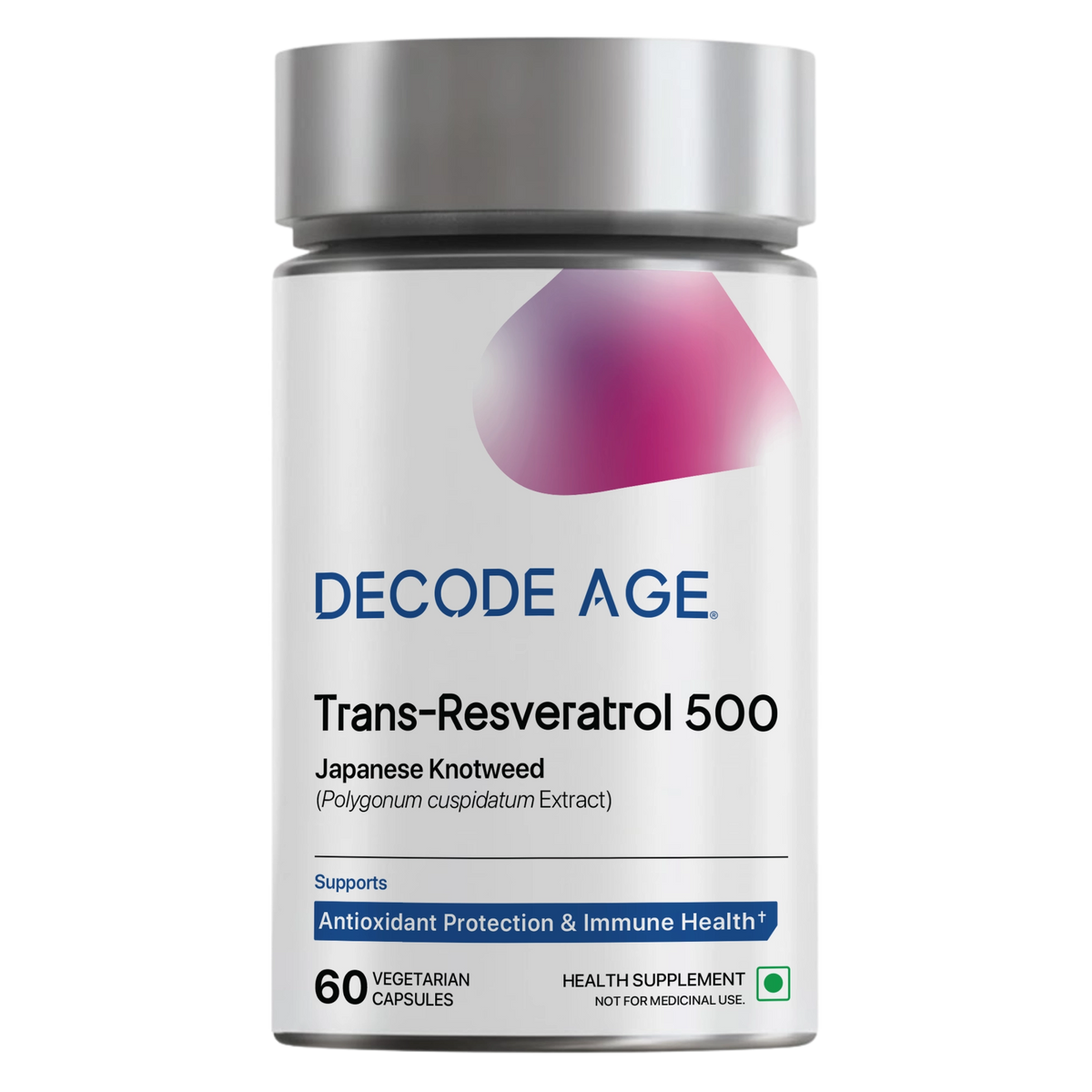
Decode Age’s Trans-Resveratrol is available in 250 mg and 500 mg strengths and is sourced from Japanese knotweed (Polygonum cuspidatum).[2] These are common supplement strengths, but researchers have not established an oral dose that works for skin health. The presence of trans-resveratrol alone does not prove that a supplement offers skin benefits.
Skin Benefits Are Not Yet Proven
While the anti-ageing benefits of resveratrol are well-documented for general health, skin-specific effects remain unproven in humans. Studies are small and short, results for elasticity and hydration are mixed, and combination formulas make it hard to separate resveratrol’s effects from those of other ingredients.[1][2]
FAQs
How do I choose a resveratrol skincare product?
Trans-resveratrol is the biologically active form preferred in formulations. Research on its effects on skin is still developing. Some studies suggest improvements in elasticity, moisture, roughness and pigmentation, but results vary.
Evidence for topical skincare and oral supplements should be assessed separately - findings from one cannot be assumed to apply to the other. Larger, long-term human trials are needed to confirm resveratrol’s skin benefits.
Can resveratrol irritate sensitive skin?
The evidence discussed here does not show whether resveratrol irritates sensitive skin. As an antioxidant, resveratrol helps reduce oxidative stress and inflammatory signalling in the skin [1][2][3].
Human studies on its skin benefits remain limited, with results that sometimes differ. Oral and topical resveratrol have different exposure routes, so findings from one should not be assumed to apply to the other [1][5].
Can I use resveratrol with other skincare ingredients?
The evidence described here does not show whether resveratrol can be used alongside other skincare ingredients. Human evidence for skin benefits is strongest for topical use or combined oral and topical use, rather than oral use alone.
In an 8-week trial involving women over 40, wrinkle scores improved mainly with combined use. Topical trans-resveratrol increased sebum (skin oil), while other measures showed no statistically significant differences [1][2].

Leave a comment
All comments are moderated before being published.
This site is protected by hCaptcha and the hCaptcha Privacy Policy and Terms of Service apply.