



- Studied dose: usually 20 mg/day
- Study length: mostly 6 to 12 weeks
- Best-supported area: mitochondrial signalling and physical function
- Less certain area: memory, focus, and mood
What Is PQQ?
Pyrroloquinoline quinone (PQQ) is a natural compound found in soil and in small amounts in many foods. You may also see its older name, methoxatin.
Discovery and Biological Role
PQQ is an o-quinone first found as a cofactor in bacterial enzymes. Since then, researchers have looked at it closely for its link with cellular energy metabolism and mitochondrial signalling [2].
In the body, PQQ works as a cofactor for enzymes such as mammalian lactate dehydrogenase. This matters because that enzyme helps convert NADH to NAD⁺ and supports the production of pyruvate. Both of these steps are tied to how cells make and use energy [2]. That’s one big reason PQQ often comes up in discussions around cellular energy and mitochondrial health.
Natural Food Sources of PQQ
PQQ is present in trace amounts in foods such as nattō, spinach, green tea, kiwi, parsley, carrots, dark chocolate, and tomatoes [2].
Among these, nattō appears to be the richest known food source, with about 61 ng/g. Most other food sources tend to fall between 3.7 and 50 ng/g [2].
Here’s a quick look:
| Food source | Approximate PQQ content |
|---|---|
| Nattō | 61 ng/g |
| Spinach, green tea, kiwi, parsley, carrots, dark chocolate, tomatoes | 3.7 to 50 ng/g |
| Estimated daily intake from food | 0.1 mg to 2 mg |
Even with a healthy diet, intake stays low. Average daily intake from food is estimated at only 0.1 mg to 2 mg [2]. By comparison, clinical studies have often used doses of around 20 mg per day [2].
Why PQQ Is Classified as a Redox Compound
What sets PQQ apart is its redox-active structure. In plain terms, it can move between oxidised and reduced states without being used up in the process [2]. It is also quite stable, since it does not easily polymerise or auto-oxidise [2].
That means PQQ can take part in oxidation-reduction reactions again and again. This repeated redox cycling may help limit oxidative stress [2].
These chemical traits matter because mitochondria are the cell’s main energy engines.
sbb-itb-55c436e
Why Mitochondria Matter for Energy and Healthy Ageing
To see why PQQ gets so much attention, it helps to start with mitochondria. These tiny parts inside cells produce energy, and their function tends to drop with age. PQQ is being studied because it may help in two ways: it may help shield mitochondria from damage, and it may help the body form new mitochondria. In simple terms, PQQ is being looked at for its possible role in keeping the cell’s energy system in better shape.
Mitochondria, ATP, and Cellular Energy
This redox activity matters because mitochondria are the main site of cellular energy production. They turn nutrients into ATP, which cells use for almost every job they perform [1][2]. From muscle movement to cell repair, ATP is the fuel that keeps things running.
Mitochondria also help regulate fat metabolism. So when mitochondrial function drops, the effect is not limited to energy alone. It can also disturb the body’s broader energy balance and how well it uses fuel day to day [2].
What Happens to Mitochondria as You Age
As mitochondria age, they tend to produce more ROS. That adds to oxidative stress and can lower energy output [2]. It’s a bit of a nasty loop: damaged mitochondria make more ROS, and that extra ROS can drive even more damage.
Over time, this decline has been linked with lower stamina, slower recovery, and weaker cognitive performance [1][2]. That helps explain why mitochondrial health comes up so often in talks around ageing, fatigue, and brain function.
Mitochondrial Biogenesis vs Mitochondrial Protection
When researchers discuss mitochondrial health, they usually mean one of two separate processes.
Mitochondrial biogenesis is the making of new mitochondria inside a cell. This process is regulated mainly by a protein called PGC-1α, often referred to as the "master regulator" of mitochondrial growth [2][3].
Mitochondrial protection focuses on keeping the mitochondria you already have in good working order. That includes neutralising ROS, helping preserve mitochondrial DNA, and maintaining membrane stability [2].
PQQ is being studied for both of these roles, though human evidence is still limited [1][2]. The next section looks at how PQQ may work on these pathways at the cellular level.
| Feature | Mitochondrial Biogenesis | Mitochondrial Protection |
|---|---|---|
| Primary Goal | Create new mitochondria | Defend existing mitochondria |
| PQQ Mechanism | Activates PGC-1α and CREB pathways | Scavenges ROS, prevents membrane depolarisation |
| Impact on Energy | Increases total capacity for ATP production | Maintains efficiency of current ATP production |
| Ageing Context | Addresses age-related decline in mitochondrial number | Reduces oxidative wear and tear on cells |
How a PQQ Supplement Works
PQQ works through a few cell-level pathways tied to mitochondrial health. In simple terms, it seems to affect how mitochondria are made, protected, and kept working well. That matters because, as biological age increases, mitochondria tend to make less energy and more oxidative stress. Most of what we know so far comes from lab and animal work, while human research is still growing and remains limited.
PQQ and Mitochondrial Biogenesis
One of the main areas of interest is mitochondrial biogenesis, which means the formation of new mitochondria. PQQ may affect PGC-1α signalling, a pathway involved in regulating mitochondrial growth. If that happens, a cell may end up with greater mitochondrial capacity.
In one small human study, taking 20 mg/day of PQQ for six weeks increased skeletal muscle PGC-1α compared with placebo [3]. That said, aerobic performance did not differ between the groups. So, while PQQ may affect mitochondrial signaling, that does not always mean a person will notice an immediate change in exercise output.
PQQ may also support mitochondrial function in another way: by lowering oxidative stress and helping mitochondria stay resilient under strain.
PQQ, Oxidative Stress, and Cellular Resilience
PQQ is a redox-active compound, which means it can transfer electrons and keep doing so without being used up too fast. Lab studies suggest PQQ has strong redox activity [2]. Put simply, it may help neutralize reactive oxygen species, or ROS, again and again rather than in a one-and-done way.
It also seems to activate the Nrf2 pathway, which switches on the body’s internal antioxidant defense system [2]. That’s a big part of why researchers are interested in it. Instead of only dealing with ROS directly, PQQ may also help the body step up its own defense response.
Beyond that, PQQ appears to help maintain membrane potential and calcium balance, both of which are tied to cell survival [2]. If you think of mitochondria as tiny power plants, these functions help keep the system steady instead of letting it flicker under stress.
Brain and Metabolic Signaling
PQQ also appears to activate the AMPK pathway, a cellular energy sensor involved in energy sensing and fuel use [2]. This is one reason it comes up in discussions around metabolic health and mitochondrial support.
On the brain side, PQQ has been linked to the PINK1/Parkin pathway, which supports mitophagy, the process cells use to clear out damaged mitochondria [2]. That cleanup job is especially important in brain cells, where energy demand stays high. The idea is straightforward: if damaged mitochondria are cleared more well, cell quality control may improve. Still, the human evidence here is early, so it’s wise not to get ahead of the data.
The mechanism data help explain how PQQ may work, but the bigger issue is whether these pathways lead to measurable effects in people. Right now, these mechanisms look promising, but clinical studies carry more weight; next, we look at what human trials actually show.
| Mechanism | Cellular Target | Primary Effect |
|---|---|---|
| PGC-1α signalling | Mitochondrial gene expression | Stimulates formation of new mitochondria |
| Redox cycling | ROS neutralisation | Protects mitochondrial membranes from oxidative damage |
| Nrf2 pathway | Internal antioxidant genes | Activates the body's own defence system |
| AMPK activation | Energy-sensing proteins | Supports energy sensing and fuel use |
| PINK1/Parkin pathway | Mitophagy in brain cells | Supports clearance of damaged mitochondria |
What Human Clinical Trials Say About PQQ
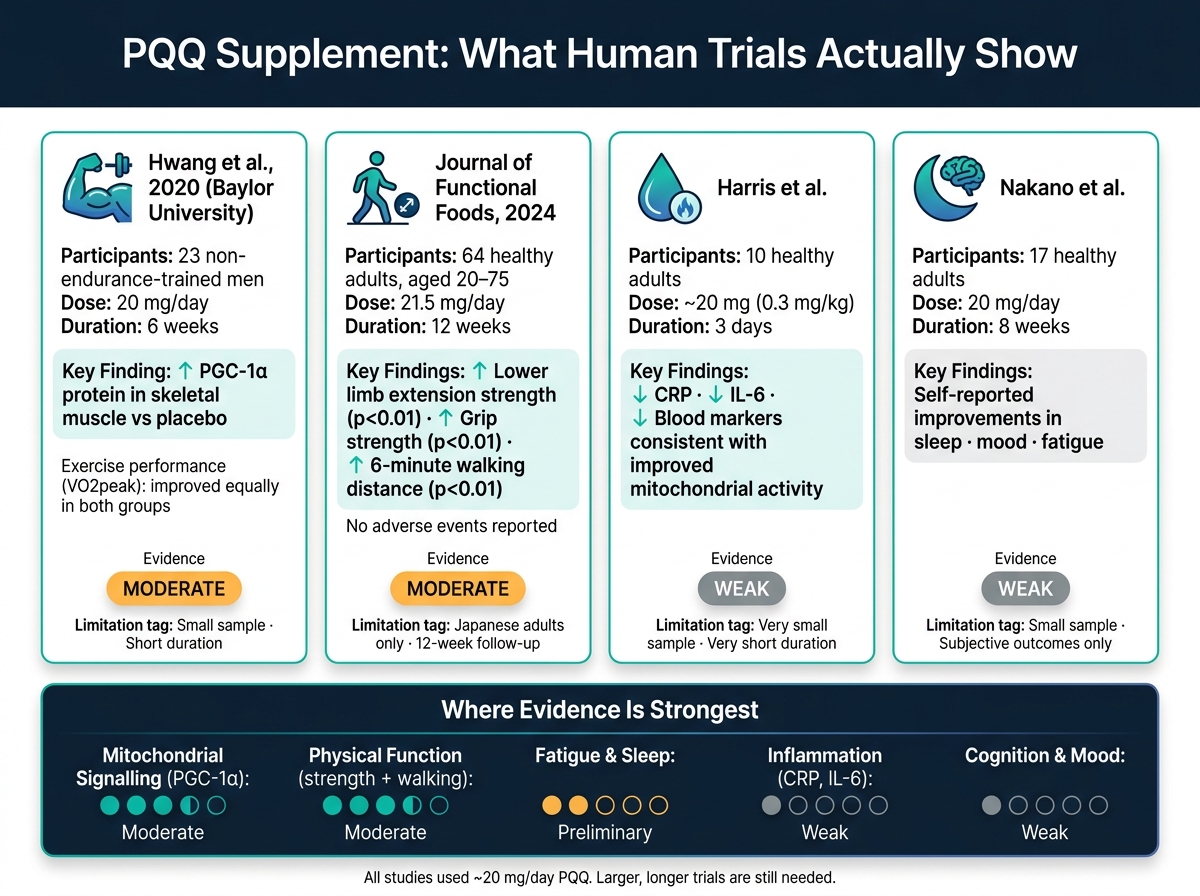
PQQ Supplement: Human Clinical Trial Evidence Summary
Human trials on PQQ are still few, but the early data gives us something useful to work with. So far, the clearest signals show up in mitochondrial signalling, fatigue-related measures, and day-to-day physical function. That doesn’t mean every claimed PQQ benefit is settled science. It means the human evidence is starting to take shape, and a few findings stand out more than others.
Evidence for Energy, Fatigue, and Physical Function
One of the most cited human studies came out of Baylor University in 2020. In that trial, 23 non-endurance-trained men took either 20 mg/day of PQQ or a placebo for six weeks while following a supervised endurance-training programme. Both groups improved their aerobic capacity, measured by VO2peak. But there was one difference that caught attention: only the PQQ group showed a marked increase in PGC-1α protein levels in skeletal muscle [3].
Why does that matter? PGC-1α is closely linked with mitochondrial biogenesis and signalling. So even though exercise performance improved in both groups to a similar degree, the PQQ group showed a biological shift that may point to changes happening under the hood.
A more recent 2024 randomised, double-blind, placebo-controlled trial, published in the Journal of Functional Foods, looked at 21.5 mg/day of PQQ disodium salt in 64 healthy Japanese adults aged 20–75 over 12 weeks. By the end of the study, the PQQ group had better lower limb extension strength, grip strength, and 6-minute walking distance than the placebo group, with p < 0.01. No adverse events were reported among those who completed the trial [4].
This matters because it moves the conversation beyond lab markers. Instead of only showing a shift in muscle proteins or blood chemistry, this trial points to changes people may actually notice in daily life, like walking capacity and strength.
There’s also a short-term human study in 10 healthy adults that tested a single dose of 0.3 mg/kg of PQQ, which works out to around 20 mg for many adults. Within three days, researchers saw reductions in C-reactive protein (CRP) and interleukin-6 (IL-6), while other blood markers shifted in a direction linked with better mitochondrial activity [1]. That’s interesting, but it’s still an early clue, not a firm clinical takeaway.
Evidence for Cognition, Mood, and Sleep
The picture gets softer when we move into mood, sleep, and mental sharpness. In an eight-week study, 17 healthy adults took 20 mg/day of PQQ and reported better sleep, mood, and fatigue from baseline [1].
That sounds promising, but this is where it helps to keep both feet on the ground. The study was small, and the outcomes were self-reported. In plain terms, people said they felt better, but the trial design doesn’t let us say with much confidence how much of that came from PQQ itself.
Clinical Trial Summary Table
| Study | Participants | Dose | Main Findings | Evidence Strength | Limitations |
|---|---|---|---|---|---|
| Hwang et al., 2020 (Baylor University) | 23 non-endurance-trained men | 20 mg/day for 6 weeks | Increased PGC-1α protein levels in skeletal muscle; no added improvement in VO2peak vs placebo | Moderate | Small sample; short duration |
| Journal of Functional Foods, 2024 | 64 healthy adults (aged 20–75) | 21.5 mg/day for 12 weeks | Improved lower limb extension strength, grip strength, and 6-minute walking distance (p < 0.01) | Moderate | Limited to healthy Japanese adults; 12-week follow-up only |
| Harris et al. | 10 healthy adults | 0.3 mg/kg for 3 days | Reduced CRP and IL-6; blood markers consistent with improved mitochondrial activity | Weak | Very small sample; very short duration |
| Nakano et al. | 17 healthy adults | 20 mg/day for 8 weeks | Self-reported sleep, mood, and fatigue improved from baseline | Weak | Small sample; subjective outcomes only |
Taken together, the human research points most clearly toward mitochondrial signalling and physical function, with early but less certain signals for fatigue, sleep, and mood. The big gap is scale. We still need larger and longer trials across more varied groups before stronger claims make sense.
These early findings lead straight into the next issue: which PQQ benefits are backed by research, and which ones are still ahead of the evidence?
PQQ Supplement Benefits Supported by Research
When you strip away the hype, the human research on PQQ tends to fall into three main buckets. The key point is simple: these effects appear to flow from mitochondrial support. They should not be treated as separate, independent claims.
Cellular Energy and Mitochondrial Health
The clearest human signal for PQQ is its role in mitochondrial signalling. In one small trial, researchers saw higher skeletal muscle PGC-1α, a marker linked with mitochondrial biogenesis [3]. A later trial also reported gains in grip strength, leg strength, and walking performance [4].
That matters because it places PQQ closer to mitochondrial function support than to the kind of instant energy lift people often expect from stimulants. In plain terms, this is less about a quick jolt and more about how cells make and manage energy.
Cognitive Health and Daily Resilience
This is where a lot of supplement marketing gets ahead of the science. Human data on cognition are still limited, and claims around focus or memory are not proven. Small studies point to better sleep and lower fatigue, but they do not show strong gains in memory or attention [1].
A more careful way to look at this is through brain cell energy resilience, not old-school “brain boosting.” So far, sleep and fatigue look like the clearest early human signals, while memory and attention still sit in the “too early to say” category.
Oxidative Stress and Healthy Ageing
PQQ also has redox activity, which may help cells cope with age-linked stress. In a short human study, about 20 mg of PQQ lowered CRP and IL-6 within three days [1][2]. That suggests a possible effect on low-grade inflammation, though the evidence is still thin.
So yes, there’s a signal here, but it’s early. It’s better to read this as a hint of cellular resilience support rather than a firm anti-ageing claim.
Taken together, the strongest human case for PQQ at this stage is mitochondrial support and physical function.
| Benefit Area | Proposed Mechanism | Human Evidence |
|---|---|---|
| Mitochondrial health | Supports PGC-1α and mitochondrial biogenesis | Moderate - increased PGC-1α in skeletal muscle [3] |
| Physical function | May support muscle mitochondrial function | Moderate - improved grip strength, leg extension, and walking endurance [4] |
| Sleep and fatigue | May support cellular energy and resilience | Preliminary - self-reported improvements in a small trial [1] |
| Inflammation | May help lower low-grade inflammation | Weak - CRP and IL-6 decreased in a short human study [1][2] |
| Cognitive health | Possible brain energy resilience effects | Weak - early human evidence only [1] |
Next comes the practical question: what dose has been studied, and who should check with a clinician first?
PQQ Supplement Dosage and Safety
Doses Used in Clinical Studies
The dose studied most often in human trials is 20 mg per day. The European Food Safety Authority (EFSA) has also listed 20 mg per day as a safe dose for adults. That’s far above what people usually get from food, where PQQ intake is only present in tiny amounts [2].
In human research, 20 mg/day has commonly been used for 6 to 12 weeks. A dose of 21.5 mg/day has also been studied over 12 weeks. Across published human trials, the usual range is 10–20 mg/day.
| Study Focus | Daily Dose | Duration |
|---|---|---|
| Mitochondrial biogenesis | 20 mg | 6 weeks |
| Muscle strength and function | 21.5 mg | 12 weeks |
| Inflammation and metabolism | ~20 mg (0.3 mg/kg) | 3 days |
PQQ reaches peak blood levels within 2–3 hours. In plain terms, taking it daily matters more than obsessing over the exact time of day.
Safety Profile and Possible Side Effects
At clinical doses, PQQ has been well tolerated in small human studies. In a 12-week trial involving 64 healthy adults who took 21.5 mg/day, researchers reported no adverse events [4]. Toxicology data also point to a broad safety range, with a No Observed Adverse Effect Level (NOAEL) of 100 mg/kg of body weight per day [2].
That said, more is not better. It’s smart to stick to the dose on the label. Very high doses have led to kidney-safety concerns in toxicology work [1][2]. Human safety data beyond 12 weeks is also still limited [2].
So while the short-term data looks reassuring, label discipline still matters.
Who Should Speak With a Doctor First
PQQ is usually well tolerated, but a few groups should talk to a healthcare professional before using it. This includes pregnant or breastfeeding individuals, since strong human safety data in these groups is still lacking [1][2]. People with pre-existing kidney conditions should also be careful, given the possible renal stress seen at very high doses [1][2].
If you take prescription medicines, check with your doctor before starting PQQ. Interaction data is still limited [1][2].
After dosage and safety, the next thing to check is best anti-ageing supplements for product quality, including label accuracy and third-party testing.
How to Choose a Quality PQQ Supplement
Choose a PQQ supplement that matches the form, dose, and testing used in human studies, or follow a comprehensive guide to choosing the best longevity supplement for your specific needs.
What to Check on the Label
Start with the form of PQQ. Look for PQQ Disodium Salt on the label. This is the form used in clinical studies [2][4].
Then check the dose per serving. A serving of around 20 mg is the amount used most often in human studies [2][3][4]. If a product gives far less, or hides the amount inside a blend, it becomes harder to compare with the research.
It also helps to check how clearly the brand lists its ingredient source and production method. If that detail is missing, vague, or tucked away inside a proprietary blend, take that as a warning sign. You should be able to see what you're paying for without having to guess.
Then look for third-party testing. In India, FSSAI compliance is a basic checkpoint. Independent testing for purity, potency, and contaminants adds one more layer of trust [1].
Use the checklist below to compare products at a glance.
Why PQQ Is Often Paired With CoQ10
CoQ10 sits in a separate lane because it supports a different part of mitochondrial energy. PQQ is often paired with CoQ10 because the two work on different mitochondrial functions. Read the full guide here: PQQ + CoQ10 Together: Why This Combo Works for Cellular Energy.
Supplement Buying Checklist
| Buying Criterion | Why It Matters |
|---|---|
| PQQ Disodium Salt form | The form used in clinical studies [2][4] |
| Around 20 mg per serving | Matches the dose used in many human trials [2][3][4] |
| Stated ingredient source and production method | Supports label transparency and traceability [1] |
| FSSAI compliance and independent testing | Helps verify purity, potency, and absence of contaminants [1] |
| GMP-certified manufacturing | Supports consistent quality |
| No hidden proprietary blends | Makes it easier to verify the actual dose and source of each ingredient |
| Paired with CoQ10 (optional) | Supports both mitochondrial biogenesis and energy production |
How PQQ Fits Into a Broader Healthy Ageing Plan
Lifestyle Habits That Support Mitochondria
A PQQ supplement is not a quick pick-me-up. It is not a stimulant, and it does not replace the basics. PQQ tends to make more sense when it sits inside a routine that already supports mitochondrial health: good sleep, regular movement, a nutrient-dense diet, and steady stress control. That’s why it fits far better into a healthy ageing plan than into any “instant energy” pitch.
Exercise is one part of that picture. PQQ may support how the body responds to training by increasing mitochondrial biogenesis signals such as PGC-1α [3]. Put simply, it may help the body build and maintain the energy-making machinery that exercise already pushes into action.
Recovery matters just as much. Training gets most of the attention, but recovery is where a lot of the repair work happens. Sleep, rest, and lower fatigue all feed into mitochondrial function. Small trials suggest PQQ may help here too, with 20 mg daily linked to better sleep quality and less fatigue [1].
Diet plays a role, but there’s a catch. Foods contain only trace amounts of PQQ, so getting to the doses used in studies through food alone is unlikely [2]. In practice, high-quality supplements are the more direct way to reach study-level intake.
Conclusion: What to Realistically Expect From PQQ
PQQ makes the most sense as part of a bigger routine, alongside exercise, good sleep, and a nutrient-dense diet. For CoQ10 pairing, see our dedicated PQQ + CoQ10 article. Based on current evidence, PQQ offers modest support for mitochondrial health, with the clearest results seen after 8–12 weeks at studied doses.
FAQs
What is PQQ?
Pyrroloquinoline quinone (PQQ) is a redox-active, vitamin-like compound found in certain foods. It works as an enzymatic cofactor and is mostly studied for its possible role in supporting mitochondrial biogenesis and helping shield existing mitochondria from oxidative stress.
Because mitochondria are central to cellular energy production, PQQ may play a part in energy metabolism and healthy ageing. The human data is still limited, so it’s best to view the research with some caution. That said, PQQ is generally seen as safe at common supplemental doses of 20 mg per day.
What does a PQQ supplement do?
PQQ is a naturally occurring compound linked to cellular energy metabolism. Researchers mainly study it for its role in mitochondrial biogenesis, which means helping the body make new mitochondria, and for helping shield existing mitochondria from oxidative stress.
In human studies, a daily intake of 20 mg has been linked with possible gains in attention, memory, muscle strength, physical function, sleep quality and fatigue. PQQ is generally considered safe, but there is no standard dose. It’s best to speak with a healthcare professional before using it.
How does PQQ support mitochondria?
PQQ is a naturally occurring redox-active compound that researchers study for its role in mitochondrial biogenesis - the process of making new mitochondria. It’s also looked at for how it may help protect existing mitochondria from oxidative stress. Put simply, that could help support energy metabolism and how well cells cope with stress.
Human studies, often using 20 mg per day, suggest PQQ may support cognition and physical function. It’s often paired with CoQ10, since both are linked to mitochondrial health. That said, long-term human data are still limited, so it’s wise to speak with a healthcare provider before starting supplementation.
What is mitochondrial biogenesis?
Mitochondrial biogenesis is the process by which your cells make new mitochondria. Since mitochondria play a central role in producing cellular energy, or ATP, this process helps support energy output and metabolic health.
PQQ has been studied for its potential role in supporting mitochondrial biogenesis. It may also help protect existing mitochondria from oxidative stress, which matters because oxidative damage can affect how well cells produce energy.
Does PQQ improve energy?
PQQ may help support day-to-day energy by helping your cells look after their mitochondria, the parts often called the cell’s power units. Researchers study it for two main reasons: its possible role in mitochondrial biogenesis - the process of making new mitochondria - and its ability to help protect existing mitochondria from oxidative stress.
Human studies using 20 mg daily have pointed to possible gains in fatigue, sleep quality, cognition, and physical function. That said, the research is still developing, so it’s best to read these findings with measured optimism rather than treat them as settled fact. At usual intake levels, PQQ is generally considered safe.
What are the benefits of PQQ?
PQQ is a naturally occurring redox compound often used to support mitochondrial health and cellular energy. One of its main roles is helping mitochondrial biogenesis - the process by which the body makes new mitochondria.
Early research suggests PQQ may support cognitive function, including memory and attention. Some studies also point to support for muscle strength and physical function in healthy adults. That said, human research is still limited, so it’s smart to view these findings with measured interest rather than certainty.
In clinical studies, 20 mg per day is a common dose. Amounts of up to 100 mg per day have also been well tolerated.
What dosage has been studied?
Human studies have often used 20 mg of PQQ per day. In a few trials with healthy adults, that amount was linked with better performance on some cognitive tasks, improved sleep quality, and gains in muscle strength. That said, the human research is still limited, so it’s wise not to read too much into early results.
At common intake levels, PQQ is usually seen as safe, and clinical studies have not reported major adverse events. Since there’s no standard dosage guideline that applies to everyone, it’s best to speak with a healthcare professional before starting a supplement.
Is PQQ safe?
PQQ is generally considered safe. In human clinical trials, 20 mg/day has been used without adverse effects.
That said, human research is still limited when compared with animal studies. So, it’s smart to speak with a healthcare professional before starting a supplement, especially if you have a medical condition, take prescription medicines, or are pregnant or breastfeeding. It also helps to choose third-party tested products, so you know the label matches what’s in the bottle.
Should PQQ be taken with CoQ10?
PQQ is often paired with CoQ10 for a simple reason: both are linked to mitochondrial function, but they seem to help in slightly different ways. PQQ may support the creation of new mitochondria, a process called mitochondrial biogenesis, and it may also help protect cells from oxidative stress.
In human studies, a common dose is 20 mg daily. PQQ is generally seen as safe, but the human data is still limited, so there’s still a lot we’re learning. It’s best to speak with a healthcare professional before starting PQQ, especially if you take other medicines.



Leave a comment
All comments are moderated before being published.
This site is protected by hCaptcha and the hCaptcha Privacy Policy and Terms of Service apply.