



Why CoQ10 and Vitamin E Do Not Always Absorb Well
Why fat-soluble nutrients are hard for the body to absorb
CoQ10 and vitamin E are fat-soluble nutrients, which means they depend on dietary fat for proper absorption [2][4]. In plain terms, if there isn’t enough fat around during digestion, the body may not take up these nutrients very well.
CoQ10 is even more difficult to absorb than many other fat-soluble compounds because it has very low water solubility. That creates a problem in the digestive tract, which is largely a watery setting. As a result, only a limited amount may pass through the gut wall and enter circulation [2].
The intestine is often the main bottleneck here. More is not always better: taking a higher dose does not automatically mean the body will absorb more. In practice, bioavailability often matters more than dose alone. That’s where piperine starts to get attention.
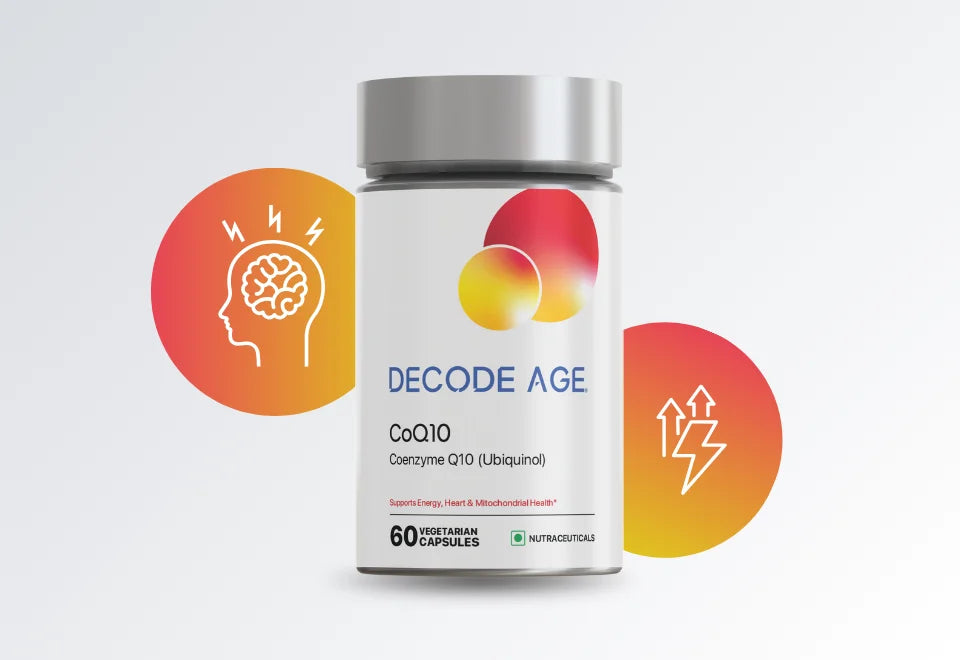
CoQ10 also exists in different forms. Ubiquinol is usually absorbed more easily than ubiquinone [2][5].
Why absorption matters more with age
As people get older, the body’s own CoQ10 production tends to drop, so absorption becomes a bigger deal with time [2]. A supplement can look good on paper, but if the body struggles to absorb it, the payoff may be limited.
This issue can be even more pronounced in people with malabsorption-related conditions such as coeliac disease or ulcerative colitis. In those cases, the amount of a fat-soluble nutrient that finally reaches circulation may fall further [3].
When absorption starts to weaken, the answer isn’t always “take more.” Often, the better move is to support how the nutrient is absorbed in the first place. That is why absorption support matters.
sbb-itb-55c436e
How BioPerine Helps CoQ10 and Vitamin E Work Better
What BioPerine is and how piperine works
BioPerine® helps deal with a common problem: poor absorption. CoQ10 and vitamin E may be useful nutrients, but if the body doesn’t absorb enough of them, part of the dose can go to waste. That’s where BioPerine® fits in. It works as a bioavailability enhancer rather than a nutrient on its own [1][4]. It delivers a standardised dose of piperine [1][4], and its job is simple: help the body take in more of what’s already in the formula [1][4].
Piperine does this by slowing the breakdown of certain nutrients and helping more of them pass through the intestinal lining [1][4]. Put plainly, it gives nutrients like CoQ10 and vitamin E a better shot at reaching the bloodstream.
What research shows for CoQ10 and vitamin E
This matters most when absorption is the main hurdle. BioPerine® has been clinically shown to improve CoQ10 bioavailability [1][4]. For vitamin E, the logic is similar. Since piperine helps with the uptake of fat-soluble nutrients, there’s a sound absorption-based reason to pair it with vitamin E as well [1][4].
| Nutrient | BioPerine® Effect | Primary Mechanism |
|---|---|---|
| CoQ10 | Increased bioavailability | Enzyme inhibition and improved uptake [1][4] |
| Vitamin E | Enhanced absorption | Improved uptake [1][4] |
| Fat-soluble nutrients | Absorption support | Reduced intestinal breakdown [1] |
This kind of absorption support can matter more when the aim is energy production, antioxidant defence, or healthy ageing.
Why Better Absorption Matters for Energy, Antioxidants, and Ageing
How CoQ10 supports mitochondrial energy and reduces fatigue
CoQ10 sits at the core of mitochondrial ATP production. Put simply, if absorption is poor, less CoQ10 is available to support cellular energy.
Some studies link CoQ10 supplementation with lower fatigue [2]. When absorption is better, more CoQ10 can reach circulation and support cellular energy production, which may help ease fatigue [6].
That same edge in absorption also matters when we look at cell protection.
How vitamin E and CoQ10 protect cells from oxidative damage
Oxidative damage is one of the main drivers of ageing and many chronic diseases [4]. Over time, free radicals can harm DNA, proteins, and fatty acids.
Vitamin E helps shield cell membranes from oxidative damage [4]. CoQ10, on the other hand, supports antioxidant defence inside the mitochondria [2]. In plain terms, they work in different parts of the cell, which is why the pairing makes sense.
BioPerine® plays a useful role here because absorption affects how much of each nutrient gets into circulation. Better uptake means more CoQ10 and vitamin E enter the bloodstream, where they may help neutralise free radicals and support the body’s own antioxidant enzyme systems [1][4].
That leads to a simple next step: who is this combination most relevant for?
Who may benefit most from this combination
| Who May Benefit | Why This Combination Is Relevant |
|---|---|
| Adults aged 40–60 | Helps address age-related decline in CoQ10 production [2] |
| Adults aged 60 and above | Helps address age-related decline in CoQ10 production [2] |
| Individuals on statin therapy | Statins are known to reduce the body's natural CoQ10 levels [2] |
| People with low energy or fatigue | Better cellular energy production may help reduce tiredness and support recovery [6] |
| Those seeking antioxidant support | Improved uptake helps CoQ10 and vitamin E support cellular defences against oxidative stress [4] |
That makes formulation, meal context, and consistency the next practical questions.
How to Use CoQ10, Vitamin E, and BioPerine More Effectively
CoQ10 + Vitamin E + BioPerine: Absorption, Benefits & Who Should Use It
Better absorption matters only when the formula is built for it and the supplement is taken in a way the body can use.
What to look for in a well-designed formulation
If BioPerine is added to improve absorption, the rest of the formula should work toward the same goal.
Dose matters, but delivery matters more. A high milligram count on the label does not tell you how much CoQ10 actually reaches the bloodstream.
CoQ10 is a good example. It often needs to be pre-dispersed before the body can absorb it well. As David Mantle and Alex Dybring note:
"Failure to subject crystalline CoQ10 to crystal dispersion therefore reduced bioavailability by approximately 75%." [10]
That line says a lot. If the CoQ10 stays in crystal form, much of it may pass through the body without being used. Simply taking more does not fix a weak formulation.
Because CoQ10 and vitamin E are fat-soluble, they are usually better delivered in a carrier oil inside a softgel. Dry powder capsules are, in most cases, a weaker option for these nutrients [10].
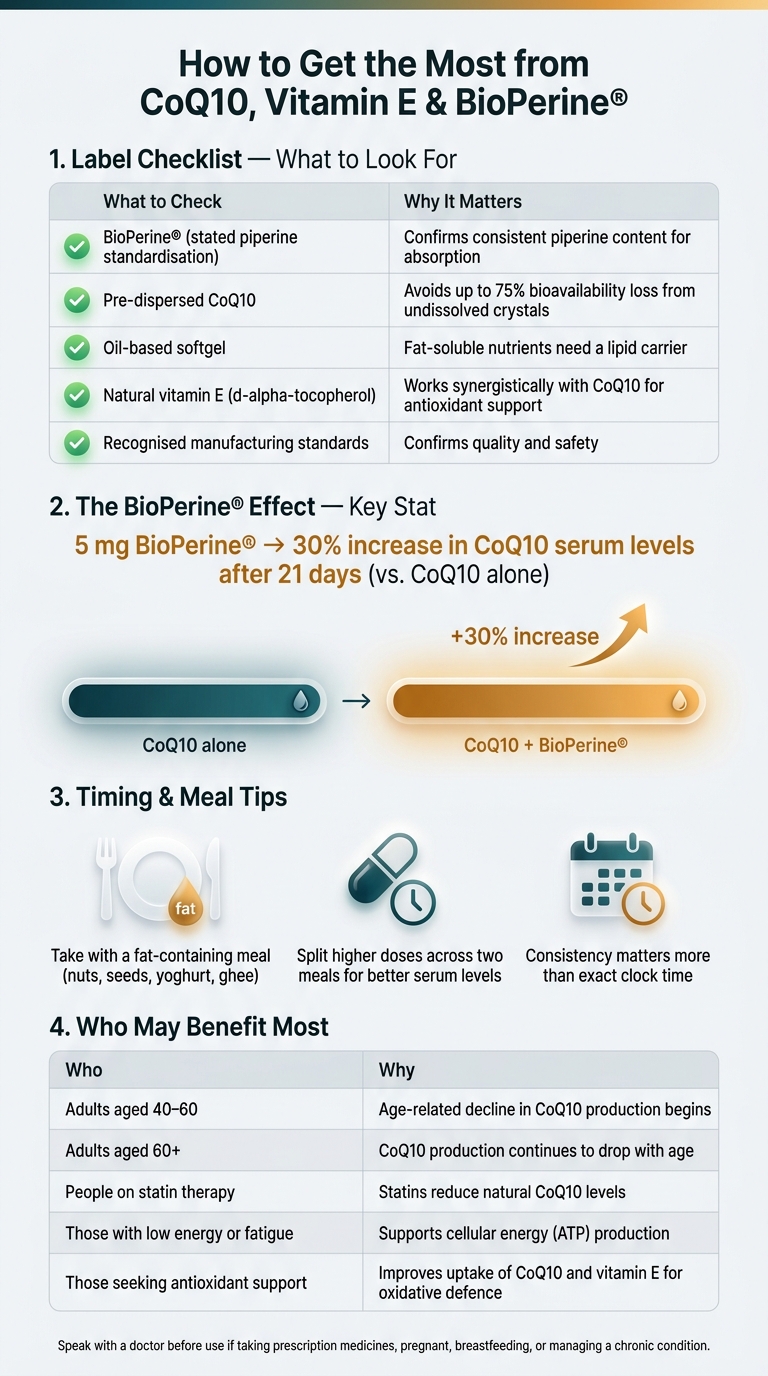
For BioPerine®, check for the branded ingredient name and a stated piperine standardisation. A generic black pepper extract without this detail is less predictable [8]. One dose studied often is 5 mg of BioPerine per serving. In a double-blind study, this led to a 30% increase in CoQ10 serum levels after 21 days when compared with CoQ10 taken alone [7][11].
For vitamin E, look for natural vitamin E (d-alpha-tocopherol). It works well alongside CoQ10 in antioxidant formulas [9].
| What to Check on the Label | Why It Matters |
|---|---|
| BioPerine® (stated piperine standardisation) | Helps confirm a consistent piperine content for absorption [8] |
| Pre-dispersed CoQ10 | Helps avoid up to 75% loss in bioavailability from undissolved crystals [10] |
| Oil-based softgel | Fat-soluble nutrients need a lipid carrier for absorption [10] |
| Natural vitamin E (d-alpha-tocopherol) | Works well with CoQ10 in antioxidant formulas [9] |
| Recognised manufacturing standards | Helps confirm quality and safety [8] |
Once the formula is sorted, timing affects how much the body can put to use.
Best timing, meal context, and consistency
Take these nutrients with a meal that contains fat. Fat helps the body absorb both CoQ10 and vitamin E [10]. Everyday foods like nuts, seeds, yoghurt, or ghee can make this easy at breakfast or lunch.
If your daily dose is on the higher side, splitting it across two meals may work better than taking it all at once. This can improve serum levels more reliably [10].
And then there’s the part people often overlook: consistency. Clock time matters less than taking it regularly. If doses are missed often, stable blood levels are less likely to build, even with a well-made formula [10].
Not everyone should use piperine-based formulas, which makes safety the next question.
Safety Considerations and How to Decide If This Is Right for You
When to be cautious or seek medical advice
Even a well-made formula isn’t the right fit for everyone, and that matters with piperine in particular.
BioPerine® has GRAS status, but the same absorption-boosting action that makes it useful can also create problems with some medicines. BioPerine® increases absorption, which is also why it can affect medicines. It inhibits P-glycoprotein and interferes with glucuronidation, a process the body uses to clear medications. The result is that certain drugs can reach higher blood levels than intended [8]. If you take prescription medicines, especially ones that depend on the body’s transport and clearance pathways, it’s wise to speak with a doctor before adding a supplement that contains piperine.
A few other groups should also check first with a medical professional. This includes people who are pregnant, breastfeeding, or living with a chronic illness. And if your stomach tends to react easily, piperine may cause irritation [8].
If that safety profile works for your situation, the next step is figuring out how it fits into your bigger health routine.
How supplementation fits into a broader healthy ageing plan
CoQ10 can have a place in a healthy ageing plan, but it isn’t for everyone, and it shouldn’t sit on its own like a magic fix. It tends to make more sense when it’s part of a bigger plan that includes tracking your biological age, regular movement, good sleep, and medical guidance where needed.
The main point is simple: use CoQ10 only when the dose, formulation, and your own health context line up. The aim is targeted support, not just taking more for the sake of it.
FAQs
Does BioPerine help everyone absorb CoQ10 better?
Not always. BioPerine is a standardised black pepper extract that’s rich in piperine. It may help the body absorb certain nutrients better by affecting absorption in the gut, along with some enzymes and transport proteins.
Human research gives us a useful example. In one clinical study, taking 5 mg of piperine with CoQ10 increased plasma CoQ10 exposure by about 30% over 21 days. It has also been studied alongside nutrients like beta-carotene, selenium, resveratrol and curcumin.
Should I take CoQ10, vitamin E, and BioPerine with food?
BioPerine® may help with the absorption of some nutrients, including CoQ10 and vitamin E, but that’s only one piece of the puzzle.
The bigger factor is often the supplement’s formulation. Things like proper crystal dispersion and lipid-based encapsulation can make a major difference to how well the body absorbs and uses those nutrients.
Can BioPerine interact with medicines?
Yes, it may. BioPerine is a standardised black pepper extract with at least 95% piperine, and it helps improve the absorption of certain nutrients.
It may change how substances are processed in the body by:
- inhibiting P-glycoprotein
- suppressing glucuronidation enzymes
- stimulating thermogenesis in the intestinal tract
In simple terms, it can help the body take in some compounds more effectively, which is why it’s often added to supplement formulas.




Leave a comment
All comments are moderated before being published.
This site is protected by hCaptcha and the hCaptcha Privacy Policy and Terms of Service apply.