



What Is Vitamin DAKE®?
Vitamin DAKE isn't a single vitamin — it's a formulation that combines four fat-soluble vitamins (D, A, K, and E) into one capsule. Unlike water-soluble vitamins, fat-soluble ones dissolve in fat and get stored in your liver and tissues, which is exactly why combining them into one dose, taken with a meal, makes practical sense.
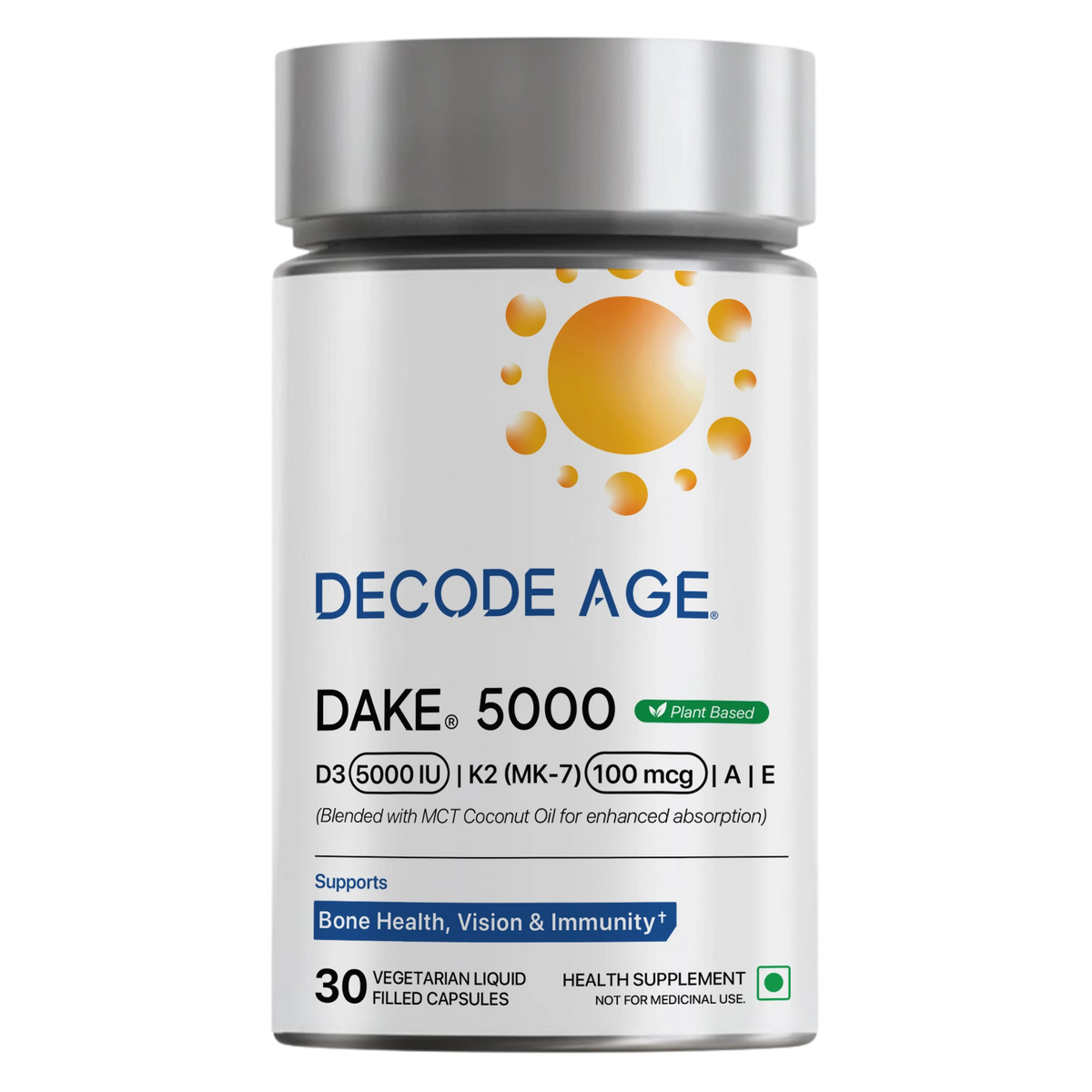
Decode Age's version, DAKE® 5000 IU, is a 30-capsule liquid-filled vegetarian formula built around a specific idea: D3 and K2 are more useful together than apart, and A and E round out the fat-soluble picture most diets under-deliver on.
Vitamin D3: The Bone and Immune Anchor
Vitamin D's main job is getting calcium out of your food and into your bones — without it, your body can absorb calcium but can't really use it. The NIH Office of Dietary Supplements sets the RDA at 15 mcg (600 IU) for adults 19-70, rising to 20 mcg (800 IU) past 70, and estimates roughly one in four Americans falls short of adequate blood levels.
DAKE® delivers 125 mcg (5,000 IU) per capsule — well above the baseline RDA, positioned for people with higher requirements (limited sun exposure, darker skin, higher body weight, or diagnosed deficiency) rather than as a baseline top-up. If you're not sure which camp you're in, a blood test is the only way to know for certain; this isn't a one-size-fits-all dose.
Why Vitamin K2 Rides Alongside D3 (Not Separately)
Here's the part most vitamin D supplements skip: taking D3 alone increases how much calcium your blood absorbs, but it's vitamin K2 that activates osteocalcin, the protein that actually directs that calcium into bone instead of leaving it to accumulate in artery walls. The NIH fact sheet on vitamin K sets adequate intake at 120 mcg/day for men and 90 mcg/day for women, and links higher K intake to stronger bones and lower hip-fracture rates.
DAKE® uses the MK-7 form of K2 at 100 mcg per capsule — the longer-acting form, chosen specifically to pair with the high D3 dose rather than leaving that calcium-direction step to chance.
Vitamin A: Vision and Immune Support
Vitamin A's best-known role is night vision, but it's also load-bearing for immune defense and organ function — the NIH notes it "helps your heart, lungs, and other organs work properly" in addition to supporting normal vision and reproduction. The current RDA is 900 mcg RAE for men and 700 mcg RAE for women.
DAKE® provides 1,000 mcg as retinyl palmitate — 100% of the standard adult RDA in a form your body can use directly, rather than beta-carotene, which requires an extra conversion step some people handle inefficiently.
Vitamin E: The Antioxidant Layer
Vitamin E's job is protecting your cells from oxidative damage — the wear-and-tear from normal metabolism, pollution, and UV exposure — and it also plays a role in keeping blood vessels open and blood from clotting inside them. The NIH RDA for adults is 15 mg/day.
DAKE® includes d-alpha tocopherol — the natural, more bioavailable form of vitamin E — as part of the blend, rounding out the D/A/K combination with antioxidant coverage.
Does Combining All Four Actually Work Better Than Taking Them Separately?
This is the honest tradeoff: taking four separate supplements gives you more control over individual dosing, but it also means four separate absorption windows, four labels to track, and — in D3's case specifically — no guarantee the K2 half of the equation is covered at all. Decode Age's internal data on the D3+K2 pairing specifically shows a 4.9% increase in bone mineral density in postmenopausal women with osteopenia/osteoporosis over the study period, and a 64.3% reduction in Atopic Dermatitis SCORAD severity linked to the same combination — both effects tied to the combination, not either vitamin alone.
The tradeoff runs the other way too: if you already get enough vitamin A or E from diet, a combination capsule doses you for the average person, not your specific gaps. DAKE® is built for people managing multiple fat-soluble gaps at once — not a replacement for testing where your personal levels actually stand.
Who Reviews Say It's For (and Who Should Skip It)
The combination of D3, K2, and other vitamins is convenient in a single capsule.
It's formulated for people with elevated vitamin D needs, anyone prioritizing bone density, athletes and active adults with higher micronutrient turnover, and people who've already identified multiple fat-soluble gaps rather than just one. Because the D3 dose is high (833% of baseline RDA) and vitamin K affects blood clotting, it's not the right starting point if you're on blood thinners, have a diagnosed vitamin A or D toxicity risk, or haven't had levels checked — talk to a doctor before starting a high-dose fat-soluble combination, since unlike water-soluble vitamins, excess doesn't simply flush out.
FAQs
Do I need both D3 and K2, or is D3 alone enough?
D3 alone raises calcium absorption but doesn't direct where that calcium goes — K2 (specifically MK-7) activates the protein that steers it into bone rather than arteries. If you're supplementing meaningful D3 doses long-term, pairing it with K2 addresses a gap D3 alone leaves open.
How much vitamin D should I actually be taking by age?
The NIH RDA is 15 mcg (600 IU) for adults 19-70 and 20 mcg (800 IU) for adults over 70 — but these are baseline figures for average dietary needs, not therapeutic doses for diagnosed deficiency, which a doctor should guide.
Is beta-carotene the same as vitamin A?
No — beta-carotene is a precursor your body converts into retinol (active vitamin A), while retinyl palmitate (used in DAKE®) is already in the form your body uses directly, skipping that conversion step.
Is vitamin D really a hormone, not just a vitamin?
Functionally, yes — once vitamin D is converted in the liver and kidneys, it acts like a steroid hormone, binding to receptors in cells throughout the body rather than just serving as a passive nutrient.
Can low vitamin D affect sleep?
Some research links vitamin D receptors in brain regions that regulate sleep to disrupted sleep patterns in deficient individuals, though this is an active area of research rather than a settled mechanism — it's a reason to get levels checked if sleep issues persist, not a guarantee that supplementing fixes them.





Leave a comment
All comments are moderated before being published.
This site is protected by hCaptcha and the hCaptcha Privacy Policy and Terms of Service apply.