



Why Mitochondria Need More Than One Nutrient
Mitochondria are at the heart of cellular energy production, above all in high-demand tissues like the heart and brain. When mitochondrial function slips, you can feel it in day-to-day energy, mental sharpness, and physical movement. Two jobs matter most here: making ATP well and keeping mitochondria in good shape.
How Mitochondria Make ATP
ATP is produced through the electron transport chain (ETC), which operates on the inner mitochondrial membrane. Electrons from digested food move through a series of protein complexes, building a proton gradient that powers ATP synthesis. CoQ10 acts as the mobile electron carrier that keeps this system running, and its levels drop with age [2].
There’s a catch, though. ATP production is not a clean, friction-free process. As mitochondria make energy, they also generate stress. So cells need more than fuel alone - they also need systems for repair, cleanup, and renewal.
Oxidative Stress and Mitochondrial Maintenance
The ETC also generates reactive oxygen species (ROS) [2]. Mitochondrial DNA faces more risk because it sits close to the ETC and has weaker repair capacity [2]. That puts pressure on the cell to maintain tight quality control.
To keep mitochondria working well, cells rely on:
- antioxidant defence
- mitophagy
- biogenesis
CoQ10 helps shield mitochondrial membranes from oxidative damage [2]. PQQ has been studied for its role in activating PGC-1α, the master regulator that signals the cell to make new mitochondria [3]. Put simply, CoQ10 helps support ATP production, while PQQ is being studied for mitochondrial renewal. That’s why CoQ10 deserves a closer look next, since it sits right inside the ATP production pathway.
sbb-itb-55c436e
How CoQ10 Supports Cellular Energy
CoQ10 - also called coenzyme Q10 or ubiquinone - is a fat-soluble molecule found in the inner mitochondrial membrane. It helps your cells make energy, which is why it serves as the existing-mitochondria partner in the PQQ + CoQ10 pairing. Put simply, PQQ is linked with mitochondrial renewal, while CoQ10 helps the mitochondria you already have do their job.
CoQ10's Role in ATP Production
Inside the electron transport chain, CoQ10 works as a mobile electron carrier. It shuttles electrons from Complex I and Complex II to Complex III [1][2]. That movement helps maintain the proton gradient needed for ATP synthase to produce ATP. If CoQ10 levels are too low, electron flow can slow down, the gradient can weaken, and ATP output can fall [2].
CoQ10 does more than support energy production. In its reduced form, ubiquinol, it also acts as a fat-soluble antioxidant. It helps limit lipid oxidation in mitochondrial membranes and helps regenerate vitamin E into its active form [2][5]. That’s a big part of why CoQ10 is seen as the energy-support side of this duo.
There’s also an age angle here. The body’s CoQ10 production tends to peak in early adulthood, and tissue levels may drop by about 50% between ages 20 and 80 [2]. That decline helps explain why CoQ10 gets so much attention in healthy ageing discussions.
What Human Research Shows
Human data suggests CoQ10 may help with fatigue, though the effect isn’t the same for everyone. A 2022 meta-analysis of 13 randomised controlled trials covering 1,126 people found that CoQ10 lowered fatigue scores compared with placebo, with a small-to-moderate effect size (Hedges' g ≈ −0.40) [4].
Some patterns stand out in the research:
- Bigger effects have been seen in older adults and people taking statins [4][5].
- Smaller effects tend to show up in healthy younger adults [4][5].
- Changes in energy and fatigue usually take about 4 to 8 weeks of regular use to become noticeable [4].
That timing matters. CoQ10 isn’t the sort of supplement people usually feel overnight. It tends to work more like a slow build than a sudden switch.
PQQ is studied for a different mitochondrial function: renewal.
How PQQ Works in Mitochondrial Function
PQQ is often discussed in the context of mitochondrial biogenesis, which is the process cells use to make new mitochondria. In simple terms, if your cells can build more mitochondria, they may be better placed to support energy production over time. That link is one reason PQQ comes up so often in longevity conversations.
PQQ and Mitochondrial Biogenesis
PQQ is studied for its role in activating PGC-1α (peroxisome proliferator-activated receptor gamma coactivator 1-alpha), which is widely seen as the main regulator of mitochondrial biogenesis. Once PGC-1α is turned on, it works alongside transcription factors NRF-1 and NRF-2 to start the genetic programme needed to build new mitochondrial structures. Preclinical research suggests this may happen through CREB, SIRT1, and AMPK signalling pathways [2][3].
That said, most of what we know about this mechanism still comes from animal and lab research. Human data are still limited, so there’s a gap between the theory and what has been clearly shown in people [3][4].
That’s also why researchers often look at PQQ together with CoQ10 instead of treating it as a standalone mitochondrial nutrient. If you want a deeper look at PQQ itself, see the pillar guide.
What Human Research Shows
Human studies on PQQ are still small, but they do hint at possible effects on mitochondrial signalling, cognition, fatigue, and sleep [2][3]. Early clinical findings suggest PQQ may increase PGC-1α protein levels, which fits with the proposed mitochondrial biogenesis mechanism [3]. Other studies have reported gains in cognitive performance, sleep quality, and fatigue scores [2][3].
Still, this isn’t the kind of nutrient you’d expect to work overnight. If there is an effect, it’s more likely to build slowly over time rather than show up at once.
So far, the trials have been limited in size, and bigger human studies are still needed before anyone can make firm claims.
The next section looks at the limited human evidence behind that pairing.
Why Researchers Study CoQ10 and PQQ Together
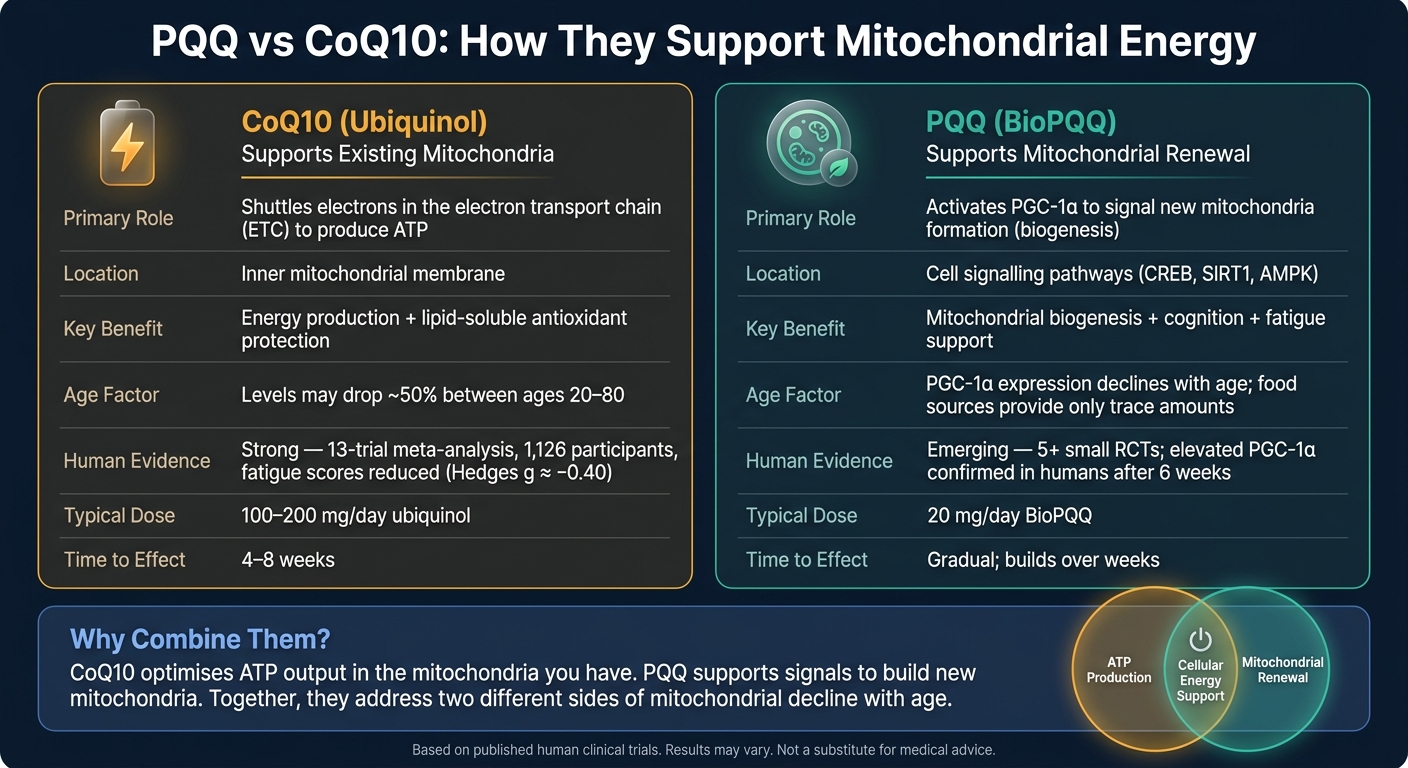
PQQ vs CoQ10: How They Support Mitochondrial Energy
Different Roles, One Shared Focus
Researchers look at CoQ10 and PQQ together because they appear to work on different sides of mitochondrial function. That’s the key idea here. The pairing is worth studying, but it still doesn’t prove a clear effect in people.
CoQ10 works inside existing mitochondria. Its main job is to shuttle electrons through the electron transport chain, which helps cells make ATP, the body’s main energy currency. PQQ, by contrast, is studied as a signalling molecule. It may help switch on PGC-1α, often called the master regulator of mitochondrial biogenesis, which means it may nudge cells to make new mitochondria over time [1][2].
Put simply, CoQ10 is linked with energy production in the mitochondria you already have, while PQQ is being studied for signals tied to making more mitochondria. That distinction matters, especially with ageing. CoQ10 levels tend to fall with age, and PGC-1α expression also drops over time. So the body may face a double hit: weaker energy output and slower mitochondrial renewal [2].
That’s why the two are seen as complementary, not overlapping. One is studied for mitochondrial renewal, and the other for ATP production efficiency [1][2]. Still, the human data on the combination itself remains limited. So while the biology looks promising on paper, the case is not settled.
Table 1: PQQ and CoQ10 at a Glance
| Nutrient | Primary Role | Main Evidence |
|---|---|---|
| CoQ10 | Electron carrier for ATP production; lipid-soluble antioxidant within the mitochondrial membrane | Strong: multiple RCTs and meta-analyses for fatigue [2][4] |
| PQQ | Signals for mitochondrial biogenesis; redox cofactor | Emerging: small RCTs on cognition, sleep, and mitochondrial markers; strong preclinical data [3][4] |
Table 2: PQQ vs CoQ10 Mechanism Comparison
| Feature | CoQ10 | PQQ |
|---|---|---|
| Primary Mechanism | Shuttles electrons in the electron transport chain (ETC) | Upregulates PGC-1α to support new mitochondria |
| Cellular Location | Inner mitochondrial membrane | Cell signalling pathways |
| Human Evidence | Extensive: 13-trial meta-analysis for fatigue [2][4] | Limited but growing: 5+ small RCTs for cognition and biogenesis markers [3][4] |
| Typical Supplementation Goal | Support energy production efficiency and antioxidant protection | Support long-term mitochondrial biogenesis |
The next question is whether this complementary biology shows up in human trials.
What Human Studies Show About PQQ and CoQ10 Together
Cognition, Fatigue, and Energy Outcomes
Human research on PQQ and CoQ10 together is still limited, but the early signal is fairly consistent. Studies have looked at this pairing because each compound seems to support cellular energy in a different way. CoQ10 helps with energy production, while PQQ may help with mitochondrial renewal. So the idea is simple: can those two roles add up to measurable effects in people?
So far, small human trials suggest possible gains in cognition, fatigue, and mitochondrial signalling. Still, the evidence is early-stage, and that matters. This is not a catch-all “energy booster,” and the reported effects are subtle rather than stimulant-like [4]. In other words, people aren’t feeling as if they’ve had an extra cup of chai or coffee. The changes, where seen, seem more linked to cellular function than to a short burst of alertness.
One mechanistic study found higher PGC-1α levels after 6 weeks of PQQ use, which supports the mitochondrial biogenesis hypothesis in humans [3]. That’s one of the more interesting parts of the research. It doesn’t just ask, “Did people feel better?” It also asks, “Did anything shift at the biological level?”
These findings line up with the earlier mechanism: CoQ10 supports energy production, while PQQ may support mitochondrial renewal.
Table 3: Clinical Trial Summary
| Clinical Trial | Participants | Intervention | Main Findings | Evidence Strength |
|---|---|---|---|---|
| Koikeda et al. | 71 middle-aged and older adults with subjective forgetfulness | 20 mg PQQ + 300 mg CoQ10 (24 weeks) | Significant improvements in memory, attention, and cognitive performance vs. placebo [1] | Moderate (RCT, longer duration) |
| Stout et al. | Healthy adults | 20 mg PQQ + 300 mg CoQ10 | Combination improved cognitive scores more than either nutrient alone [2] | Moderate (RCT, small sample) |
| Lowery et al. | 23 untrained males | 20 mg PQQ (6 weeks) | Elevated PGC-1α protein levels, supports the mitochondrial biogenesis hypothesis in humans [3] | Moderate (Mechanism confirmation) |
| Nakano et al. | 17 adults | 20 mg PQQ (8 weeks) | Improved fatigue scores, sleep quality, and mood [2][4] | Weak (Small, open-label) |
Taken together, these trials suggest there may be a link between this pairing and better cognitive performance or lower fatigue. But let’s be careful here. The sample sizes are small, and the study pool is still thin. That means the results are interesting, not final.
Safety and Evidence Gaps
At the doses used in published trials, the combination appears to be well tolerated. The form used in most studies has GRAS status [3]. Small human studies have not reported a harmful interaction between PQQ and CoQ10.
Even so, a few groups should be careful:
- Pregnant and breastfeeding women have not been studied well enough and should avoid use unless a clinician advises it [3][4].
- People taking warfarin should speak with a healthcare provider before adding CoQ10, because CoQ10 is structurally similar to vitamin K and may affect anticoagulant activity [4].
There’s also a clear gap in the evidence base. CoQ10 has much stronger human data behind it. A 2022 meta-analysis of 13 randomised controlled trials, covering 1,126 participants, found that CoQ10 reduces fatigue scores [4]. PQQ, by contrast, has much less human research, and many of the energy-related claims around it still come from preclinical work.
That’s why the next step is less about hype and more about fit: who is this pairing most likely to help, and in what context?
Who May Want to Consider PQQ with CoQ10
Adults Focused on Healthy Ageing and Mitochondrial Health
PQQ with CoQ10 may appeal to adults who want mitochondrial support, though it isn’t something everyone needs.
Age is the clearest reason many people look into it. CoQ10 levels tend to fall as we get older, and that matters because CoQ10 helps with ATP production in existing mitochondria. PQQ, on the other hand, is being studied for mitochondrial renewal. Food contains only trace amounts of PQQ, while research has used much higher doses [3]. Put simply, the pairing looks at two different sides of mitochondrial health: ATP output and mitochondrial renewal.
This can matter even more when day-to-day mental or physical load is high.
Active Adults and Busy Professionals
Ageing isn’t the only reason people consider PQQ with CoQ10. Higher daily energy demand is another one. When physical and mental demands go up, mitochondria have to work harder. That’s why busy professionals often look at this pairing when mental fatigue starts to creep in and steady focus feels harder to maintain. Active adults think about it for a similar reason: higher output calls for more ATP.
That said, supplements don’t do the heavy lifting on their own. Sleep, regular movement, and a solid diet still do most of the work when it comes to mitochondrial health.
Next, the article turns to label details, dose, and quality standards.
How to Choose a PQQ and CoQ10 Supplement
If this combo matches what you want from a supplement, the next step is simple: read the label properly. A lot of products look similar at first glance, but the form, dose, and build quality can change what you’re actually getting.
What to Check on the Label
PQQ and CoQ10 don’t work in the same way, so it’s not enough to just spot both names on the bottle. The form matters, and so does the dose.
For CoQ10, look for ubiquinol instead of ubiquinone. It is usually absorbed better, especially in adults over 40 [2]. For PQQ, check for BioPQQ, a fermentation-derived form used in most human clinical trials [2][3].
The doses used most often in human studies are:
CoQ10 is fat-soluble, so delivery format matters too. An oil-based softgel is usually absorbed better than a dry powder capsule [1][2]. Taking it with a meal that contains some fat may also help uptake [1][2].
Quality and Manufacturing Standards
A label can promise a lot, but that only means something if the product is made well. Look for supplements produced in GMP-certified facilities and checked through third-party testing. That helps confirm label accuracy and screens for contaminants.
It also helps to look for standardised branded ingredients such as Kaneka Ubiquinol and BioPQQ. These are the same forms used in research. BioPQQ also has GRAS status and an EFSA safety assessment at 20 mg/day [3][4].
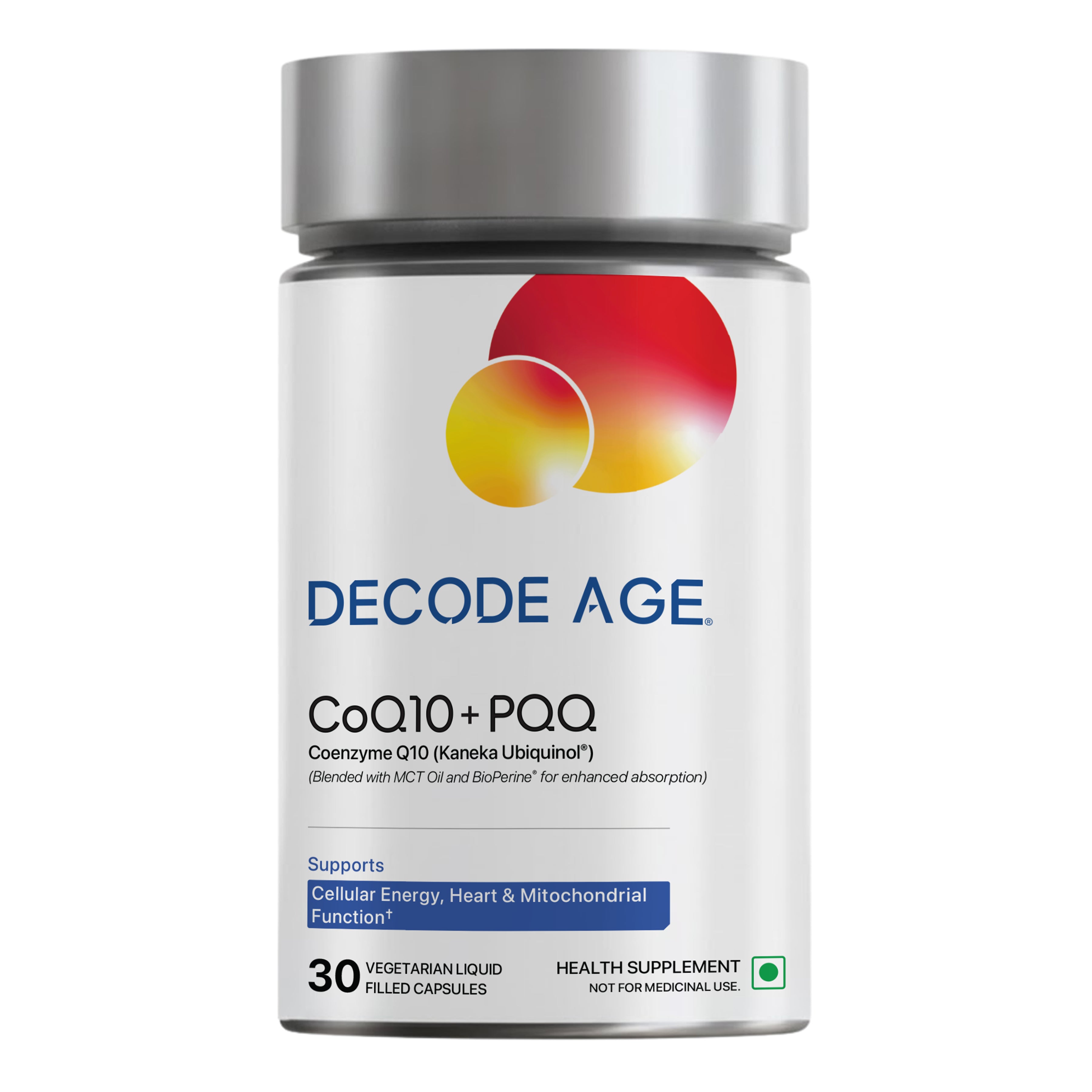
Decode Age's CoQ10 + PQQ formula is one example of a product that clearly states ingredient forms, sourcing, and GMP manufacturing.
Use the checklist below to compare products at a glance.
Table 4: Supplement Buying Checklist
| Buying Checklist Item | Why It Matters |
|---|---|
| Ubiquinol (not Ubiquinone) | Usually absorbed better and more biologically active for adults over 40 [2]. |
| BioPQQ brand name | Confirms the ingredient is the fermentation-derived form used in clinical research [3]. |
| 20 mg PQQ / 100–200 mg CoQ10 | Doses that match human research and common supplementation goals [2][3]. |
| Oil-based softgel | CoQ10 is fat-soluble; oil carriers improve absorption over dry powders [1][2]. |
| Third-party testing | Checks label accuracy and screens for contaminants. |
| Transparent labelling | Helps you avoid proprietary blends that hide the exact dose of each active ingredient. |
If PQQ feels stimulating, take it in the morning. Then give it some time. Use it steadily for 4 to 8 weeks before deciding how it’s working for you [1][4].
Once the product checks out, the next step is figuring out how it fits into your daily routine.
Using This Combination as Part of a Broader Health Plan
Once you’ve picked a good product, the next step is simple: make it fit into a routine that already supports mitochondrial health. Supplements should play a supporting role. They’re not a stand-in for proper sleep, regular movement, or a balanced diet. PQQ and CoQ10 may help support mitochondrial health, but they work best when they’re part of the bigger picture.
Define Your Goals Before You Supplement
The best way to think about PQQ and CoQ10 is to start with your goal. What are you trying to support - daily energy, mental sharpness, exercise recovery, or healthy ageing? That makes it much easier to choose the best longevity supplement for your needs.
| Goal | Primary Nutrient Focus | What to Monitor |
|---|---|---|
| General energy and fatigue | CoQ10 | Reduction in afternoon energy dips |
| Healthy ageing and longevity | PQQ + CoQ10 | Steady energy over time |
| Cognitive support | PQQ | Mental clarity and focus |
| Exercise recovery | CoQ10 | Reduced muscle soreness |
Give it a few weeks before deciding whether it’s helping. Small changes are easy to miss if you’re not paying attention. CoQ10 is fat-soluble, so it’s best taken with a meal that includes some fat. Many people like taking it in the morning, mainly because it’s easier to stick with the habit that way.
When to Speak with a Healthcare Professional
Even supplements that are generally well tolerated can interact with medicines, so safety matters just as much as dosage. Speak with a clinician before use if you take warfarin, blood-pressure medicine, statins, or any anticoagulant. PQQ should be avoided during pregnancy and breastfeeding, as there is not enough safety data for these populations [3][4]. If you have a heart or kidney condition, it’s also wise to get medical advice before starting.
Conclusion: Key Points on PQQ and CoQ10 Together
PQQ and CoQ10 are often discussed together because they support mitochondrial energy in different but related ways. CoQ10 helps ATP production in existing mitochondria, while PQQ is linked with a possible role in mitochondrial biogenesis through PGC-1α. Put simply, that’s why this pairing is studied as a mitochondrial energy supplement.
FAQs
Should I take PQQ and CoQ10 together?
PQQ and CoQ10 support mitochondrial health in different but linked ways. CoQ10 helps your existing mitochondria make energy and also works as an antioxidant. PQQ, on the other hand, is being studied for its role in cell signalling pathways tied to mitochondrial biogenesis, which means the process linked to making new mitochondria.
Taken together, they may support both mitochondrial function and mitochondrial upkeep. That’s the main idea behind pairing them: CoQ10 helps the mitochondria you already have do their job, while PQQ is being looked at for how it may influence the body’s mitochondrial renewal systems.
The human research so far looks promising, but it is still modest. Some studies suggest possible benefits for fatigue and cognitive function, though the evidence is not yet strong enough to make broad claims.
If you’re thinking of using both, take them with a fat-containing meal to help absorption, and speak with your doctor first.
How long does this combo take to work?
There’s no set timeline here. CoQ10 helps your existing mitochondria do their job by supporting energy production, while PQQ has been studied for its role in cell signalling linked to mitochondrial biogenesis.
Early research on using them together looks promising, especially for fatigue and cognitive function. That said, human data is still limited, so it’s wise to keep expectations grounded. Since both are fat-soluble, they’re best taken with a meal that contains some fat.
Who may benefit most from PQQ with CoQ10?
PQQ and CoQ10 support mitochondrial health in two different ways. CoQ10 helps your current mitochondria make cellular energy and also works as an antioxidant. PQQ, on the other hand, is being studied for its role in supporting the formation of new mitochondria.
That’s why some people look at this pairing with interest. It may make sense for those focused on mitochondrial health, energy ageing, or cellular function. Still, the human research is limited, so it’s smart to keep expectations grounded.
For best use, take both with a meal that contains some fat, since that can help with absorption. If you use anticoagulants, statins, or blood pressure medicine, or if you are pregnant or breastfeeding, speak with your physician before taking them.


Leave a comment
All comments are moderated before being published.
This site is protected by hCaptcha and the hCaptcha Privacy Policy and Terms of Service apply.