



Collagen Benefits for Skin
In the skin, collagen helps support firmness, elasticity, and texture by helping maintain the dermal matrix. That’s why most conversations around collagen and skin tend to focus on hydration, elasticity, and firmness.
Hydration, Elasticity and Skin Firmness
Collagen is often linked with skin hydration, elasticity, and firmer-looking skin. In many skin-focused routines, it’s paired with ingredients like ceramides or hyaluronic acid to help support the skin barrier [2].
Fine Lines and Wrinkle Appearance
Changes in the look of fine lines and wrinkles don’t happen overnight. Visible results usually take weeks to months of steady use [5][6].
How Long Skin Results May Take
Skin changes tend to build little by little, so timing matters just as much as dose. It makes more sense to judge results over weeks, not days [6].
sbb-itb-55c436e
Collagen Benefits for Joints and Mobility
Collagen does more than support skin. It also plays a part in cartilage and other connective tissues that help joints move with less friction. That’s why collagen often comes up in discussions around joint comfort, stiffness, and day-to-day mobility, especially for active adults and older adults.
Joint Comfort, Stiffness and Mobility
When joints go through strain or injury, the body responds by stimulating fibroblasts, the cells that produce collagen [2]. That link helps explain why collagen gets so much attention in joint health. The bigger issue, though, is practical: does taking collagen as a supplement help people feel and move better?
What Studies Show in Active Adults and Older Adults
Human studies suggest that collagen supplementation may support joint comfort and may help reduce stiffness in both active adults and older adults [5][3][4][1]. In plain terms, the research points to collagen as a useful part of the picture for people who want better movement support, whether they exercise often or are simply trying to stay mobile with age.
Where Collagen Fits in a Joint-Support Routine
In day-to-day use, collagen is usually one part of a broader joint-support plan, not a stand-alone fix. It can sit alongside nutrients such as vitamin D, calcium, magnesium, and omega-3s, which are also often used to support bone, muscle, and joint function.
Collagen and Healthy Ageing
How Collagen Relates to Visible and Structural Ageing
Collagen loss shows up in two places at once: on the surface and beneath it. You may notice skin getting thinner, less springy, or a bit rougher over time. Under the surface, the same drop in collagen can affect connective tissues such as cartilage, tendons, ligaments and bone.
That’s where it helps to separate visible ageing from structural ageing. They’re linked, but they’re not identical. Structural ageing refers to deeper changes in connective tissue. Visible ageing tends to appear through shifts in skin texture and pore visibility [2].
This distinction matters because people often talk about collagen as if it only affects how skin looks. It doesn’t. Collagen is part of the body’s support framework, so changes in collagen can have effects that go beyond the mirror.
The next step is more specific: which collagen type, source and form matter most.
What Collagen Can and Cannot Do
It’s best to think of collagen as support for healthy ageing, not as a fix that can reverse ageing or rebuild tissue that has already been lost. Its role is supportive, not curative.
That may sound less flashy, but it’s the more honest way to look at it. Collagen may help support normal skin and connective-tissue function. What it cannot do is act like a reset button for age-related tissue change.
From this point, the bigger question is not whether collagen is “good” or “bad”, but which type, source and form make the most sense, rather than relying on broad ageing claims.
Types, Sources and Forms of Collagen
Once the benefits of collagen are on the table, the next step is simple: which type, source, and form should you pay attention to?
The short answer: all three matter, but not always in the way supplement labels suggest.
Type I, Type II and Type III Collagen
Type I and Type III collagen are the main structural forms linked with skin and connective tissue. Type II collagen is the main form found in cartilage. That sounds neat on paper, but for most readers, the bigger point is this: type, source, and form often matter more than the name on the front of the pack.
Think of it like buying protein. The label tells you one part of the story. What’s inside, how it’s processed, and why you’re taking it usually matter more.
Marine vs Bovine Collagen
Marine collagen comes from fish, while bovine collagen comes from cattle. In most cases, the source matters less for “which one works” and more for practical things such as diet preference, tolerability, and whether the label fits your needs.
For example:
- Marine collagen may suit people who avoid bovine sources.
- Bovine collagen may suit those who are fine with cattle-based products.
- The better pick often comes down to ingredient preference and how your body handles it.
Why Hydrolysed Collagen Peptides Are Commonly Used
Hydrolysed collagen is collagen that has been broken down into smaller peptides. That’s the main reason it is the form most often used in supplements and in research studies [2].
In plain terms, this form is easier to include in powders, capsules, and daily routines. That’s why you’ll spot hydrolysed collagen peptides so often when reading supplement labels or study summaries [2].
How to Choose a Collagen Supplement
Once you know the main collagen forms, the next step is simple: read the label like it matters, because it does. A collagen supplement can look polished on the front of the pack and still tell you very little where it counts. If your goal is skin support, joint comfort, or post-workout recovery, the details on dose, source, and testing matter far more than flashy claims. Here’s what to look for.
What to Look for on the Label
Focus on four checks: dose, source, third-party testing, and ingredient transparency.
Start with the dose per serving. The label should clearly state how much collagen you get in each serving. If that number is hard to find, that’s not a good sign.
Check the source if you follow certain food rules or have allergy concerns. Collagen may come from bovine, marine, chicken, or other animal sources, so it’s worth checking before you buy.
Look for vitamin C. Vitamin C supports collagen synthesis and is often included in collagen formulas [1].
Verify quality and transparency. Third-party testing can help confirm that what’s on the label is what’s in the tub or sachet. Marks such as USP Verified or NSF certification are worth checking for because they speak to label accuracy and manufacturing quality [1][3].
This is also where ingredient honesty comes in. Watch for amino spiking, where cheap amino acids such as glycine or taurine are added to push up protein test numbers without adding much in terms of structural support [4]. That may sound technical, but the idea is simple: the product looks stronger on paper than it is in practice.
Independent testing found that 23 out of 40 tested supplement products contained less protein than advertised [4].
A full amino acid profile can help you spot protein padding. Proprietary blends are another red flag, since they hide the amount of each ingredient [6]. And if a brand makes big claims, don’t take them at face value. Look for the actual study details, not just a polished line on the box.
Who May Benefit Most
Collagen supplementation is not something everyone needs, but some groups have a clearer reason to think about it.
Adults noticing age-related changes in skin or joints, fitness enthusiasts, and people dealing with joint concerns are the groups most often discussed in the evidence [1][2][4].
If you fit into more than one of these groups, trying a well-formulated supplement may make more sense. If you are pregnant, breastfeeding, or have a known allergy to bovine or marine sources, speak with a healthcare professional before starting [2]. Then check the dose and safety points before you make a purchase.
Decode Age Collagen in Context
Decode Age Collagen should be judged by the same standards as any other option: a clear dose, transparent sourcing, and third-party testing.
Dosage, Safety and What to Expect
Dosage Ranges Used in Studies
Check the collagen amount per serving first. The label should also spell out the form and source. That means whether it is peptides or another form, and whether it comes from fish, bovine, or another source. Clear labelling matters far more than vague marketing claims [6].
Results usually take weeks, not days. If the dose looks clear and the source is stated properly, the next thing to check is safety and how well you tolerate it.
Safety, Allergies and Who Should Be Cautious
Collagen supplements are generally considered safe for long-term daily use in healthy adults when taken at recommended doses [1].
Still, a bit of caution goes a long way. If you have a fish or cattle allergy, check the source with care before buying or using any product [2]. Some people notice mild stomach issues at the start, such as bloating or diarrhoea. In most cases, this settles within one to two weeks [1].
If you are pregnant, breastfeeding, living with a chronic health condition, or taking multiple medicines, speak with a healthcare professional before starting collagen [6][5]. It also helps to choose products with third-party certification, as this can support label accuracy and contaminant checks [3][1].
A Simple Expectations Guide
Judge collagen by steady use over weeks, not by what happens after a day or two. That is the more sensible benchmark.
The tables below summarise where collagen may help most and which forms are commonly used.
Evidence Snapshot Tables
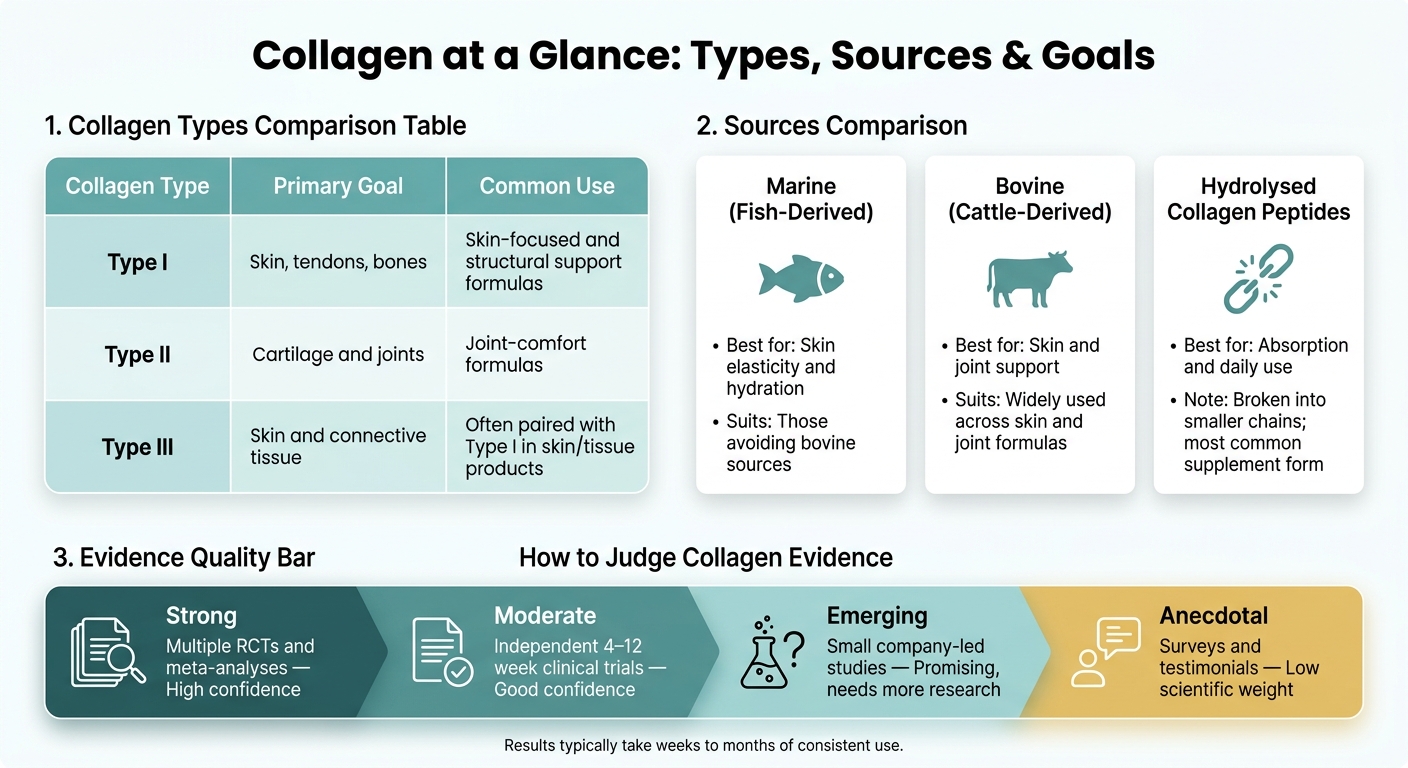
Collagen Types & Sources: Which One Is Right for You?
These tables help sort collagen claims into two buckets: what has decent human data behind it, and what still sits in the “sounds nice, but show me more proof” zone.
How to Judge Collagen Evidence
Use this table to tell apart claims backed by solid research from those based on early signals or personal stories.
| Evidence Level | Typical Source | Interpretation |
|---|---|---|
| Strong | Multiple RCTs and meta-analyses | High confidence; results are reproducible and widely accepted [2][5] |
| Moderate | Independent 4–12 week clinical trials | Good confidence; evidence supports specific claims for the tested population [4][5] |
| Emerging | Small company-led studies | Promising, but still needs larger and longer studies [2][6] |
| Anecdotal | Surveys and testimonials | Low scientific weight; reflects individual experience rather than biological proof [5][6] |
That distinction matters. A collagen product may sound impressive on the label, but the claim only means something if the study quality holds up.
Once the evidence level is clear, the next step is simpler: match the collagen type to the goal.
Collagen Types at a Glance
| Collagen Type / Source | Primary Goal | Common Use |
|---|---|---|
| Type I | Skin, tendons, bones | Common in skin-focused and structural support formulas [2] |
| Type II | Cartilage and joints | Common in joint-comfort formulas [5] |
| Type III | Skin and connective tissue | Often found alongside Type I in skin and tissue support products [2] |
| Marine (fish-derived) | Skin elasticity and hydration | Suits those who avoid bovine sources [4] |
| Bovine (cattle-derived) | Skin and joint support | Widely used across skin and joint formulas [2] |
| Hydrolysed collagen peptides | Absorption and daily use | Broken into smaller chains for easier absorption; the most common supplement form [2][4] |
A simple way to read this: Type I and III usually show up in skin-led formulas, while Type II is more often linked to cartilage and joint use. Hydrolysed collagen peptides are the form most people see in daily powders, sachets, and drinks because they’re easier to use and mix into a routine.
Conclusion: Is Collagen Worth Considering?
Taken together, the research points to collagen as something worth considering if your goal is modest support for skin or joints over time [6]. It’s not magic, and it won’t change things overnight, but for some people, it may play a useful supporting role when used with steady habits.
It also makes sense to pair collagen with vitamin C, since vitamin C helps the body make collagen. At the same time, protecting your skin from UV exposure matters just as much, because too much sun can speed up collagen breakdown [1][2].
Used with realistic expectations, collagen is best seen as a support ingredient, not a fix.
FAQs
Can collagen work from food alone?
Food can help the body make collagen, but the picture is a bit more nuanced than “eat one food and get better skin or joints.” Collagen production depends on having enough total protein, enough amino acids, and key nutrients such as vitamin C, zinc, and copper. It also depends on age, since the body tends to make less collagen over time.
This matters in India, where eating patterns vary a lot. Some people get enough protein without much effort. Others, especially those on low-protein or vegetarian diets, may fall short more often than they realise. In those cases, relying on food alone for collagen support may not always be easy.
A clear way to explain it is this:
- Food supports collagen production, especially when the diet includes enough protein and micronutrients.
- Collagen intake from food can vary, based on what a person eats day to day.
- Age-related changes may lower collagen synthesis, even when the diet looks decent on paper.
- Supplementation may be worth considering for people with low protein intake, limited dietary variety, higher needs, or specific skin, bone, or joint goals.
For non-vegetarians, collagen-rich foods may include bone broth, meat with connective tissue, fish skin, and slow-cooked cuts. For vegetarians, the focus shifts from eating collagen to supporting the body’s own collagen synthesis through foods such as dals, beans, soy, paneer, curd, nuts, seeds, amla, citrus fruits, capsicum, and whole grains.
That said, it’s best not to overpromise. Food-first is a sensible starting point, but it may not fully cover everyone’s needs. If protein intake is low, appetite is poor, ageing is a factor, or dietary choices are restrictive, a collagen supplement or a broader protein support plan may be considered. The key is to present this as a practical option, not a magic fix.
What is the right age to start collagen?
The current search results aren't usable for this query. They focus on other supplements and don't cover the core collagen topics needed for an accurate answer, such as:
- skin support
- joint health
- ageing
- collagen types
- dosage
- safety
- strength of evidence
Please send collagen-specific search results or the source list you want used. Once I have that, I can rewrite the section properly and keep it aligned with the source material.
If you'd like, I can also help you by listing the kind of collagen sources that would fit this section best, such as PubMed studies, review papers, clinical trials, and brand or editorial sources focused on collagen.
Should I take collagen every day?
That depends on the article’s approved direction. To answer it properly, we first need to lock a few basics: the main focus, who the piece is for, how deep the science should go, and how we want to handle collagen types and safety.
We should also line up product positioning, internal links, table use, the India angle, and whether the tone should be a consumer-friendly clinical guide.


Leave a comment
All comments are moderated before being published.
This site is protected by hCaptcha and the hCaptcha Privacy Policy and Terms of Service apply.