



The best time to take vitamin D is not a specific hour of the day. Morning, afternoon or evening can all work. What matters more is taking it consistently and following the instructions for your supplement.
For conventional vitamin D supplements, taking the dose with a meal containing some dietary fat can support absorption. If your supplement is already delivered in an oil-based formulation, meal effects may be less important, although the product label should still guide how you take it.
| Timing option | Practical guidance | What to consider |
|---|---|---|
| Morning | A convenient option if breakfast is consistent | Take it as directed, ideally with a regular meal if the formulation requires it |
| Lunch | Works well for many routines | A balanced meal containing some fat can be suitable |
| Evening | Also suitable | There is no good evidence that evening dosing is inherently less effective |
| With food | A practical choice for many conventional vitamin D supplements | Dietary fat can improve absorption of vitamin D3 in some formulations |
| Empty stomach | Depends partly on formulation | Vitamin D can still be absorbed, but conventional formulations may benefit from being taken with food |
Is It Better to Take Vitamin D in the Morning or Evening?
There is currently no established best time of day to take vitamin D. Research has not shown that an identical dose taken in the morning consistently works better than the same dose taken in the evening.
That means the most useful timing rule is simple: choose a time that fits your routine and makes it easier to take your supplement consistently.
If breakfast is predictable, morning can be convenient. If you regularly skip breakfast but always eat dinner, evening may be easier to maintain.
Morning or lunchtime may also suit people who feel that taking vitamin D later in the day affects their sleep. This is a practical adjustment based on individual experience, not a universal biological requirement to take vitamin D in the morning.
Does Taking Vitamin D at Night Affect Sleep?
Vitamin D status has been studied in relation to sleep quality, and supplementation may influence sleep outcomes in some populations. However, this does not establish that taking vitamin D at night causes insomnia.
Research looking at vitamin D and sleep is different from research directly comparing a vitamin D capsule taken in the morning with the same capsule taken at night. Direct evidence for a harmful nighttime dosing effect remains limited.
If you repeatedly notice sleep disruption after taking vitamin D in the evening, move the same dose to breakfast or lunch and see whether the pattern changes. If sleep problems persist, speak with a qualified healthcare professional rather than assuming vitamin D is the only cause.
Why Taking Vitamin D With Food Can Matter
Vitamin D is a fat-soluble vitamin. Human studies have found that taking conventional vitamin D3 with a fat-containing meal can increase absorption compared with taking it with a fat-free meal.
However, dietary fat should not be treated as an absolute requirement for every vitamin D formulation. Research using vitamin D3 already dissolved in an oily solution found no significant difference between fasting and fed conditions.
This distinction matters because the formulation of the supplement can influence how much meal timing matters.
How Much Fat Do You Need With Vitamin D?
You do not need a heavy or unusually high-fat meal simply to take vitamin D. A normal balanced meal containing some dietary fat is a practical choice.
Examples include:
- Eggs with yoghurt or another regular breakfast
- Dal, vegetables and curd prepared with some cooking oil
- Paneer with vegetables and grains
- Nuts, seeds, nut butter or tahini
- Tofu, pulses or vegetables prepared with a source of dietary fat
The aim is not to create a special “vitamin D meal”. It is to fit supplementation into an eating pattern you can maintain.
Should You Take Vitamin D With Your Largest Meal?
A small clinical study found that people who switched their vitamin D supplementation to their largest meal experienced higher blood levels of 25-hydroxyvitamin D.
However, the study was small and does not establish that everyone must take vitamin D with their largest meal.
A dependable balanced meal is more useful than trying to identify a supposedly perfect meal every day.
What Is a Common Mistake When Taking Vitamin D?
One common mistake is focusing heavily on the exact time of day while overlooking more important factors, such as:
- Taking the supplement consistently
- Following the recommended serving
- Checking whether vitamin D is present in other supplements
- Considering the formulation of the product
- Using higher doses only when appropriate
More vitamin D is not automatically better. Excessive vitamin D intake can disturb calcium balance and can cause harm.
If you are using a high-strength vitamin D supplement or treating a confirmed deficiency, follow medical guidance rather than adjusting the dose yourself.
What Is the Best Time to Take Vitamin D3 and K2 Together?
Vitamin D3 and vitamin K2 can generally be taken as part of the same routine. There is no established need to take one in the morning and the other in the evening.
Vitamin D supports normal calcium absorption and contributes to bone and muscle function, while vitamin K contributes to normal blood clotting and bone-related processes.
The two nutrients have complementary physiological roles, but adding K2 does not make excessive vitamin D intake safe.
People taking warfarin or similar vitamin K antagonist medicines should speak with their healthcare professional before using a supplement containing vitamin K.
How to Take Decode Age DAKE 600 IU
Decode Age DAKE 600 IU combines vitamin D3 from lichen with vitamin K2 MK-7, vitamin A and vitamin E.
Unlike a standard dry vitamin D tablet, DAKE is formulated with coconut-derived MCT oil. This provides an oil-based environment for its fat-soluble vitamins.
Follow the product directions and take one capsule after a meal. You do not need to create an unusually high-fat meal specifically for DAKE.
What About DAKE 5000 IU?
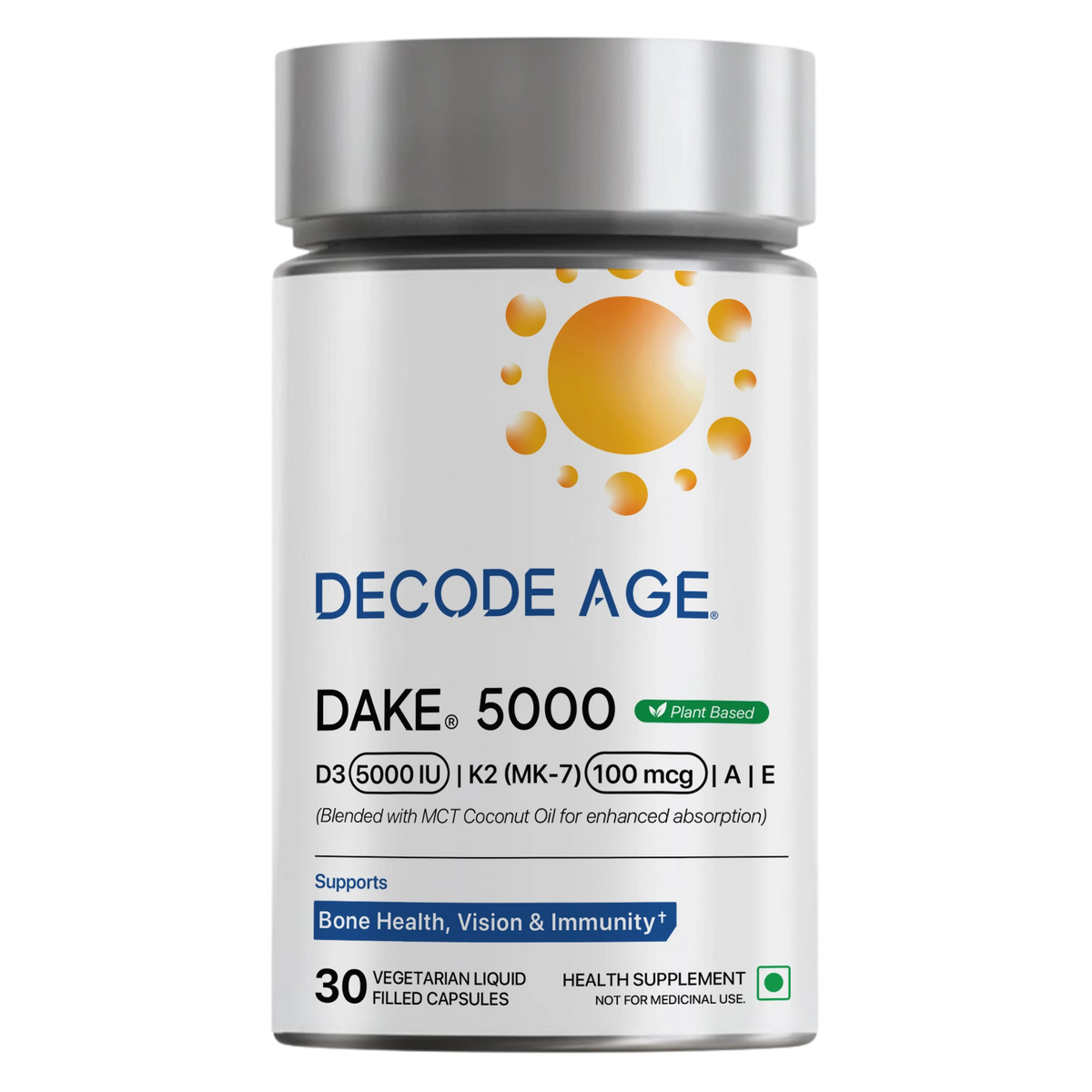
DAKE 5000 IU is a higher-potency formulation containing 5000 IU of vitamin D3 alongside vitamin K2 MK-7, vitamin A and vitamin E.
It is not the default choice for everyone. The current product guidance states that it should be used under medical supervision.
If you have a confirmed vitamin D deficiency or believe you need a higher dose, testing and professional guidance can help determine an appropriate supplementation plan.
How to Decide How Much Vitamin D You Need
The amount of vitamin D you need is a different question from when you should take it.
Appropriate intake can depend on:
- Your current vitamin D status
- Sun exposure
- Dietary intake
- Age
- Skin pigmentation
- Digestive absorption
- Kidney or liver conditions
- Medicines that affect vitamin D or calcium metabolism
- Vitamin D already present in other supplements
A maintenance supplement and a clinician-directed treatment for vitamin D deficiency are not interchangeable.
If deficiency or high-dose supplementation is a concern, a 25-hydroxyvitamin D blood test can help a healthcare professional assess vitamin D status and decide whether treatment is required.
Why Vitamin D Deficiency Can Still Occur in India
Living in a sunny country does not automatically guarantee adequate vitamin D status.
Indoor lifestyles, limited effective sun exposure, skin pigmentation, clothing practices, dietary patterns and individual biological factors can all influence vitamin D status.
Rather than assuming that everyone in India is deficient or adequately supplied, testing can be useful when clinical risk factors or symptoms justify it.
What Should You Not Mix With Vitamin D?
Vitamin D may need additional consideration when used alongside certain medicines or other supplements.
Speak with a clinician or pharmacist if you use:
- Other high-dose vitamin D supplements
- High-dose calcium supplements
- Medicines that affect fat absorption
- Certain diuretics that influence calcium balance
- Vitamin K-containing products while taking warfarin or similar anticoagulants
Professional guidance is particularly important for people with kidney disease, high calcium levels, malabsorption disorders, sarcoidosis or other conditions that affect vitamin D and calcium metabolism.
So, When Should You Take Vitamin D?
There is no proven universal best hour for taking vitamin D.
Morning, afternoon or evening can all be appropriate. For conventional vitamin D supplements, pairing the dose with a regular meal containing some dietary fat can support absorption. Oil-based formulations may behave differently, so always follow the directions for the specific product you use.
The simplest routine is usually the best one: take the correct dose, follow the product instructions and choose a time you can maintain consistently.
Vitamin D Timing FAQs
Is vitamin D better in the morning or at night?
Neither time has been proven universally superior. Choose a time that fits your routine. If taking vitamin D at night repeatedly seems to affect your sleep, try moving the dose earlier.
Can I take vitamin D on an empty stomach?
Vitamin D can still be absorbed without food, particularly in some oil-based formulations. However, human studies suggest that taking conventional vitamin D3 alongside a meal containing some dietary fat can improve absorption.
Should I take vitamin D before or after food?
There is no established minute-by-minute window. If the product is intended to be taken with food, take it during or shortly after a regular meal and follow the label directions.
Can I take vitamin D3 and K2 together?
Yes, vitamin D3 and K2 can generally be included in the same supplementation routine. People taking warfarin or other vitamin K antagonist medicines should seek professional advice before taking supplements containing K2.
Does vitamin D at night cause insomnia?
Current evidence does not establish that taking vitamin D at night causes insomnia. Studies have linked vitamin D status and supplementation with sleep outcomes, but that is not the same as proving that evening dosing disrupts sleep.
What if I miss my vitamin D dose?
Follow the product label or your clinician's instructions. Do not automatically double the next dose, particularly when using a high-strength vitamin D supplement.



Leave a comment
All comments are moderated before being published.
This site is protected by hCaptcha and the hCaptcha Privacy Policy and Terms of Service apply.