



Male Fertility Basics: Why Sperm Need Energy
The main semen parameters that matter
A standard semen analysis looks at a few core markers. In CoQ10 research, the ones that come up most often are sperm count, motility, morphology, and DNA fragmentation.
Count tells you how many sperm are being made. Motility shows how many are moving, especially those moving forward well enough to reach the egg. Morphology looks at sperm shape and size. DNA fragmentation measures the share of sperm carrying damaged genetic material. High fragmentation is a recognised cause of unexplained infertility [2] and is linked to lower pregnancy rates. In day-to-day practice, these results are usually read against WHO reference ranges.
Put simply, these markers help show both how many sperm are present and how well they may function. That matters, because a sample can look decent on one marker and still run into trouble on another.
The table below sums up the semen markers most relevant to CoQ10 studies.
| Semen Parameter | What It Measures | Why It Matters |
|---|---|---|
| Concentration | Sperm per mL of semen | Shows the density of the sample |
| Total Count | All sperm in the ejaculate | Points to overall sperm production |
| Motility | Percentage of moving sperm | Needed to travel towards the egg |
| Morphology | Size and shape of sperm | Can affect swimming and egg penetration |
| DFI | Percentage with DNA damage | High levels are linked to lower pregnancy rates |
How mitochondria power sperm movement
Sperm need a lot of energy to move and to take part in fertilisation. That energy comes in the form of ATP, which is made in the mitochondria found in the sperm midpiece [4]. If you picture a sperm cell like a tiny swimmer, the mitochondria are its battery pack.
This makes mitochondrial function directly relevant to male fertility. It also explains why CoQ10 gets so much attention in this area. CoQ10 helps support mitochondrial energy production, and sperm depend on that energy for motility.
How oxidative stress damages sperm
Sperm are especially at risk from oxidative stress. Their plasma membranes are rich in polyunsaturated fatty acids, and these are easy targets for reactive oxygen species, or ROS. When ROS levels climb past the antioxidant defences in seminal fluid (often supported by CoQ10 supplements), lipid peroxidation starts. From there, the damage can spread.
The effects may include:
- Lower motility
- Structural abnormalities
- DNA fragmentation
One tricky part is that standard semen results can still appear normal even when oxidative damage is present [1].
That link between energy production and oxidative damage is a big reason CoQ10 has become such a key area of interest in male fertility research.
sbb-itb-55c436e
Why CoQ10 Is Studied for Male Fertility
CoQ10 sits near the heart of sperm energy supply and antioxidant defence. That’s the main reason researchers keep coming back to it in male fertility studies. On paper, the logic is simple: sperm need energy to move, and they also need protection from oxidative stress. CoQ10 is involved in both.
CoQ10's role in energy production inside cells
CoQ10 is a key part of the mitochondrial electron transport chain. It works as an electron carrier that helps mitochondria make ATP [1][6]. In plain terms, it helps cells produce usable energy.
For sperm, that matters a lot. The tail needs ATP to power forward movement. If energy output drops, motility can suffer.
How CoQ10 may protect sperm from oxidative damage
CoQ10 also works as an antioxidant. Sperm membranes contain high levels of polyunsaturated fatty acids, which makes them more prone to oxidative damage. This is a weak spot, and reactive oxygen species can hit it hard.
By helping limit ROS-driven lipid peroxidation, CoQ10 may help protect sperm membrane integrity and DNA [1]. You can think of it as support on two fronts: helping sperm keep moving while also helping shield their structure.
CoQ10 levels in semen and sperm cells
CoQ10 can be measured in seminal fluid, and its concentration has been linked with sperm count and motility [1][6]. That link doesn’t prove cause and effect, but it does give researchers a solid reason to study it more closely.
In studies, a dose of 200 mg/day increased seminal plasma CoQ10 by about three-fold and sperm-cell levels by about two-fold [1]. That shows oral supplementation can change CoQ10 status in the reproductive tract, not just in theory but in measured samples.
| CoQ10 Function | Mechanism in Sperm Cells | Relevance to Fertility |
|---|---|---|
| Bioenergetic | Electron carrier in the transport chain; supports ATP production | Powers the sperm tail for forward movement |
| Antioxidant | Limits ROS-driven lipid peroxidation | Protects sperm membrane integrity and DNA |
| Seminal biomarker | Natural seminal marker linked to sperm count and motility | Provides a biological rationale for supplementation |
Mechanism alone does not prove benefit; the next section tests this in human studies.
What Human Studies Show: Sperm Count, Motility, Morphology, and DNA Fragmentation
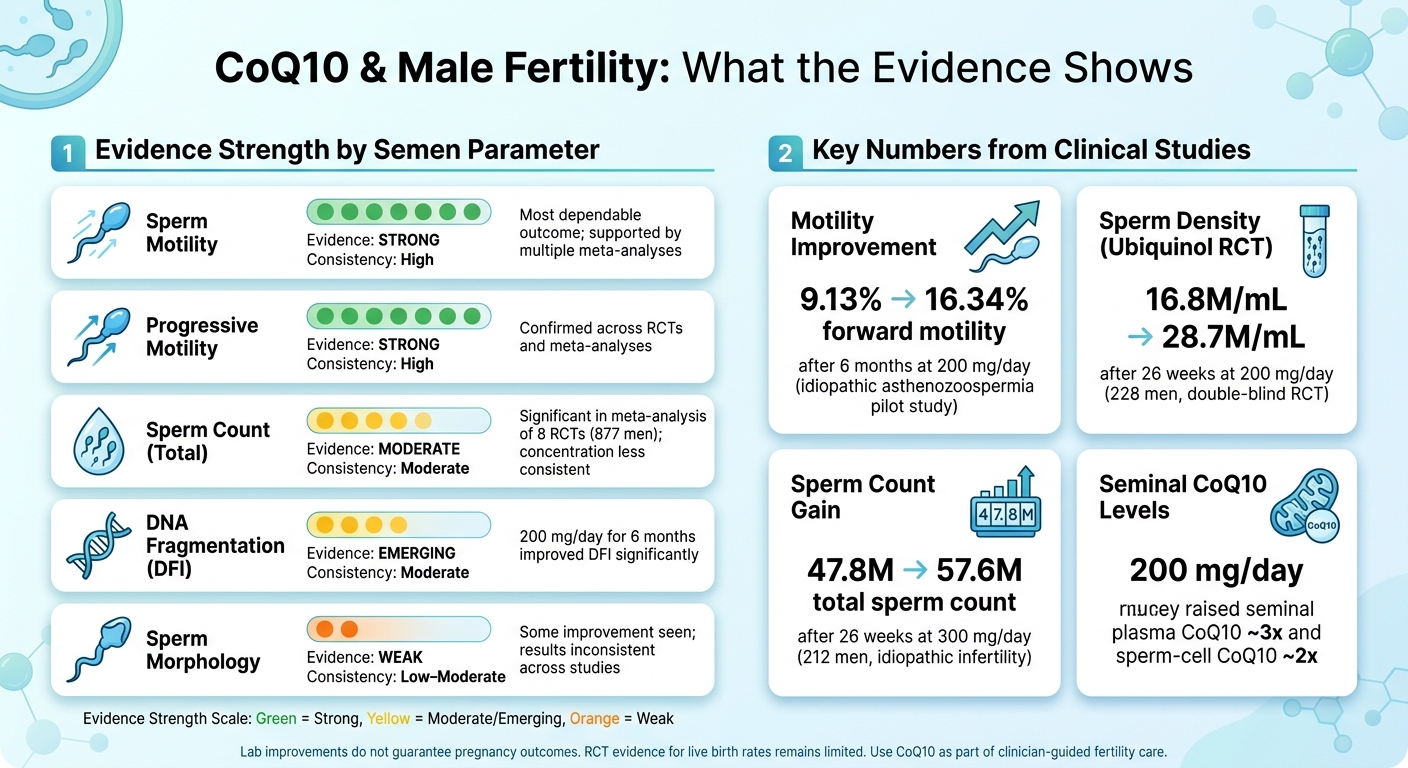
CoQ10 for Male Fertility: Evidence Strength by Semen Parameter
Human studies point to one pattern more than any other: CoQ10 seems to help sperm motility most clearly. Effects on sperm count are less steady, while morphology and DNA damage show mixed but useful signals. So it makes sense to begin with motility, where the evidence is strongest.
Sperm count and concentration
A 2025 meta-analysis of 8 randomised controlled trials covering 877 men found a statistically significant improvement in total sperm count, but sperm concentration did not reach statistical significance in the same review [3]. That distinction matters. Count and concentration are linked, but they are not the same thing, and studies do not always move both in the same direction.
In a study of 212 men with idiopathic infertility, taking 300 mg/day for 26 weeks increased total sperm count from 47.8 ± 11.2 million to 57.6 ± 14.4 million [1]. Another 2025 prospective study of 250 patients suggests dose may play a part: 200 mg/day led to bigger gains in sperm concentration than 100 mg/day [2].
So the signal on count is there, but it is not as steady as the one seen for motility.
Sperm motility and progressive movement
This is where CoQ10 looks most convincing. The same meta-analysis reported higher total motility and progressive motility in men taking CoQ10 [3]. In a pilot study of men with idiopathic asthenozoospermia, 200 mg/day increased forward motility from 9.13% ± 2.50% to 16.34% ± 3.43% after six months [1].
That result lines up with CoQ10’s role in mitochondrial ATP production. Put simply, sperm need energy to move, and mitochondria are the engine room. If that engine works better, movement may improve too.
Across meta-analyses and randomised trials, this pattern keeps showing up. Motility is the most dependable semen outcome linked with CoQ10 supplementation.
The next step is to ask whether better movement also comes with better sperm structure and less DNA damage.
Morphology and DNA integrity
Morphology appears to improve in some studies, but the effect is smaller and less steady. The same meta-analysis found higher proportions of normally formed sperm in CoQ10-treated groups [3]. Still, this result is not as consistent as the improvement seen in motility.
DNA fragmentation is a bit more interesting. Treatment with 200 mg/day for six months significantly improved the DNA Fragmentation Index (DFI) [2]. That matters because sperm can look acceptable on a standard semen test and still carry DNA damage. This is one reason DFI is now often read alongside routine semen analysis.
| Semen Parameter | Consistency of Improvement | Strength of Evidence |
|---|---|---|
| Sperm Motility | High | Strong - multiple meta-analyses |
| Progressive Motility | High | Strong - multiple meta-analyses |
| Sperm Count | Moderate | Mixed - conflicting RCT results |
| Sperm Morphology | Low to Moderate | Weak - inconsistent findings |
| DNA Fragmentation | Moderate | Emerging - positive recent trials |
Lab gains are useful, but they still do not prove a pregnancy benefit.
Do Better Semen Results Lead to Pregnancy?
Better semen numbers on a lab report are encouraging. But for most couples, the bigger issue is simple: do those changes help lead to pregnancy?
Right now, the answer is still a bit unsatisfying. CoQ10 seems to help some semen markers, but the proof for pregnancy and live birth is still thin.
Pregnancy and live birth outcomes
Most CoQ10 trials look at semen parameters like motility, count, and morphology. Those markers matter, but they are still lab markers, not direct proof of fertility success. A man may show better sperm movement or a higher count on paper, yet that does not always translate into pregnancy.
Some open-label studies have reported hopeful pregnancy rates. Still, those findings carry less weight than blinded randomised trials, because they are more open to bias.
Meta-analyses of RCTs back improvements in sperm count and motility, but they do not show the same level of proof for pregnancy outcomes [3]. That gap is important. It means CoQ10 may support sperm health, but we still need larger, better-run RCTs to know whether it changes the odds of conception or live birth in a clear way.
There is one more practical point here. When CoQ10 is stopped, semen parameters often drift back toward baseline within 3 to 6 months [1]. So even where lab gains appear, they may not last without continued use.
What fertility guidance currently says
Current fertility guidance places CoQ10 in the supportive category for idiopathic male infertility. In plain terms, that means it may help in some cases, but it is not viewed as a proven fertility treatment.
That matters in the real world. If conception has not happened after 12 months of regular, unprotected intercourse, CoQ10 should be used alongside a fertility work-up, not in place of one. For couples, that can be the difference between trying a support supplement and missing a deeper issue that needs medical care.
| Evidence Type | What It Shows | Strength |
|---|---|---|
| Meta-analyses of RCTs | Improved sperm motility and count | High for motility; moderate to high for count |
| Prospective open-label studies | Pregnancy outcomes reported, but evidence is less certain | Low to moderate |
| RCTs (pregnancy/live birth) | Insufficient data to confirm a clear benefit | Low |
If you plan to use CoQ10, the next thing to look at is dose, duration, and form.
CoQ10 Dosage for Male Fertility: How Much, How Long, and Which Form
Once you get past the research, the practical bit is simple: how much should you take, for how long, and in which form?
Doses used in clinical research
Most studies on male fertility use 200–300 mg per day [1][6]. Some go up to 400 mg daily, and in a few trials, those higher doses were linked with bigger improvements in sperm motility and antioxidant markers [1].
A 2025 study by Chaymae Rochdi and colleagues at Mohammed VI University Hospital Centre tracked 250 men with idiopathic oligoasthenozoospermia for 6 months. Men taking 200 mg/day had better gains in sperm concentration and DNA Fragmentation Index than men taking 100 mg/day. Their partners also had a higher pregnancy rate [2]. That points to an important takeaway: very low doses may not do enough.
Across several trials, the clearest changes tend to show up after about 3 months, with stronger results often seen by 6 months.
How long to take CoQ10 before checking semen results again
This part comes down to biology. Spermatogenesis takes about 72 to 90 days, so most studies check semen markers again after 3 to 6 months [1][5][2]. That timeline makes sense. You’re not flipping a switch overnight; you’re waiting for a new cycle of sperm production.
Here’s the general pattern seen in research:
- Sperm concentration and motility may improve by around 3 months
- Morphology can take longer to shift [3][2]
- After stopping CoQ10, semen markers often drift back towards baseline within 3 to 6 months [1]
So if someone starts CoQ10 and tests again after only a few weeks, they may be jumping the gun.
Ubiquinone vs ubiquinol: which form to choose
CoQ10 usually comes in two forms: ubiquinone and ubiquinol.
| Feature | Ubiquinone | Ubiquinol |
|---|---|---|
| Form | Oxidised form | Reduced, active antioxidant form |
| Research use | Used in most early fertility studies [1][6] | Used in more recent studies [1] |
| Common research dose | 200–400 mg/day [1] | 150–200 mg/day [1] |
| Best-known role | Mitochondrial ATP production [6] | Direct scavenging of reactive oxygen species [1] |
Both forms have shown positive results in fertility research. A 2012 randomised, double-blind, placebo-controlled trial gave 228 men 200 mg of ubiquinol daily for 26 weeks. Sperm density went from 16.8 million/mL to 28.7 million/mL, and motility increased from 25.4% to 35.8% [1]. As with other studies, the gains may fade after stopping.
Ubiquinol is the reduced form and is usually absorbed more easily, which is why studies often use it at slightly lower doses [1][2].
At this stage, the main decision is usually about form and dose. Safety and possible interactions are the next things to look at.
Safety, Side Effects, and Use Alongside Fertility Treatment
After efficacy and dosage, safety and treatment timing help decide whether CoQ10 makes sense in a fertility plan.
Side effects and general safety profile
CoQ10 is generally well tolerated. Trials have reported very few serious adverse events [3]. When side effects do show up, they are usually mild and linked to the gut, such as nausea, stomach upset, or loose stools. Taking CoQ10 with food, or splitting the daily dose into smaller amounts, may help with tolerance.
Overall, clinical studies show that CoQ10 is usually easy for most men to take.
When to speak with a healthcare professional first
CoQ10 is not something every man should begin without medical advice. Because it is structurally similar to vitamin K, it may reduce the effect of warfarin. It may also interact with insulin and some blood pressure medicines, so men with diabetes or high blood pressure should check with a clinician first.
Men with existing liver or kidney conditions, or those having chemotherapy, should also get advice before starting. If you are already on a fertility treatment pathway - whether that includes a semen analysis workup, IUI, IVF, or ICSI - it is best to coordinate CoQ10 use with your fertility specialist instead of starting it on your own.
Using CoQ10 as an adjunct to fertility care
In men with unexplained infertility, CoQ10 should be used as an adjunct, not as a replacement for diagnosis or treatment of the underlying cause.
If semen analysis or assisted reproduction is already in progress, the timing of supplementation should be planned with the treating clinician. For IUI or IVF, align the start date and dose with the clinic.
How to Choose a Good CoQ10 Supplement
If you plan to use CoQ10 for sperm health, pick a product you can stay with every day for 3 to 6 months. That matters because supplements like this usually aren’t a one-week fix. After that, check three things on the label: form, dose, and absorption support.
What to check on the label
Start with the form of CoQ10 in the product. Most labels mention either ubiquinone, the oxidised form, or ubiquinol, the reduced form, which is often absorbed more easily [1]. Both forms have appeared in clinical research.
Then look at the dose per serving. A good rule is to match the dose range used in studies. That usually means 200 to 400 mg per day for support related to sperm motility [2][5].
Bioavailability and formulation quality
CoQ10 is a fat-soluble nutrient, so the format makes a difference. Oil-based softgels are often a better pick than dry powders. You can also look for formulas that use carriers like rice bran oil or soybean oil to help absorption [1]. Taking CoQ10 with a meal that includes some fat can help too.
Form is only one part of the story. Manufacturing quality matters just as much. Look for products made in GMP-certified, FSSAI-compliant facilities. If a brand also shares where its raw material comes from, that’s a good sign. It shows the company is willing to tell you what’s inside the bottle, not just sell the front label.
A practical buying checklist for Indian readers
Because CoQ10 often needs at least 3 to 6 months of steady daily use, it helps to think beyond the pack price. A bottle may look cheap at first glance, but the better comparison is price per milligram. Just divide the total cost in ₹ by the total milligrams in the bottle. It’s a simple check, but it can save you from overpaying.
| What to Check | Why It Matters |
|---|---|
| Form: ubiquinone or ubiquinol | Helps you understand the supplement's absorption profile and antioxidant form |
| Dose per serving (aim for 200–400 mg/day) | Matches the range most often linked with better sperm motility [2][5] |
| Oil-based softgel delivery | Supports absorption of this fat-soluble nutrient [1] |
| GMP-certified, FSSAI-compliant facility | Helps ensure manufacturing quality and ingredient accuracy |
| Third-party testing seal (USP or NSF) | Helps confirm purity and absence of contaminants |
| Batch number and expiry date printed on pack | Supports traceability and freshness |
| Price per milligram in ₹ | Helps you judge affordability over a 3 to 6 month supply |
Once the label checks out, the next thing to look at is safety and possible drug interactions.
Conclusion: Where CoQ10 Fits in a Male Fertility Plan
Taken together, the research points to CoQ10 as a support tool, not a fix-all. The clearest signal is in sperm motility, while results for other semen markers are weaker and less steady. Some newer data suggest that 200 mg/day may help improve pregnancy rates after 6 months of use, but the bigger picture on live birth outcomes is still uncertain [2].
That’s why choosing the right patient matters. Men with low sperm motility without a clear cause, or those dealing with unexplained infertility, are the most likely to benefit. In most cases, CoQ10 fits into a 3- to 6-month pre-conception window, which matches the full cycle of spermatogenesis [1].
There’s another practical point here: the gains may taper off after stopping. So, timing and day-to-day consistency aren’t small details; they matter. When used as advised, CoQ10 makes the most sense as one part of a longer fertility plan.
CoQ10 earns its place because sperm need two things at once: mitochondrial energy and defence against oxidative stress. If you're weighing up options, keep your eye on the basics - dose, form, and product quality. For dosage guidance and product selection, stick with clinically studied dosing and a well-formulated CoQ10 supplement.
CoQ10 fits best as a supportive, evidence-informed add-on for men with low motility or unexplained infertility - not as a stand-alone treatment, but as part of clinician-guided fertility care.
FAQs
Who is most likely to benefit from CoQ10?
CoQ10 may help most in cases of idiopathic male infertility, where no clear cause is found and oxidative stress may be harming semen quality. Studies suggest it may support sperm motility, total sperm count, and sperm DNA integrity.
In most studies, the effects tend to show up after 3 to 6 months of daily use, usually at 100–300 mg per day. One practical point: semen markers may drift back to baseline after stopping supplementation.
Should I get a semen analysis before starting CoQ10?
A semen analysis can give you a clear starting point before you begin CoQ10. It helps you see where things stand, so any changes over time are easier to track.
Research suggests CoQ10 may support male fertility in two main ways: it may help lower oxidative stress, and it may support ATP production, which fuels sperm movement and function.
Studies have reported gains in sperm motility, total sperm count, normal sperm shape, and, in some cases, DNA fragmentation. The strongest results are usually seen after 3 to 6 months of daily use, most often at 100 mg to 300 mg per day.
Can CoQ10 be taken during IVF or ICSI?
Yes. Research suggests CoQ10 may support male fertility during IVF or ICSI by helping improve sperm motility. Some studies also link it with better sperm count, morphology, and lower DNA fragmentation.
Common study doses are 100–300 mg daily for 3–6 months. That timeline makes sense because sperm development takes around 74 days, so changes often need a few months to show up. Even so, stronger studies are still needed, especially when it comes to outcomes like pregnancy rates and live births.


Leave a comment
All comments are moderated before being published.
This site is protected by hCaptcha and the hCaptcha Privacy Policy and Terms of Service apply.