



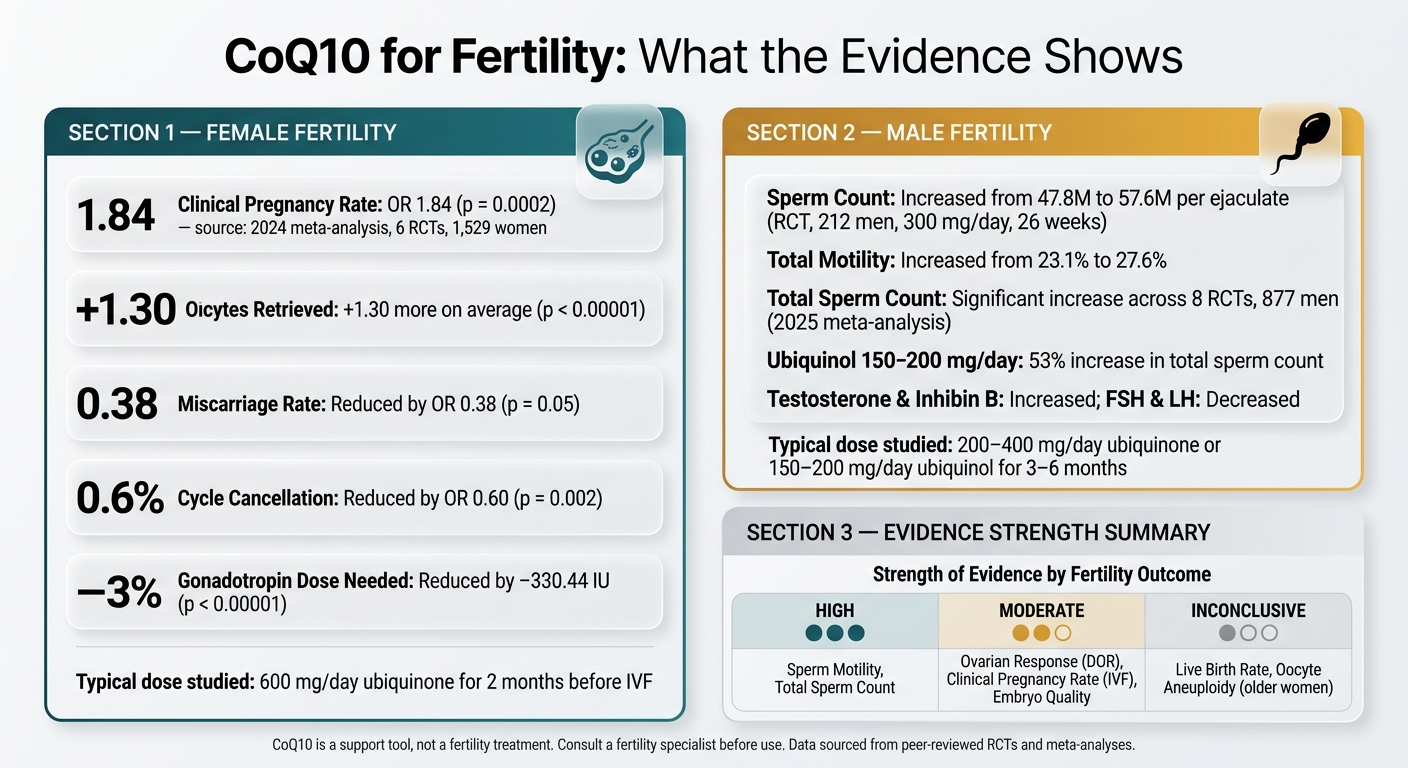
CoQ10 for Fertility: Key Evidence at a Glance
What Is Coenzyme Q10 and How Does It Work?
CoQ10, ATP, and Mitochondrial Energy Production
Fertility starts at the cell level. Two things matter a lot here: steady energy supply and protection from oxidative stress. Coenzyme Q10, or CoQ10, helps with both.
CoQ10 is a fat-soluble compound found in cell membranes, with its highest levels in the inner mitochondrial membrane. Its main job is to move electrons through the electron transport chain, which helps the cell make ATP, the energy currency cells run on [2][3].
That link to fertility is a big one. Oocytes have the highest mitochondrial density of any human cell, and they need large amounts of ATP to mature properly and support fertilisation [2]. Put simply, no energy, no smooth cell function.
CoQ10 as an Antioxidant in Reproductive Cells
CoQ10 also helps protect cells from oxidative damage. It can limit harm to DNA, proteins, and cell membranes. That matters in reproductive health because sperm cells are especially exposed. Their membranes are rich in polyunsaturated fats, which makes them more likely to undergo oxidative damage [7].
There’s another point worth noting. Oral CoQ10 supplementation has been verified to reach the follicular fluid, which means it does get into the fluid surrounding the developing egg [1]. That’s important because it shows the compound can reach the ovarian microenvironment, not just circulate in the bloodstream.
Ubiquinone vs Ubiquinol: What You Need to Know
CoQ10 comes in two forms. Ubiquinone is the oxidised form, while ubiquinol is the reduced form and the active antioxidant form [1]. The body keeps moving between these two states through its redox cycle [3].
| Feature | Ubiquinone | Ubiquinol |
|---|---|---|
| Chemical state | Oxidised [1] | Reduced form (active) [1] |
| Primary role | Supports the electron transport chain and ATP production [2] | Helps prevent lipid peroxidation as an antioxidant [3][1] |
Both forms have been shown to increase CoQ10 levels in seminal fluid and follicular fluid [7][3].
These cell-level functions help explain why CoQ10 is studied so often in ageing eggs, sperm health, and fertility treatment.
sbb-itb-55c436e
Ask The Expert - Mahesh Jayaraman | Episode 02 |
Why Fertility Declines With Age
Ageing puts pressure on the same mitochondrial systems that CoQ10 helps support, especially in eggs and sperm.
How Egg Quality and Ovarian Function Change With Age
In women, the drop in fertility with age is closely linked to oocyte quality and mitochondrial function. As oocytes get older, their mitochondria become less efficient. That means less energy for key jobs like chromosome separation, fertilisation, and early embryo development. If chromosome separation goes wrong, embryo development is less likely to progress well. Aged oocytes show high aneuploidy rates in women aged 35–43 [3].
CoQ10 levels also decline with age, which further reduces mitochondrial support in eggs [3].
Age-Related Changes in Sperm and Oxidative Damage
Male fertility also changes with age, though the biology is a bit different. As men get older, oxidative stress can damage sperm membranes and increase lipid peroxidation, DNA fragmentation, and apoptosis [7]. Over time, this can lead to poorer motility, weaker morphology, and lower DNA integrity.
Between 30% and 80% of infertile men have high levels of reactive oxygen species in their seminal fluid [7]. Age-related hormone shifts can add to the problem. FSH and LH often rise, while testosterone and inhibin B tend to fall, which points to reduced testicular function [7][6].
Lifestyle, Metabolic Health, and Oxidative Stress
Age is only part of the story. Smoking, pollution, obesity, and diabetes can all increase oxidative stress in both eggs and sperm [7][3].
In men, varicocele has been linked to lower CoQ10 levels and higher oxidative stress markers [7]. In women, conditions such as PCOS and endometriosis can create follicular environments with a higher oxidative load [3].
Taken together, these changes help explain why CoQ10 is being studied in fertility medicine.
CoQ10 and Female Fertility: What the Science Shows
Human studies are now looking at a practical question: can CoQ10 help egg quality, ovarian response, and IVF results?
Egg Quality, Ovarian Reserve, and Embryo Development
CoQ10 helps mitochondria make ATP, which is the energy source developing oocytes need. It may also reduce ROS-related damage during egg development [3]. Research also suggests that CoQ10 pretreatment may help follicle survival and increase antral follicle count (AFC) [3].
In women under 35 with poor ovarian reserve, taking 600 mg per day for two months before IVF led to better fertilisation and a higher number of good-quality embryos [3].
Evidence in Women With Diminished Ovarian Reserve or Poor IVF Response
The clearest human data so far comes from women with diminished ovarian reserve (DOR) and those who respond poorly during IVF or ICSI. A 2024 meta-analysis pooled six randomised controlled trials with 1,529 participants with DOR. It found that CoQ10 pretreatment was linked with better IVF outcomes, including a higher clinical pregnancy rate, more oocytes retrieved, more optimal embryos, fewer cycle cancellations, lower gonadotropin use, and a lower miscarriage rate [4].
| Outcome in DOR Patients (IVF/ICSI) | Effect of CoQ10 Pretreatment | Statistical Significance |
|---|---|---|
| Clinical Pregnancy Rate | Increased (OR 1.84) | p = 0.0002 |
| Number of Oocytes Retrieved | Increased (MD +1.30) | p < 0.00001 |
| Miscarriage Rate | Decreased (OR 0.38) | p = 0.05 |
| Cycle Cancellation Rate | Decreased (OR 0.60) | p = 0.002 |
| Total Gonadotropin Dose Required | Reduced (MD −330.44 IU) | p < 0.00001 |
Lower gonadotropin use may point to a better ovarian response to stimulation [4]. In simple terms, the ovaries may need less medication to produce a response, which is a meaningful signal in IVF settings.
There is also some data in older women. In women aged 38 and above undergoing in vitro maturation (IVM), adding CoQ10 to the culture media improved maturation rates to 82.6%, compared with 63% in controls. It also lowered chromosome-error rates in mature oocytes to 36.8%, versus 65.5% in untreated oocytes [3].
What the Reviews Conclude for Women
Taken together, the best evidence is in women with DOR, poor ovarian response, and clomiphene-resistant PCOS [4][3]. That said, there’s still a catch. Many studies are small, doses vary a lot, and methods are not always aligned. Because of that, the evidence on live birth rates is still not settled [4][3].
Next, the same question is whether CoQ10 helps male fertility in a similar way.
CoQ10 and Male Fertility: What the Science Shows
Male factor infertility is linked to about half of all infertility cases, and oxidative stress plays a big part in many of them [7]. So the key issue isn’t just that CoQ10 is present in sperm. What matters is whether it improves the functions sperm need for fertilisation.
How CoQ10 May Support Sperm Function
Sperm need a steady supply of mitochondrial ATP to move well, and their fat-rich membranes are easy targets for ROS damage. CoQ10 helps on both fronts by supporting energy production and antioxidant defence [7][3]. In simple terms, it may help sperm move better while also helping protect their structure and DNA.
Some clinical findings also suggest effects beyond sperm cells alone. CoQ10 supplementation has been linked with higher serum testosterone and inhibin B, along with lower FSH and LH, which points to a possible role in testicular function [5][6].
That’s the biological case. The human trials look at whether these effects show up in men with infertility.
Clinical Trials in Idiopathic Male Infertility
Across human studies, the most steady findings are seen in sperm motility and count. In a randomised, double-blind, placebo-controlled trial of 212 infertile men with idiopathic oligoasthenoteratospermia, 300 mg of CoQ10 per day for 26 weeks increased sperm count from 47.8 ± 11.2 × 10⁶ to 57.6 ± 14.4 × 10⁶. Motility also improved from 23.1 ± 2.1% to 27.6 ± 2.2% [7][6].
Another trial comparing doses in 65 men found that 400 mg daily led to stronger gains in sperm kinetic parameters and antioxidant enzyme activity than 200 mg daily [7]. That matters because it hints that dose may affect results, at least in some men.
A 2025 meta-analysis of eight randomised controlled trials covering 877 men backed up these trends at the population level. It found significant increases in total sperm count, total and progressive motility, and the share of normally formed sperm. It also reported higher testosterone and inhibin B [5].
The next step is sorting out where the evidence is strong and where it still looks patchy.
What the Reviews Conclude for Men
The clearest signal is for sperm motility and total sperm count. These show steady, statistically significant gains across many RCTs and meta-analyses [5][7]. Morphology and DNA fragmentation have moderate support, with better results often seen in men who start with high oxidative stress [7].
| Semen Parameter | Evidence Strength | Typical Outcome |
|---|---|---|
| Total Motility | High | Significant increase across multiple RCTs [7][5] |
| Total Sperm Count | High | Significant increase per ejaculate [5] |
| Morphology | Moderate | Higher proportion of normally formed sperm [5][6] |
| DNA Integrity | Moderate | Reduction in DNA fragmentation and oxidative stress markers [7] |
| Sperm Concentration | Low/Mixed | Variable results; high heterogeneity in meta-analyses [5] |
| Semen Volume | Low | No significant change in most trials [5] |
Where things are less clear is natural pregnancy and live birth. One prospective study of 287 men reported a total pregnancy rate of 34.1% at a mean of 8.4 months after CoQ10 therapy [7]. Even so, larger trials focused on pregnancy outcomes are still needed before any firm call can be made [5][6].
"CoQ10 is still one of the most promising molecules to treat idiopathic male infertility and warrants further investigation." - Gianmaria Salvio et al. [7]
One practical point stands out: benefits may fade within 12 to 30 weeks after stopping supplementation, so timing may matter a lot [7][6]. That becomes even more relevant when fertility treatment is planned, which is why the next section looks at CoQ10 in IVF and IUI.
CoQ10 and Assisted Reproductive Treatments
When conception shifts to IVF or IUI, timing becomes just as important as how CoQ10 works in the body. In this setting, CoQ10 is usually used before treatment as a supporting add-on, not as a stand-alone fertility option.
Taking CoQ10 Before IVF or IUI
Clinical studies have usually started CoQ10 1–3 months before an IVF or IUI cycle in women, and 3–6 months before in men, in line with the spermatogenesis cycle [3][7][5]. That timing makes sense because eggs and sperm need time to develop, so starting early gives the supplement a better chance to act during that window.
Possible Effects on Ovarian Response and Embryo Development
In women with DOR or poor ovarian response, CoQ10 pre-treatment has been linked with a higher number of oocytes retrieved and a better response to ovarian stimulation. In men, it has been tied to improved motility and total sperm count, which may help IVF or ICSI outcomes [4][5]. That said, these changes have not been shown to lead to live birth in a steady way across studies.
Why Specialist Guidance Matters
Dose and supplement combinations can differ based on the diagnosis and the clinic’s treatment plan [7][3]. That’s why fertility specialist input matters. They can line up CoQ10 timing with the treatment cycle and the person’s underlying fertility issue.
The next section pulls these IVF and IUI findings into an overall trial summary.
What Clinical Trials Show Overall
Taken together, the studies above show a fairly clear pattern, even if the size of the effect changes from one group to another. In human trials, CoQ10 shows its clearest signal in mitochondrial support. That shows up most clearly as better sperm motility in men and a better ovarian response in women with diminished ovarian reserve. At the same time, the evidence base still has gaps. Many trials are small, study designs differ, and live birth data are still sparse.
Key Findings From Female Fertility Studies
The strongest female evidence comes from women with diminished ovarian reserve (DOR) or poor ovarian response who are undergoing IVF. A 2024 meta-analysis of 6 RCTs involving 1,529 women with DOR found that CoQ10 pretreatment was linked with a higher clinical pregnancy rate (OR = 1.84) and a lower miscarriage rate (OR = 0.38) [4]. The same analysis found that CoQ10 pretreatment increased oocyte yield and cut the gonadotropin dose needed during stimulation [4].
That matters because women with DOR often face a frustrating numbers game: fewer eggs retrieved, heavier stimulation, and less room for error. CoQ10 does seem to help on those IVF-response measures. But there’s still one big caveat: live birth data remain limited.
The male evidence is more consistent on semen measures, though it still does not prove a clear pregnancy effect.
Key Findings From Male Fertility Studies
A meta-analysis of 8 RCTs involving 877 men found higher total sperm counts and progressive motility in participants treated with CoQ10 [5]. In plain terms, sperm tended to move better and appear in greater numbers during supplementation. That fits with CoQ10’s role in cellular energy production, since sperm movement depends heavily on mitochondrial function.
There is, however, a practical catch. Sperm parameters often drift back to baseline within about 6 months of stopping supplementation [7]. So the effect may not last once intake stops.
Evidence Summary Table
| Fertility Goal | Main Effect Studied | Strength of Evidence |
|---|---|---|
| Sperm motility | Enhances mitochondrial energy for movement | High |
| Ovarian response (DOR) | Increases oocyte yield; lowers gonadotropin dose | Moderate |
| Clinical pregnancy rate (IVF) | Improves odds in women with DOR | Moderate |
| Embryo quality | May improve high-quality embryo numbers | Moderate |
| Oocyte aneuploidy | May lower chromosomal abnormalities in older oocytes | Low/Emerging |
| Live birth rate | Most important outcome | Inconclusive |
The next section turns this evidence into practical guidance on dose, timing, and safety.
Dosage, Duration, and Safety When Trying to Conceive
Dose and timing matter. That’s what turns a study result into something you can actually use when planning pregnancy or IVF.
Doses and Timeframes Used in Clinical Studies
Clinical studies in women have tested daily CoQ10 doses ranging from 180 mg to 1,200 mg per day [3]. In PCOS research, 180 mg has been used from cycle day 2 until ovulation. Women with diminished ovarian reserve have also been studied with CoQ10 pretreatment before IVF [3][4]. That said, a daily dose of 1,200 mg did not improve pregnancy rates in poor ovarian responders [3].
In men, most randomised controlled trials have used 200 mg to 400 mg per day. Some studies have also tested ubiquinol at 150 mg to 200 mg daily for 6 months [7].
In fertility research, the timing has been fairly consistent:
- Women usually took CoQ10 for 1 to 2 months before IVF
- Men usually took it for 3 to 6 months
The table below shows the main study patterns across groups.
| Population | Dose | Duration | Main Finding |
|---|---|---|---|
| Women with DOR preparing for IVF | 600 mg (ubiquinone) | 2 months | Improved embryo quality [3] |
| Women with PCOS | 180 mg (ubiquinone) | Cycle day 2 to ovulation | Increased ovulation rate (65.9% vs 15.5% in controls) [3] |
| Men with idiopathic infertility | 200–400 mg (ubiquinone) | 3–6 months | Improved sperm count, motility, and morphology [7] |
| Men with idiopathic infertility | 150–200 mg (ubiquinol) | 6 months | 53% increase in total sperm count [7] |
One point stands out in male fertility studies: sperm gains have been shown to return to baseline within about 6 months after stopping supplementation [7]. In plain terms, the effect seems linked to continued use rather than a lasting carryover effect.
CoQ10 is also fat-soluble, so it’s better absorbed when taken with a meal that contains some dietary fat [3]. A simple breakfast or lunch with nuts, curd, eggs, or another fat source can help.
These ranges give a rough frame for what has been tested. But study doses are only part of the picture. Safety and supplement quality matter just as much.
Safety, Side Effects, and Drug Interactions
CoQ10 is generally well tolerated. When side effects do show up, they’re usually mild and tend to involve the stomach or gut. If it causes discomfort, taking it with food may help.
There are a couple of points worth flagging. In one male trial, 300 mg/day for 26 weeks lowered FSH and LH [7]. In ovarian stimulation protocols, CoQ10 may also change response patterns [3]. That doesn’t mean it should be avoided, but it does mean it shouldn’t be added casually.
Tell your fertility specialist before starting CoQ10, especially if you’re using clomiphene citrate or preparing for an ART cycle. Fertility care can be finely timed, and even small changes to a supplement plan can matter.
Fertility Planning and When to Seek Medical Advice
CoQ10 is an adjunct, not a fertility treatment. Think of it as something that may support a plan, not replace one. That’s why timing matters so much, whether you’re trying naturally or preparing for IVF.
A fertility specialist can help you decide if CoQ10 fits your protocol, what dose may suit your case, and how long to use it. This matters even more if you have PCOS, diminished ovarian reserve, or take other medicines [3][4].
Once dose and safety are sorted, the next practical step is product selection. Not all CoQ10 supplements are made the same, so the next step is choosing a CoQ10 supplement with the right form, dose, and testing.
How to Choose a High-Quality CoQ10 Supplement
After dose and safety, product quality plays a big part in whether the product in your hand lines up with the research. If you’re choosing CoQ10 for fertility, don’t stop at the front label. Check the form, the stated dose, and whether the product has been tested properly.
What to Check on the Label
Start with the form. The label should clearly say whether the product contains ubiquinone (the oxidised form) or ubiquinol (the reduced, active antioxidant form) [7][3]. Both forms have been used in clinical fertility research, and research supports the use of each [7][3].
Then check the dose per serving. You want a clear amount listed per serving, not a proprietary blend that hides how much you’re getting. Since CoQ10 is fat-soluble, it’s usually best taken with food, or in an oil-based softgel [3].
If the supplement includes other ingredients, each one should be listed with its exact dose. That makes the label easier to read and helps you compare products without guesswork.
Why Manufacturing Quality and Third-Party Testing Matter
Look for GMP (Good Manufacturing Practice) certification and third-party testing for identity, purity, and potency [7][3]. These checks help show that the product is made in a consistent way and that what’s printed on the label matches what’s inside the capsule.
CoQ10 is also sensitive to heat and light, so storage and manufacturing conditions matter more than many people realise [3]. A decent label won’t tell you everything, but it can tell you a lot.
Use these checks to compare labels fast:
| Quality Marker | Why It Matters |
|---|---|
| Form stated clearly (ubiquinone or ubiquinol) | Helps you know what you are taking and how it is meant to work [7][3] |
| Transparent dose per serving | Makes it easier to compare the product with studied amounts [7] |
| Oil-based softgel or instructions to take with food | May help absorption of this fat-soluble compound [3] |
| GMP-certified manufacturing | Points to consistent product quality and safety checks [7][3] |
| Third-party testing for identity, purity, and potency | Helps check that the label matches what is inside |
Decode Age CoQ10 as a Quality-Focused Example
Decode Age CoQ10 is manufactured in an FDA-registered, GMP-certified facility.
Practical Takeaways and Next Steps
Here’s the simple way to use the evidence: decide if CoQ10 suits your case, figure out when to start, and choose the right product.
What CoQ10 May and May Not Do for Fertility
CoQ10 is not a fertility treatment. It helps support mitochondrial energy production and antioxidant defence. The strongest data so far points to sperm quality in men and ovarian response in women with diminished ovarian reserve.
That said, it does not promise conception or live birth. Evidence that CoQ10 lowers egg aneuploidy in women over 35 is weak [3]. In men, gains in sperm parameters may also drift back to baseline within 6 months after stopping supplementation [7].
Think of CoQ10 as one piece of the puzzle. It may support a fertility plan, but it should not be treated as a solo fix.
When to Consider a Fertility Work-Up
Before adding supplements, it makes sense to rule out problems that CoQ10 cannot address. It will not correct structural causes of infertility, such as blocked fallopian tubes or varicocele. A fertility work-up should come first if you have been trying for 12 months without success, or 6 months if you are over 35, or if you have irregular cycles, known reproductive conditions, abnormal semen results, or repeated assisted reproductive technology (ART) failures [7][3].
If you are planning IVF or IUI, talk to your specialist about using CoQ10 before treatment begins. Women with poor ovarian reserve are often told to start before an IVF cycle. Men are usually asked to supplement for at least 3–6 months before trying to conceive, because sperm take about 3 months to mature [7][5]. Your specialist can help decide the dose and timing that fit your plan.
Related Decode Age Resources to Explore
- Decode Age CoQ10
- CoQ10 for Male Fertility: Sperm Count, Motility & Dosage
- CoQ10 and Pregnancy: Is It Safe While Trying to Conceive?
- PQQ + CoQ10 Together: Why This Combo Works for Cellular Energy
- Why BioPerine Makes CoQ10 and Vitamin E Work Harder for You
FAQs
What is Coenzyme Q10?
Coenzyme Q10 (CoQ10) is an antioxidant and a cofactor that helps your cells make energy. That matters in fertility because egg and sperm cells need a lot of energy to function well, and both can be affected by mitochondrial strain and oxidative stress.
Research suggests CoQ10 may support egg and sperm quality, and in some cases, it may help fertility outcomes. That said, the evidence isn’t all equal. Some studies are stronger than others, so it’s best to read the findings with a bit of caution rather than treat CoQ10 as a sure fix.
The good news is that CoQ10 is generally well tolerated. If you’re thinking about adding it to your routine, a fertility specialist can help you decide whether it makes sense for your reproductive plan.
Why is CoQ10 important for fertility?
CoQ10 is a naturally occurring antioxidant that helps the mitochondria make energy. That matters in fertility because both eggs and sperm are energy-hungry cells. They also face damage from oxidative stress, which is why CoQ10 is being studied as a way to support their health.
Research suggests CoQ10 may help with egg quality, embryo quality, and some fertility outcomes in women. In men, studies point to possible support for sperm count, motility, and hormone levels. It is generally considered safe, but results can differ from person to person, so it’s best to speak with a fertility specialist first.
Does CoQ10 improve egg quality?
CoQ10 may help support egg quality, mainly in women with diminished ovarian reserve or those of advanced maternal age. Some studies suggest it may improve the number of oocytes retrieved, embryo quality, and clinical pregnancy rates.
That said, the findings are mixed. In many cases, these gains do not always translate into better final pregnancy outcomes across all groups. The right dose and long-term effects are still being studied, so it’s best to speak with a fertility specialist before starting CoQ10.
Can CoQ10 improve sperm quality?
Possibly. Current evidence suggests CoQ10 may help fertility in some cases of male infertility.
An RCT-only meta-analysis covering 8 RCTs with 877 participants found gains in total sperm count, motility, and normal morphology. It also reported higher testosterone and inhibin B levels. That said, the evidence base is still limited, and its effect on outcomes like live birth is still unclear.
Does CoQ10 help with IVF outcomes?
Possibly. For women, especially those with diminished ovarian reserve or advanced maternal age, CoQ10 may help with oocyte retrieval, embryo quality, and clinical pregnancy rates. That said, the evidence is still mixed, and better studies are needed to know whether it has a clear effect on live birth rates.
For men, CoQ10 may help improve sperm count, motility, and morphology, which may support fertility more broadly. It’s generally seen as safe, but it should only be used under the guidance of a fertility specialist.
How long should CoQ10 be taken before trying to conceive?
Most studies point to three to six months of CoQ10 use before trying to conceive, though the ideal timing can differ for men and women.
For women, some IVF/ICSI studies used three months of pre-treatment before the cycle began. For men, changes in sperm quality were often seen after three to six months. That gap makes sense, since egg and sperm biology don’t work on the same timeline.
Results can differ from person to person, so CoQ10 is best seen as one part of a broader fertility plan, not a fix on its own. It should be used under the guidance of a fertility specialist, especially if you're also looking at IVF, ICSI, or other fertility treatment options.
What dosage has been studied?
Studied dosages of CoQ10 vary, and clinical trials still haven’t pinned down a standard dose that works best for everyone. In women, some research points to better IVF outcomes, especially for those with diminished ovarian reserve or advanced maternal age. That said, the evidence on live birth rates is still mixed.
In men, CoQ10 has been linked with better sperm motility, count, and morphology, often after 3 to 6 months of use. It’s best to speak with a fertility specialist before starting supplementation.
Is CoQ10 safe when trying to conceive?
CoQ10 is generally seen as safe and is usually well tolerated when you’re trying to conceive. Researchers are looking at it closely because it helps with cellular energy production and may protect eggs and sperm from oxidative stress.
Some studies point to possible gains in IVF outcomes, egg quality, and sperm health. That said, the strength of the evidence is mixed, and the best dose is still being worked out. It’s a good idea to speak with a fertility specialist before starting supplementation.
How do I choose a quality CoQ10 supplement?
Choose a CoQ10 supplement as one part of your wider fertility plan, not as a fix on its own. Research suggests CoQ10 may help support egg and sperm quality, though the studies don’t all carry the same weight.
When picking a product, focus on one that is safe, well tolerated, and suited to your needs. Fertility plans can look very different from one person to another, so it’s best to speak with a fertility specialist before you start supplementation.

Leave a comment
All comments are moderated before being published.
This site is protected by hCaptcha and the hCaptcha Privacy Policy and Terms of Service apply.